

.pseo-content .pseo-table-wrap { overflow-x: auto; margin: 1.4em 0; -webkit-overflow-scrolling: touch; } .pseo-content table { width: 100% !important; border-collapse: collapse !important; table-layout: auto !important; font-size: 0.96em; } .pseo-content table th, .pseo-content table td { padding: 10px 12px !important; border-bottom: 1px solid color-mix(in srgb, currentColor 14%, transparent) !important; border-left: none !important; border-right: none !important; vertical-align: top !important; text-align: left !important; word-break: break-word !important; overflow-wrap: anywhere !important; white-space: normal !important; } .pseo-content table th { background: color-mix(in srgb, currentColor 6%, transparent) !important; color: inherit !important; font-weight: 600 !important; border-top: 1px solid color-mix(in srgb, currentColor 14%, transparent) !important; } .pseo-content table tr:last-child td { border-bottom: 1px solid color-mix(in srgb, currentColor 14%, transparent) !important; }
Personal trainer–focused peptide research is the study of peptide chemistry, analytical documentation, and scientific literature relevant to trainer-facing terminology, with the aim of separating laboratory evidence from unsupported coaching claims. This 2026 guide addresses the search phrase peptides for personal trainers for laboratory researchers and scientific buyers; it does not recommend compounds for coaching clients or provide administration instructions.
- Peptides for personal trainers is a search phrase, not a laboratory specification or an appropriate basis for compound selection.
- Simple Peptide supplies laboratory researchers with research-only materials, lot-specific Certificates of Analysis, and third-party purity testing.
- A Certificate of Analysis documents specified analytical findings; it does not establish suitability for human use.
- Keep peptide sourcing, evidence review, and lot verification separate from fitness coaching advice.
Why peptide research matters for this segment
Trainer-facing language and laboratory terminology answer different questions. A coaching question asks what someone should do; a research question identifies a material, an analytical method, and an experimental uncertainty. Do not convert the first question into a purchase recommendation.
For scientific professionals examining peptides for personal trainers, the useful work starts with translating broad search language into a defined literature or analytical question. Simple Peptide supplies U.S.-manufactured research peptides and related research chemicals strictly for research use, with lot-specific Certificates of Analysis and third-party purity testing.
Simple Peptide is for laboratory researchers sourcing research-only peptides with lot-specific documentation, not for personal-training applications. That distinction determines how you assess a supplier, describe a material, and communicate the limits of the evidence.
Separate the audience from the research question
A personal trainer or fitness coach is not the same audience as a laboratory purchasing team. Occupational labels do not specify a compound's identity, an analytical acceptance criterion, or the purpose of an experiment. A research brief needs those details before supplier comparison becomes useful.
The practical constraint is therefore scope, not popularity. In a 2026 research review, keep claims anchored to the setting actually studied: chemical characterization, cell-based work, or other explicitly described preclinical research. None of those settings, by itself, establishes an appropriate coaching application.
Build a documentation-led research review
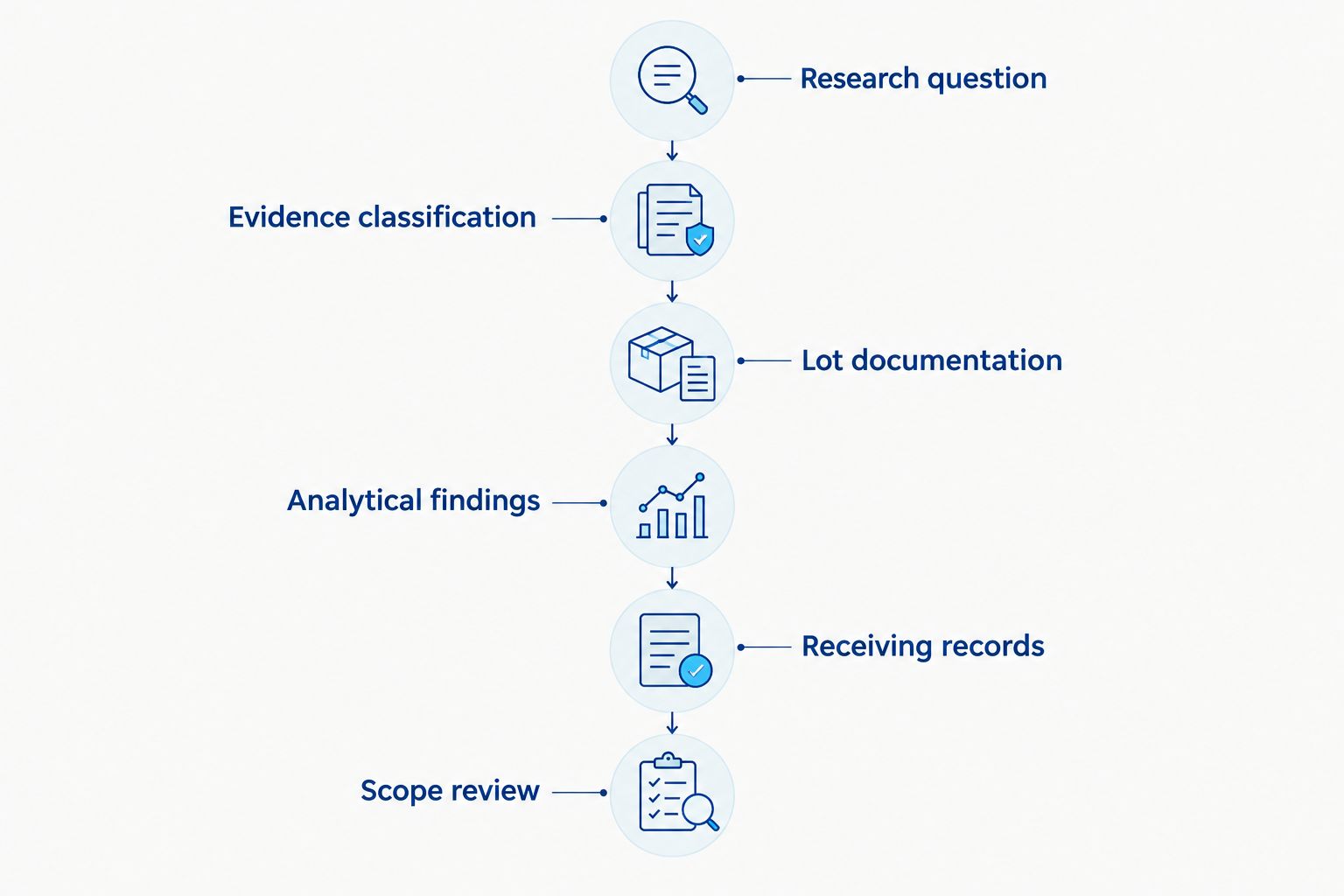
Define the laboratory question
Start with a written question and a literature search, not a list of compounds associated with fitness terminology. Identify whether you are reviewing peptide structure, analytical identity, published preclinical findings, or supplier documentation. These are distinct tasks with different evidence requirements.
A manual starting point is a shared document that records the question, included evidence types, and exclusion criteria. Your institution's existing research review process takes precedence over an informal checklist.
Make the boundary explicit. If a proposed statement asks what a trainer should recommend to a client, it does not belong in a research-only sourcing guide. Reframe the work around a laboratory question or exclude the statement.
- State the chemical or analytical question in plain language.
- Specify which research settings the review includes.
- Exclude administration advice and client-facing compound recommendations.
- Record the evidence needed to answer the question.
Classify the evidence before summarizing it
Read the source paper and its methods before relying on an abstract or supplier summary. Record the actual experimental setting, the material examined, and the measurement reported. A finding without that context is easy to overstate.
Use a spreadsheet to distinguish analytical studies from in-vitro and other preclinical work. If a source examines a particular material or preparation, preserve that distinction instead of replacing it with a broad statement about all peptides.
For a 2026 review, record publication dates and search dates separately. Publication age and the date you retrieved a paper are different facts; neither substitutes for a methods assessment.
- Capture the publication title, date, and research setting.
- Record the material identity stated in the methods.
- Summarize the measured finding without expanding its scope.
- Keep unresolved questions visible in the evidence table.
Match the material to the lot documentation
Begin with the supplier's documents and compare them manually against the purchasing record. The product description, lot identifier, and Certificate of Analysis must refer to the same material. A certificate associated with another lot does not document the lot under review.
Simple Peptide provides lot-specific Certificates of Analysis and third-party purity testing for its research materials. These documents support a defined verification task, but they do not replace your laboratory's acceptance criteria or independent assessment.
Use 1 lot identifier consistently across the purchasing record, certificate, and receiving record. This is a traceability rule for the review, not a claim that a single identifier answers every quality question.
- Match the compound description across the supplied records.
- Confirm that the certificate identifies the relevant lot.
- Record the named analytical methods and reported findings.
- Retain the certificate version reviewed at acceptance.
Interpret analytical findings within their limits
Review a Certificate of Analysis as a report of specified tests, not as a universal quality guarantee. Chromatographic purity and chemical identity are different analytical questions. HPLC describes a chromatographic separation; its interpretation depends on the method and the reported data.
A reported purity value does not, by itself, establish identity, absolute peptide content, sterility, or the absence of every contaminant. Do not infer an unreported property from a reported result. Determine which additional questions matter to the laboratory project and whether the documentation addresses them.
The manual approach is to annotate each reported finding with its method and limitation. Where your laboratory requires further testing, follow the institution's established analytical process rather than treating a supplier certificate as the final decision.
- Separate identity questions from chromatographic purity questions.
- Check whether the method and result are both stated.
- Identify relevant properties that the report does not assess.
- Escalate unresolved analytical questions through laboratory review.
Organize the purchasing and receiving records
Create a traceable record before a material enters laboratory inventory. A shared folder or institutional inventory system can connect the purchase, analytical documentation, and receiving decision without adding a new purchasing platform.
Use 3 document types as an organizing minimum for this checklist: the purchasing record, the analytical record, and the receiving record. These categories describe a proposed filing structure, not a certification standard. Your institution can require additional records.
Simple Peptide's research-only positioning fits laboratory sourcing, but the buyer remains responsible for determining whether a material and its documentation meet the project's requirements. Supplier documentation is an input to that decision, not the decision itself.
- File the purchasing record with the specified material and lot.
- Retain the analytical record and any clarification correspondence.
- Document the receiving review and acceptance decision.
- Record storage conditions from applicable material documentation.
- Preserve an accessible link between inventory and its supporting records.
Review the wording before publication
Check every summary for a shift from laboratory findings to coaching advice. A paragraph can accurately describe a paper and still become misleading if its heading promises an application that the paper did not establish.
Use 2 review stages for a trainer-facing terminology project: scientific accuracy review and research-only scope review. These are editorial checkpoints for this guide, not an external accreditation requirement. Assign the reviews through your organization's existing approval process.
For a 2026 publication, review the title, summary, table labels, and frequently asked questions as carefully as the main text. Search-oriented wording must not change the meaning of the evidence.
- Verify that each finding retains its original research setting.
- Remove compound recommendations directed at coaching clients.
- Check that headings do not promise unsupported applications.
- Keep the research-only boundary visible in the final text.
Compare documentation workflows, not coaching applications
Choose a review workflow according to the question being answered. These options are complementary: a literature review cannot verify a received lot, and an analytical report cannot establish the scope of a published finding.
The table compares research and purchasing workflows. It does not rank peptides, recommend compounds, or compare unverified supplier capabilities.
| Option | Best for | Practical advantage | Key limitation |
|---|---|---|---|
| Manual literature review | Defining a scientific question | Keeps the original methods and findings visible | Does not verify the identity or quality of purchased material |
| Supplier-document review | Checking lot traceability | Connects a material description with reported analytical findings | Covers only the properties and methods actually documented |
| Institutional analytical review | Resolving project-specific verification questions | Evaluates evidence against laboratory requirements | Requires appropriate methods, facilities, and qualified reviewers |
| Simple Peptide research sourcing | Laboratory buyers seeking research-only materials with lot-specific documentation | Provides U.S.-manufactured research materials, lot-specific COAs, and third-party purity testing | Does not establish suitability for coaching applications or replace laboratory acceptance review |
The strongest workflow keeps literature interpretation and material verification separate, then records both. Combining them into a single supplier score hides which question each piece of evidence answers.
If you are considering a supplier comparison, use the Simple Peptide vs Core Peptides comparison as a separate reading path. Verify any supplier-specific statement against current documentation rather than assuming a comparison title establishes equivalent testing, manufacturing, or research scope.
Common mistakes in trainer-facing peptide research
Treating an audience label as a material specification
Peptides for personal trainers describes a search context, not a chemical identity. It cannot tell a purchasing team which material, sequence, formulation, or analytical criteria a project requires.
Replace the audience label with a defined laboratory question before evaluating materials. Keep the original search phrase only where it helps explain the scope of the review.
Reading purity as a complete quality assessment
A purity result answers the question associated with its analytical method. It does not automatically answer every identity, content, contamination, or handling question.
List the properties your project needs verified and match each one to actual documentation. Leave an unanswered question unresolved rather than converting it into an assumption.
Translating preclinical findings into coaching advice
A laboratory finding retains the limits of its experimental setting. Rewriting it as a recommendation for fitness clients changes the claim rather than merely simplifying the language.
Keep the model, measurement, and uncertainty in the summary. If that context cannot fit a short statement, shorten the claim instead of removing the limitations.
Comparing suppliers before checking the lot
Supplier-level descriptions and lot-level records serve different purposes. A general statement about testing cannot replace the certificate associated with the material being reviewed.
Assess the supplier's stated process separately from the received lot's documentation. Preserve both records without treating either as a substitute for the other.
FAQ
What does peptides for personal trainers mean in a research-only guide?
Peptides for personal trainers is a search phrase that this guide addresses through laboratory evidence and documentation review. It is not a material specification or a recommendation to use research compounds in coaching.
Who is Simple Peptide intended for?
Simple Peptide supplies laboratory researchers and scientific professionals with research-only peptides and related research chemicals. Its stated documentation includes lot-specific Certificates of Analysis and third-party purity testing.
Does a Certificate of Analysis establish suitability for human use?
No. A Certificate of Analysis reports specified analytical findings for the identified material or lot. It does not convert a research-only material into a product suitable for human or veterinary use.
Is HPLC purity the same as peptide identity?
No. Chromatographic purity and chemical identity are different analytical questions. Review the stated methods and findings rather than assuming a purity result establishes identity or every other relevant property.
Can an in-vitro finding support a coaching recommendation?
An in-vitro finding alone does not establish a coaching application. Summaries must retain the experimental setting and cannot turn a laboratory observation into advice for fitness clients.
What should a laboratory buyer check before accepting a peptide lot?
A laboratory buyer should check material identity, lot traceability, reported analytical methods, and conformity with the project’s acceptance criteria. The purchasing record, certificate, and receiving record should identify the same lot.
How should a research team compare peptide suppliers in 2026?
Compare suppliers using current, verifiable documentation relevant to the laboratory project. Separate supplier-level process statements from lot-specific analytical records, and do not infer unreported capabilities from a comparison title.
One last thing
Traceability is not the same as interpretation. A perfectly matched certificate can still be misread, while a careful literature summary cannot verify the contents of a received lot.
For your 2026 review, end with a paired question: does the evidence support the written statement, and does the documentation support acceptance of the identified material? Keep separate answers on file. That simple distinction prevents a sourcing decision from becoming an unsupported scientific claim.
Related guides
For laboratory research use only. Not for human or veterinary use. Not intended to diagnose, treat, cure, or prevent any disease.
{"@context":"https://schema.org","@type":"FAQPage","mainEntity":[{"@type":"Question","name":"What does peptides for personal trainers mean in a research-only guide?","acceptedAnswer":{"@type":"Answer","text":"Peptides for personal trainers is a search phrase that this guide addresses through laboratory evidence and documentation review. It is not a material specification or a recommendation to use research compounds in coaching."}},{"@type":"Question","name":"Who is Simple Peptide intended for?","acceptedAnswer":{"@type":"Answer","text":"Simple Peptide supplies laboratory researchers and scientific professionals with research-only peptides and related research chemicals. Its stated documentation includes lot-specific Certificates of Analysis and third-party purity testing."}},{"@type":"Question","name":"Does a Certificate of Analysis establish suitability for human use?","acceptedAnswer":{"@type":"Answer","text":"No. A Certificate of Analysis reports specified analytical findings for the identified material or lot. It does not convert a research-only material into a product suitable for human or veterinary use."}},{"@type":"Question","name":"Is HPLC purity the same as peptide identity?","acceptedAnswer":{"@type":"Answer","text":"No. Chromatographic purity and chemical identity are different analytical questions. Review the stated methods and findings rather than assuming a purity result establishes identity or every other relevant property."}},{"@type":"Question","name":"Can an in-vitro finding support a coaching recommendation?","acceptedAnswer":{"@type":"Answer","text":"An in-vitro finding alone does not establish a coaching application. Summaries must retain the experimental setting and cannot turn a laboratory observation into advice for fitness clients."}},{"@type":"Question","name":"What should a laboratory buyer check before accepting a peptide lot?","acceptedAnswer":{"@type":"Answer","text":"A laboratory buyer should check material identity, lot traceability, reported analytical methods, and conformity with the project's acceptance criteria. The purchasing record, certificate, and receiving record should identify the same lot."}},{"@type":"Question","name":"How should a research team compare peptide suppliers in 2026?","acceptedAnswer":{"@type":"Answer","text":"Compare suppliers using current, verifiable documentation relevant to the laboratory project. Separate supplier-level process statements from lot-specific analytical records, and do not infer unreported capabilities from a comparison title."}}]}