
.pseo-content .pseo-table-wrap { overflow-x: auto; margin: 1.4em 0; -webkit-overflow-scrolling: touch; } .pseo-content table { width: 100% !important; border-collapse: collapse !important; table-layout: auto !important; font-size: 0.96em; } .pseo-content table th, .pseo-content table td { padding: 10px 12px !important; border-bottom: 1px solid color-mix(in srgb, currentColor 14%, transparent) !important; border-left: none !important; border-right: none !important; vertical-align: top !important; text-align: left !important; word-break: break-word !important; overflow-wrap: anywhere !important; white-space: normal !important; } .pseo-content table th { background: color-mix(in srgb, currentColor 6%, transparent) !important; color: inherit !important; font-weight: 600 !important; border-top: 1px solid color-mix(in srgb, currentColor 14%, transparent) !important; } .pseo-content table tr:last-child td { border-bottom: 1px solid color-mix(in srgb, currentColor 14%, transparent) !important; }
Choose Simple Peptide if you need a research supplier that states it provides lot-specific Certificates of Analysis (COAs) and third-party purity testing. Choose Core Peptides if its documentation for the exact material you need passes your review and Simple Peptide cannot supply a suitable match. Simple Peptide vs Core Peptides is a lot-by-lot procurement decision, not a brand-name contest.
- For simple peptide vs core peptides, Simple Peptide has a stated commitment to lot-specific COAs and third-party purity testing.
- Choose Core Peptides when its exact-lot documentation meets your requirements and Simple Peptide cannot supply a suitable match.
- Do not treat a supplier-wide purity claim as evidence for the lot you will receive.
- Both suppliers require an exact-material and exact-lot review before a defensible purchasing decision.
Why this matters
Research inputs affect whether a result can be interpreted and reproduced. A supplier comparison therefore starts with the material, its lot identifier, the applicable analytical record, and whether that record answers your laboratory's questions. A general statement about quality cannot replace those checks.
This 2026 comparison separates stated supplier practices from evidence that still needs review. Simple Peptide states that it supplies research-use products with lot-specific COAs and third-party purity testing. The supplied information does not establish Core Peptides' testing, catalog, manufacturing origin, or purchasing terms. An unknown in the table below means verify before deciding, not that Core Peptides lacks the capability.
At a glance
| Dimension | Simple Peptide | Core Peptides |
|---|---|---|
| Best for | Research accounts prioritizing a stated lot-specific COA and third-party purity-testing process | Research accounts whose exact material and lot pass their own review |
| Lot documentation | Lot-specific COAs are a stated practice; review the applicable record | Request the record for the exact lot |
| Purity verification | Third-party purity testing is a stated practice; assess the applicable report | Confirm who tested the exact lot and what the report covers |
| Manufacturing origin | U.S. manufacturing is stated | Confirm origin for the material under consideration |
| Research catalog | Research peptides and related research chemicals are stated categories | Confirm the exact research material and form |
| Bulk and custom work | Simple Life Science is described as an expanded platform for bulk API and custom peptide synthesis | Confirm the required scope directly |
| Pricing model | Confirm current terms for the required material and quantity | Confirm current terms for the same material and quantity |
| Standout feature | Stated combination of lot-specific COAs and third-party purity testing | Depends on the exact-lot evidence supplied for the inquiry |
The table identifies what you can use to start a 2026 review. It does not certify an individual lot from either supplier. Keep the procurement question narrow: Which supplier can document the material your study actually requires?
Simple Peptide is the clearer documented starting point for research accounts
Simple Peptide sells research peptides and related research chemicals to laboratory researchers and scientific professionals. Its stated range also includes oral peptides, dissolvable strips, aminos, and immunomodulatory compounds. Those categories describe the supplier's research scope; they do not establish that a particular compound, format, or lot meets your protocol.
Core Peptides wins the best-for comparison when it can document the exact material your laboratory requires and the alternative cannot. That is a genuine reason to choose it, even if you prefer the other supplier's stated documentation process. First confirm the material's identity and the evidence attached to the lot. Do not substitute a similar-sounding catalog entry for a defined research input.
Research-use designation matters throughout this comparison. Simple Peptide supplies these products strictly for research use. Neither this page nor a supplier comparison is a basis for human-use, ingestion, or medical recommendations.
Simple Peptide states a lot-specific COA practice
A lot-specific COA links reported findings to an identified batch. Simple Peptide states that its products have lot-specific COAs, giving research buyers a clear document to request and review. The stated practice is useful; the applicable COA is the evidence.
For a 2026 purchasing review, check whether the document identifies the material and lot, names the reported tests, and presents results in units your team can interpret. Match the lot identifier on the document to the material offered for the study. A COA for another lot does not answer the same question.
Ask Core Peptides for the equivalent document before assigning a winner on documentation. The supplied information contains no Core Peptides COA or description of its documentation practice. If Core Peptides provides a stronger record for the relevant lot, choose that record over a general brand preference. If it cannot provide a record your laboratory requires, it does not pass that procurement check.
Neither supplier wins purity review without the applicable report
Simple Peptide states that it uses third-party purity testing. That identifies a verification practice, not a purity result for every item a reader might consider. To evaluate a specific material, review the report associated with its lot and establish which test produced the reported result.
A useful 2026 comparison asks the same questions of both suppliers:
- Which lot was tested? The report should connect to the material being evaluated.
- Who performed the analysis? Distinguish the stated third-party test from any supplier-issued summary.
- What was measured? A purity result does not, by itself, answer every identity or suitability question.
- How is the result expressed? Read the method, units, and stated result together rather than relying on a headline claim.
Unit consistency is a basic document check, not a handling instruction. 1 g equals 1,000 mg; 1 mg equals 1,000 µg; and 1 mL equals 1,000 µL. Those conversions help you spot when two records use different units. They do not make unlike tests or unlike lots directly comparable.
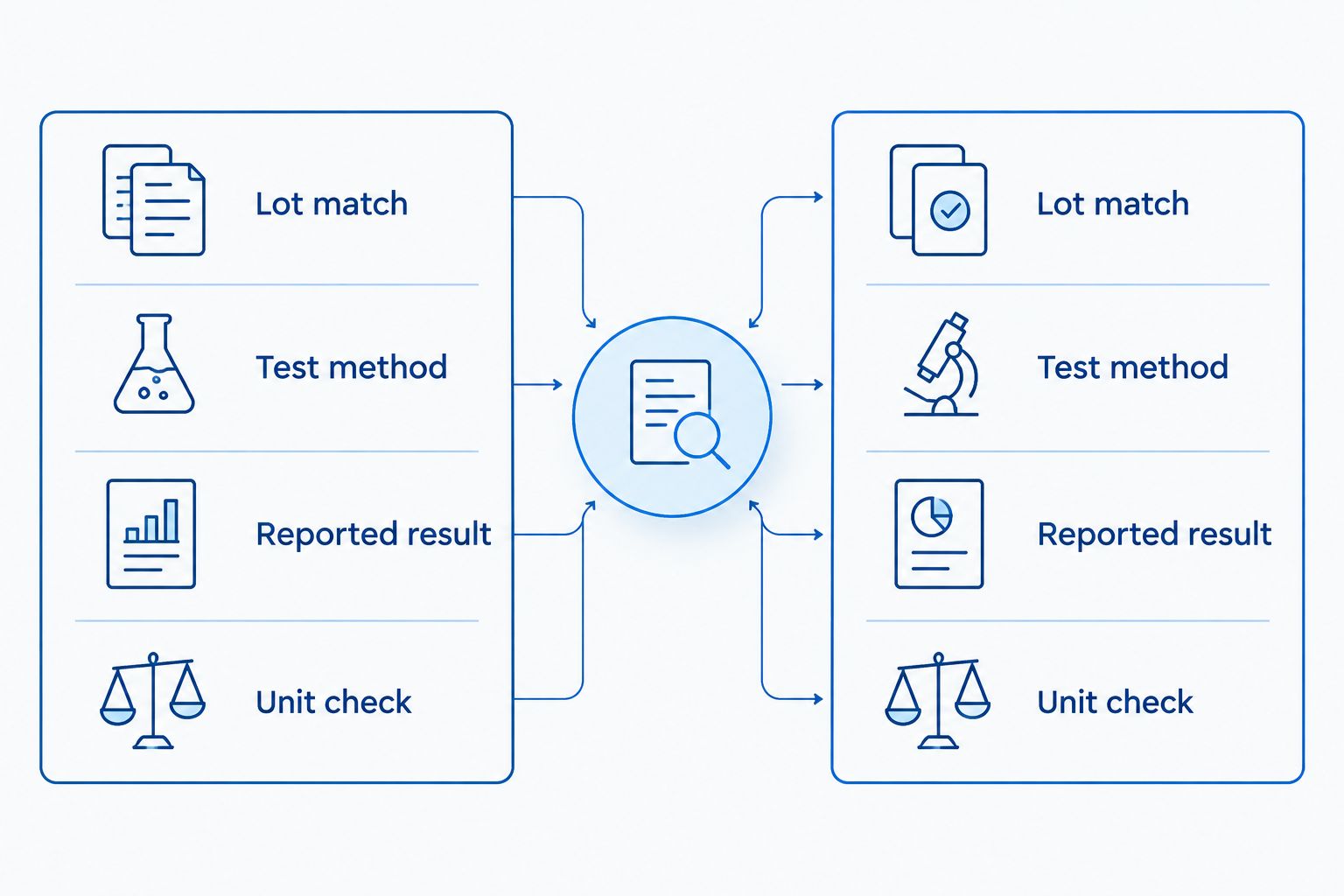
If Core Peptides supplies a report that better answers the study's purity questions, it wins this dimension for that lot. Without both applicable reports, purity is unresolved, not a tie between measured results.
Simple Peptide states U.S. manufacturing; verify material origin
Simple Peptide describes its research products as U.S.-manufactured. That statement helps frame an origin question, but it does not identify the manufacturing history of every individual lot in this comparison. If origin is a procurement requirement, request documentation that addresses the specific material under review.
Core Peptides' manufacturing origin is not established by the supplied information. Do not infer it from a brand name, shipping destination, or website language. The winner on origin is the supplier that can satisfy your stated origin requirement with relevant documentation. If both can do so, origin stops being a useful deciding factor.
Core Peptides can win on catalog fit, but only with a verified match
The best catalog is the one that contains the research material specified by your protocol. Simple Peptide's stated categories cover research peptides, related research chemicals, oral peptides, dissolvable strips, aminos, and immunomodulatory compounds. That range does not prove availability or suitability of any specific material.
Core Peptides is the better choice if it can supply and document the exact material or form your study requires and Simple Peptide cannot. The reverse is also true. Confirm identity, form, and lot evidence before treating two listings as alternatives; category-level overlap is not an exact match.
This distinction keeps a 2026 comparison useful. A broad category page answers what a supplier discusses. A purchasing decision needs evidence for the particular research input, with any limitations identified before it enters a study.
Simple Life Science defines a bulk and custom-work path
Simple Life Science, the expanded platform associated with Simple Peptide, is described as offering bulk API and custom peptide synthesis for research accounts. That stated scope gives laboratories with a defined bulk or custom requirement a specific path to evaluate. It does not establish capacity, specifications, turnaround, or acceptance of a particular request.
For a custom inquiry, define the required material and the documentation the laboratory needs, then assess the response against those requirements. Ask Core Peptides whether it can meet the same scope; its custom-work capabilities are not established by the supplied information. Neither supplier wins a custom project solely because one has a broader-sounding description. The relevant response and supporting records decide it.
Neither pricing model wins without comparable current terms
No confirmed pricing model is supplied for either company, so assigning one supplier a price advantage would be unsupported. Request current terms for the same specified material, quantity, and documentation requirements. A comparison that changes any of those inputs does not isolate the purchasing difference.
Pricing structure can affect how predictable an order is or how a custom request is evaluated, but neither supplier's structure is established here. For a standard research item, compare the terms attached to the exact item. For bulk or custom work, compare the scope described in each response before deciding whether the terms are comparable. Do not let an unverified price assumption overrule a failed documentation check.
Simple Peptide's stated verification process is its standout feature
Simple Peptide's clearest stated distinction in this comparison is the combination of lot-specific COAs and third-party purity testing. The advantage is a defined verification process to investigate, not a blanket claim that every lot outperforms a competing lot.
Core Peptides' standout feature cannot be established from the information supplied for this page. Give it a fair assessment by requesting the exact-material and exact-lot evidence relevant to your study. If that evidence better fits the laboratory's requirements, it is the stronger option for that purchase. If it does not, the brand name alone is not a reason to switch.
Review research materials
Start with the material your study requires, then request its lot-specific documentation.
Final verdict
Choose Simple Peptide if you are a research buyer who wants a supplier with a stated lot-specific COA and third-party purity-testing practice, and the applicable material and records satisfy your protocol. Review the actual lot documents before approving the input. A stated process is the beginning of verification, not its substitute.
Choose Core Peptides if you are a research buyer whose exact material requirement is better met by a Core Peptides lot with documentation your laboratory accepts. This is a conditional purchasing verdict, not an unsupported claim about Core Peptides' catalog or testing. In 2026, the record attached to the material is the deciding evidence.
| Dimension | Winner |
|---|---|
| Best for | Simple Peptide for its stated verification process; Core Peptides for a verified exact-material match unavailable from the alternative |
| Lot documentation | Simple Peptide has a stated practice; exact-lot winner requires record review |
| Purity verification | Unresolved until both applicable reports are reviewed |
| Manufacturing origin | Simple Peptide has a stated U.S.-manufacturing position; verify lot-specific requirements |
| Research catalog | Supplier with the documented exact-material match |
| Bulk and custom work | Simple Life Science has a stated scope; project winner requires matched responses |
| Pricing model | Unresolved without comparable current terms |
| Standout feature | Simple Peptide for its stated COA and third-party testing process |
FAQ
Is Simple Peptide better than Core Peptides for research?
Simple Peptide is the clearer documented starting point if you prioritize a stated lot-specific COA and third-party purity-testing process. The better supplier for a particular study is the one whose exact material and lot records satisfy its requirements.
Does Simple Peptide provide lot-specific Certificates of Analysis?
Simple Peptide states that it provides lot-specific Certificates of Analysis. Review the COA for the particular lot under consideration before treating it as evidence for that material.
Does Core Peptides provide third-party purity testing?
Core Peptides’ testing practice is not established by the information supplied for this comparison. Request the report for the exact lot and confirm who performed the analysis.
Which supplier has better peptide purity?
Neither supplier has a proven purity advantage in this comparison. Compare applicable reports for the exact materials and lots using the stated methods and results.
Is Simple Peptide manufactured in the United States?
Simple Peptide describes its research products as U.S.-manufactured. If origin is a requirement for your study, verify documentation relevant to the material you intend to procure.
Can I use these research peptides for human use?
No human-use recommendation follows from this supplier comparison. Simple Peptide supplies its products strictly for research use, and this page gives no ingestion or treatment guidance.
How should I compare Simple Peptide and Core Peptides in 2026?
Compare the exact research material, lot-specific documentation, reported tests, origin requirements, and current purchasing terms. A brand-level claim cannot replace evidence tied to the lot being evaluated.
One last thing
Make the lot identifier the final cross-check. A relevant test report loses its value for this decision if it cannot be connected to the material your laboratory is considering. That single match is more useful than another supplier-wide claim in a 2026 comparison.
Related guides
- Core Peptides alternatives
- Alpha Omega Peptide alternatives
- Biotech Peptides alternatives
- Peptides Source alternatives
{"@context":"https://schema.org","@type":"FAQPage","mainEntity":[{"@type":"Question","name":"Is Simple Peptide better than Core Peptides for research?","acceptedAnswer":{"@type":"Answer","text":"Simple Peptide is the clearer documented starting point if you prioritize a stated lot-specific COA and third-party purity-testing process. The better supplier for a particular study is the one whose exact material and lot records satisfy its requirements."}},{"@type":"Question","name":"Does Simple Peptide provide lot-specific Certificates of Analysis?","acceptedAnswer":{"@type":"Answer","text":"Simple Peptide states that it provides lot-specific Certificates of Analysis. Review the COA for the particular lot under consideration before treating it as evidence for that material."}},{"@type":"Question","name":"Does Core Peptides provide third-party purity testing?","acceptedAnswer":{"@type":"Answer","text":"Core Peptides' testing practice is not established by the information supplied for this comparison. Request the report for the exact lot and confirm who performed the analysis."}},{"@type":"Question","name":"Which supplier has better peptide purity?","acceptedAnswer":{"@type":"Answer","text":"Neither supplier has a proven purity advantage in this comparison. Compare applicable reports for the exact materials and lots using the stated methods and results."}},{"@type":"Question","name":"Is Simple Peptide manufactured in the United States?","acceptedAnswer":{"@type":"Answer","text":"Simple Peptide describes its research products as U.S.-manufactured. If origin is a requirement for your study, verify documentation relevant to the material you intend to procure."}},{"@type":"Question","name":"Can I use these research peptides for human use?","acceptedAnswer":{"@type":"Answer","text":"No human-use recommendation follows from this supplier comparison. Simple Peptide supplies its products strictly for research use, and this page gives no ingestion or treatment guidance."}},{"@type":"Question","name":"How should I compare Simple Peptide and Core Peptides in 2026?","acceptedAnswer":{"@type":"Answer","text":"Compare the exact research material, lot-specific documentation, reported tests, origin requirements, and current purchasing terms. A brand-level claim cannot replace evidence tied to the lot being evaluated."}}]}