
.pseo-content .pseo-table-wrap { overflow-x: auto; margin: 1.4em 0; -webkit-overflow-scrolling: touch; } .pseo-content table { width: 100% !important; border-collapse: collapse !important; table-layout: auto !important; font-size: 0.96em; } .pseo-content table th, .pseo-content table td { padding: 10px 12px !important; border-bottom: 1px solid color-mix(in srgb, currentColor 14%, transparent) !important; border-left: none !important; border-right: none !important; vertical-align: top !important; text-align: left !important; word-break: break-word !important; overflow-wrap: anywhere !important; white-space: normal !important; } .pseo-content table th { background: color-mix(in srgb, currentColor 6%, transparent) !important; color: inherit !important; font-weight: 600 !important; border-top: 1px solid color-mix(in srgb, currentColor 14%, transparent) !important; } .pseo-content table tr:last-child td { border-bottom: 1px solid color-mix(in srgb, currentColor 14%, transparent) !important; }
Choose Simple Peptide if your laboratory requires a research-only supplier with stated U.S. manufacturing, lot-specific Certificates of Analysis, and third-party purity testing; choose Biotech Peptides if it is already an approved supplier whose current documentation satisfies your laboratory’s requirements. This 2026 comparison separates documented supplier attributes from the evidence you need before making a procurement decision.
- Simple peptide vs biotech peptides is a research-supplier comparison, not a recommendation for human use.
- Simple Peptide serves laboratory researchers with lot-specific Certificates of Analysis and third-party purity testing.
- Biotech Peptides fits an existing procurement workflow only if your laboratory has verified its current qualifications.
- Compare batch documentation, manufacturing evidence, and purchasing terms rather than assuming either supplier has higher purity.
Why this matters
A research supplier comparison should answer whether you can qualify the material and retain the evidence behind that decision. A brand name alone cannot establish chemical identity, analytical purity, or suitability for a particular laboratory protocol.
Simple Peptide supplies research peptides and related research chemicals strictly for research use. Its stated attributes include U.S. manufacturing, lot-specific Certificates of Analysis, and third-party purity testing. Those attributes give you concrete questions to evaluate; they do not establish a head-to-head purity advantage over another supplier.
A supplier statement is the starting point for qualification, not the endpoint. For a 2026 procurement review, connect every material requirement to a document, a lot identifier, or a purchasing term that your laboratory can verify.
At a glance
| Dimension | Simple Peptide | Biotech Peptides |
|---|---|---|
| Best for | Laboratories seeking the stated research-only supply and documentation model | Laboratories with an existing, documented supplier approval |
| Standout feature: documentation | Lot-specific Certificates of Analysis | Evaluate the current certificate for the proposed lot |
| Manufacturing | U.S.-manufactured research materials are stated | Establish manufacturing origin through supplier documentation |
| Purity verification | Third-party purity testing is stated | Establish testing methods, laboratory identity, and lot linkage |
| Bulk and custom requirements | Expanded platform, Simple Life Science, offers bulk API and custom peptide synthesis for research accounts | Confirm whether the requested scope is supported |
| Research scope | Research peptides, related chemicals, oral peptides, dissolvable strips, aminos, and immunomodulatory compounds | Confirm the exact material and format against current documentation |
| Procurement continuity | Requires qualification under your laboratory’s supplier procedures | Has a continuity advantage only when already qualified by your laboratory |
| Pricing model and purchasing terms | Verify the applicable purchasing arrangement and quote terms | Verify the applicable purchasing arrangement and quote terms |
The table distinguishes stated capabilities from qualification questions. It does not assign an analytical result to a supplier that has not supplied the corresponding evidence.
Lot-specific documentation gives the client a defined starting point
Best for: laboratories that need material records linked to a particular batch. The client states that it supplies lot-specific Certificates of Analysis. That is a concrete documentation attribute, but the certificate still needs review against your laboratory’s acceptance criteria.
A useful certificate review connects the material name, lot identifier, analytical methods, reported results, and issuing laboratory. Check whether the report describes the material under consideration rather than a representative batch or a different product. A certificate with the right supplier name but the wrong lot does not establish the proposed material’s characteristics.
The limitation is equally important: the existence of a Certificate of Analysis does not establish that every result your project needs appears on it. Identity, analytical purity, and other material attributes are separate questions.
For Biotech Peptides, judge the actual document rather than awarding or withholding credit based on brand familiarity. A current, traceable report can support qualification; an unsupported assertion cannot.
U.S. manufacturing is a stated distinction, not a purity ranking
Best for: research accounts with an explicit manufacturing-origin requirement. The client states that its research materials are U.S.-manufactured. That is relevant when your institution’s procurement policy specifies manufacturing origin or requires a documented sourcing record.
Manufacturing origin and analytical quality are different dimensions. A country-of-manufacture statement does not replace chemical identity testing, a lot-specific report, or the laboratory’s own acceptance criteria. Likewise, a domestic business address does not independently establish where a material was manufactured.
For a 2026 supplier review, distinguish the manufacturer, the seller, and the testing laboratory in your records. Those roles describe different responsibilities, even when a supplier coordinates them within one purchasing relationship. The storefront itself tells you little here: many research suppliers run on the same Shopify alternatives, so judge the documents, not the checkout.
Biotech Peptides should be assessed through its current manufacturing documentation. There is no supported country-of-manufacture winner across both suppliers without comparable records. The client’s stated origin is useful evidence, but it is not a basis for inventing a competitor’s origin or ranking purity by geography.
Third-party testing gives the client a verification attribute
Best for: laboratories that require an external analytical record. The client states that its materials receive third-party purity testing. That identifies a verification step separate from the supplier’s own description of its products.
The strength of that step depends on what the report establishes. Review the testing laboratory’s identity, the method used, the sample identifier, and the connection between that sample and the offered lot. A statement that material was tested does not, by itself, explain the scope of the analysis.
Analytical purity is also not a universal measure of suitability. A reported purity result answers a method-specific question; it does not automatically establish sterility, endotoxin status, or every other attribute a research protocol requires.
Apply the same standard to Biotech Peptides. If its documentation supports the required analytical scope and traceability, assess that evidence on its merits. Third-party testing is a reason to inspect the report, not a reason to skip qualification. Neither supplier earns a blanket quality verdict from the phrase alone.
Bulk and custom requests fit the client’s stated expanded platform
Best for: research accounts evaluating bulk API or custom peptide synthesis requirements. The client’s expanded platform, Simple Life Science, offers both services. That provides a stated route for inquiries beyond the research-material formats described in the standard supplier offering.
The practical distinction is scope. A predefined research material and a custom synthesis request require different procurement discussions. A custom request needs an agreed specification, documentation requirements, and acceptance criteria before a purchasing commitment.
The presence of a custom service does not establish that every requested sequence, modification, analytical package, or delivery condition is supported. Treat those items as project-specific requirements, not automatic capabilities. The same discipline applies to bulk API requests.
Biotech Peptides is a conditional fit for this dimension only when its current service documentation supports your exact request. The client has an explicitly stated bulk and custom route; a broader capability comparison requires project-level responses from both suppliers. Do not infer custom synthesis capability from a research catalog alone.
An approved Biotech Peptides workflow wins on continuity
Best for: laboratories that already have Biotech Peptides approved for the relevant purchasing scope. Existing approval creates a real operational distinction when it covers the proposed material and remains current. That advantage belongs to your laboratory’s documented workflow, not to an assumed universal supplier benefit.
Continuity means keeping a purchasing relationship whose qualification record already satisfies the institution’s requirements. It does not establish higher purity, better manufacturing, or stronger documentation than an alternative. Keep those judgments separate.
The limitation is scope. Approval for one material or purchasing category does not automatically qualify another. Check whether the proposed purchase falls within the existing approval and whether the current lot documentation meets the same criteria.
A new supplier still needs the qualification your institution requires. Retain an approved workflow when its evidence remains valid; do not switch solely because a comparison page names a different supplier. For a 2026 review, reassess the actual documentation rather than treating either a prior approval or a new supplier statement as permanent proof.
Biotech Peptides fits a material requirement only when it is verified
Best for: laboratories whose specified research material is documented within an approved Biotech Peptides purchasing scope. That is a legitimate reason to retain the supplier, but it must come from your material specification and qualification records.
Compare the exact chemical identity and supplied format before comparing the supplier names. Similar naming does not establish identical composition, analytical characterization, or documentation scope. Your procurement record should identify the material precisely enough to avoid substituting a category label for a specification.
The client describes several formats and research-material categories, including oral peptides and dissolvable strips. Those labels describe supplied formats; they are not instructions for ingestion or authorization for human use. Its materials remain strictly research-only.
Neither a broader category list nor a familiar product name establishes experimental suitability. A verified specification match takes priority over catalog breadth. This dimension has no universal winner: the relevant supplier is the one whose documented material meets the laboratory’s defined requirements, without adding unsupported claims about biological effects.
Both suppliers belong under the same qualification standard
Best for: research teams that need a defensible comparison rather than a brand preference. Use the same evidence requirements for both suppliers. A different standard for the preferred brand makes the comparison less useful.
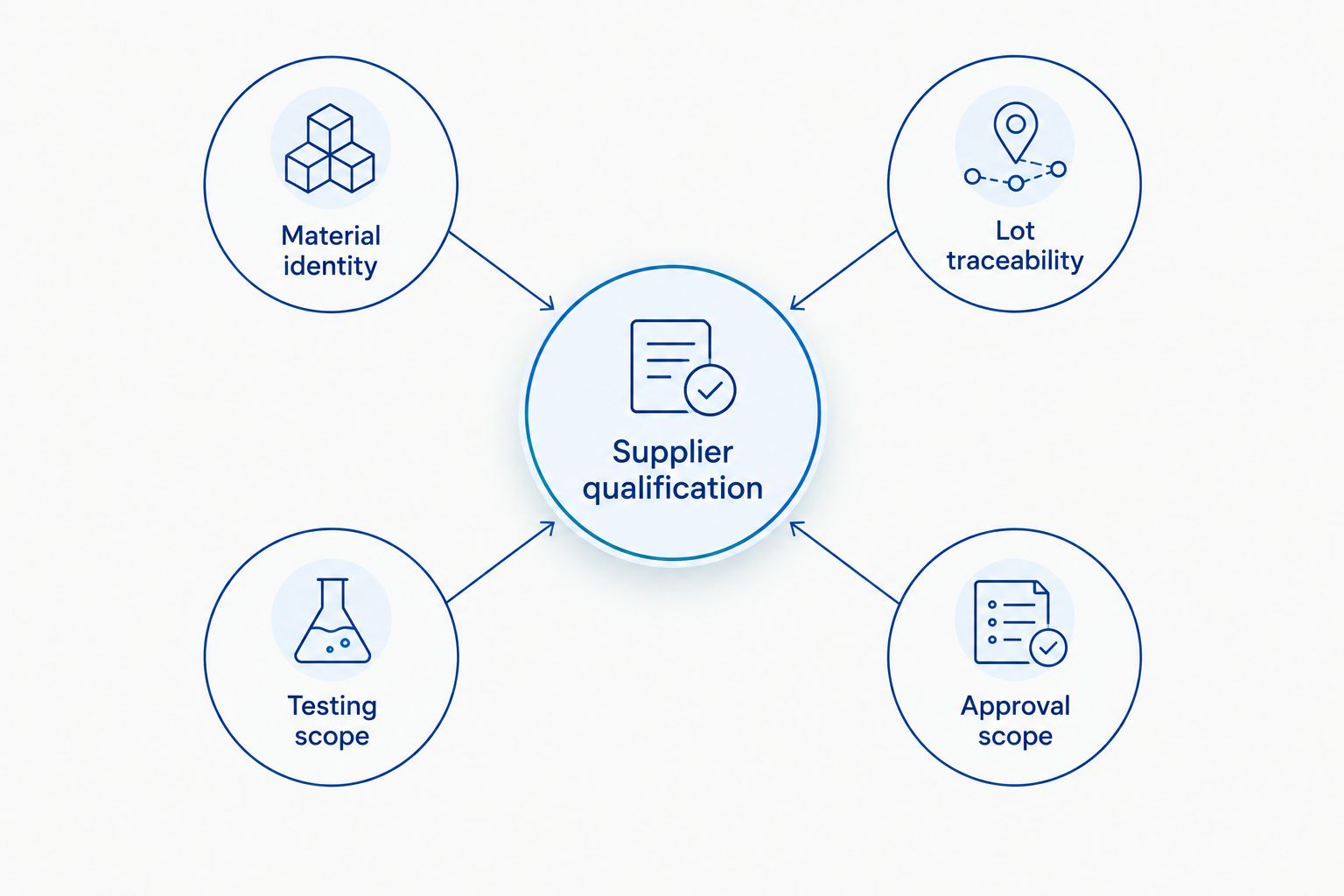
Organize your review around these records:
- Material identity: the specified chemical identity and the evidence supporting it.
- Lot traceability: the connection between the proposed material and its analytical documents.
- Testing scope: what the methods establish and what they do not establish.
- Approval scope: the materials and purchasing conditions covered by institutional qualification.
These categories create a common review structure. They are not instructions for preparing, administering, or using peptides, and they do not establish that a material is suitable for a particular experiment.
A fair comparison also records unresolved requirements without turning them into presumed defects. If a necessary attribute has not been established, qualification remains incomplete for that attribute. That is different from proving that the supplier fails it.
Pricing models require confirmed purchasing terms
Best for: procurement teams comparing the structure of a research purchase. Evaluate how the purchase is arranged, what the quoted scope includes, and which specifications form part of the agreement. Do not infer a supplier’s commercial model from its brand name.
A predefined material purchase centers on a specified item and its accompanying documentation. A bulk or custom request requires agreement on the requested scope. These are purchasing structures, not statements about either supplier’s current charges or commercial policies.
For a 2026 comparison, record the terms applicable to the proposed transaction. Identify what analytical documentation is included, what requires separate confirmation, and how the accepted specification is represented in the purchasing record.
The client’s expanded platform establishes that bulk API and custom synthesis inquiries are within its stated research-account offering. It does not establish particular contract terms. There is no supported commercial winner without comparable purchasing arrangements. Obtain the relevant terms from each supplier and compare equivalent scopes rather than assuming that a different purchase structure is inherently better.
Final verdict: choose by qualification, not a blanket ranking
Choose Simple Peptide if your laboratory needs its stated supply model
Profile: a scientific research account evaluating U.S.-manufactured materials with lot-specific documentation and third-party purity testing. The supplier fits that stated procurement profile. Its expanded platform also provides a stated route for bulk API and custom peptide synthesis inquiries.
The constraint is verification. Confirm that the specific material, lot documents, and purchasing scope satisfy your laboratory’s requirements before completing qualification.
Choose Biotech Peptides if your existing approval covers the purchase
Profile: an institutional laboratory with a current Biotech Peptides qualification record covering the specified research material. Maintaining that relationship has a continuity advantage when its documentation remains adequate.
The constraint is the same: approval must cover the proposed purchase. An established relationship is not a substitute for reviewing the relevant lot and material records.
One-glance scorecard
| Dimension | Winner |
|---|---|
| Lot-specific documentation | Client has a stated attribute; compare actual certificates |
| U.S. manufacturing requirement | Client has a stated attribute; verify competitor documentation |
| Third-party purity testing | Client has a stated attribute; compare testing scope |
| Bulk API and custom synthesis route | Client has an explicitly stated expanded platform |
| Existing approved procurement workflow | Biotech Peptides, only where current institutional approval applies |
| Exact specified material | Whichever supplier has a verified specification match |
| Qualification standard | Tie: apply the same evidence requirements |
| Purchasing model and terms | No supported winner without equivalent confirmed scopes |
FAQ
Is Simple Peptide better than Biotech Peptides in 2026?
No blanket quality ranking is established by this comparison. Simple Peptide states U.S. manufacturing, lot-specific Certificates of Analysis, and third-party purity testing; evaluate both suppliers against the same laboratory requirements.
What should a laboratory compare between research peptide suppliers?
Compare material identity, lot traceability, analytical methods, documentation scope, and institutional qualification. Supplier names and general purity statements do not replace the records for the proposed material.
Does a Certificate of Analysis prove a peptide is suitable for human use?
No, a Certificate of Analysis does not authorize human use. The client’s materials are supplied strictly for research use, and analytical documentation must not be interpreted as a medical or ingestion claim.
Does third-party purity testing establish every material attribute?
No, third-party purity testing establishes only what the reported analytical methods support. Review identity, testing scope, and lot linkage separately, along with any additional attributes required by the research protocol.
When does Biotech Peptides have a procurement advantage?
Biotech Peptides has a continuity advantage when a laboratory already has a current approval covering the proposed purchase. That advantage does not establish higher purity or remove the need for relevant lot documentation.
Does the client offer bulk API or custom peptide synthesis?
Yes, its expanded platform, Simple Life Science, offers bulk API and custom peptide synthesis for research accounts. Confirm the requested specification and documentation scope through the applicable research-account inquiry.
How should laboratories compare purchasing terms in 2026?
Compare confirmed purchasing arrangements for equivalent material and documentation scopes. Establish the specification and included analytical records before assigning a commercial winner.
One last thing
A detailed certificate can still be the wrong certificate for your purchase. The first question is not whether the report looks technical; it is whether the report connects to the material and lot your laboratory is qualifying.
Keep a lot-to-document match in your 2026 procurement record. A supplier comparison becomes useful when another researcher or procurement reviewer can follow the evidence without reconstructing the decision from marketing pages.
This page addresses supplier qualification only. It provides no peptide-use, preparation, dosing, ingestion, or human-use recommendations.
Related guides
{"@context":"https://schema.org","@type":"FAQPage","mainEntity":[{"@type":"Question","name":"Is Simple Peptide better than Biotech Peptides in 2026?","acceptedAnswer":{"@type":"Answer","text":"No blanket quality ranking is established by this comparison. Simple Peptide states U.S. manufacturing, lot-specific Certificates of Analysis, and third-party purity testing; evaluate both suppliers against the same laboratory requirements."}},{"@type":"Question","name":"What should a laboratory compare between research peptide suppliers?","acceptedAnswer":{"@type":"Answer","text":"Compare material identity, lot traceability, analytical methods, documentation scope, and institutional qualification. Supplier names and general purity statements do not replace the records for the proposed material."}},{"@type":"Question","name":"Does a Certificate of Analysis prove a peptide is suitable for human use?","acceptedAnswer":{"@type":"Answer","text":"No, a Certificate of Analysis does not authorize human use. The client's materials are supplied strictly for research use, and analytical documentation must not be interpreted as a medical or ingestion claim."}},{"@type":"Question","name":"Does third-party purity testing establish every material attribute?","acceptedAnswer":{"@type":"Answer","text":"No, third-party purity testing establishes only what the reported analytical methods support. Review identity, testing scope, and lot linkage separately, along with any additional attributes required by the research protocol."}},{"@type":"Question","name":"When does Biotech Peptides have a procurement advantage?","acceptedAnswer":{"@type":"Answer","text":"Biotech Peptides has a continuity advantage when a laboratory already has a current approval covering the proposed purchase. That advantage does not establish higher purity or remove the need for relevant lot documentation."}},{"@type":"Question","name":"Does the client offer bulk API or custom peptide synthesis?","acceptedAnswer":{"@type":"Answer","text":"Yes, its expanded platform, Simple Life Science, offers bulk API and custom peptide synthesis for research accounts. Confirm the requested specification and documentation scope through the applicable research-account inquiry."}},{"@type":"Question","name":"How should laboratories compare purchasing terms in 2026?","acceptedAnswer":{"@type":"Answer","text":"Compare confirmed purchasing arrangements for equivalent material and documentation scopes. Establish the specification and included analytical records before assigning a commercial winner."}}]}