

.pseo-content .pseo-table-wrap { overflow-x: auto; margin: 1.4em 0; -webkit-overflow-scrolling: touch; } .pseo-content table { width: 100% !important; border-collapse: collapse !important; table-layout: auto !important; font-size: 0.96em; } .pseo-content table th, .pseo-content table td { padding: 10px 12px !important; border-bottom: 1px solid color-mix(in srgb, currentColor 14%, transparent) !important; border-left: none !important; border-right: none !important; vertical-align: top !important; text-align: left !important; word-break: break-word !important; overflow-wrap: anywhere !important; white-space: normal !important; } .pseo-content table th { background: color-mix(in srgb, currentColor 6%, transparent) !important; color: inherit !important; font-weight: 600 !important; border-top: 1px solid color-mix(in srgb, currentColor 14%, transparent) !important; } .pseo-content table tr:last-child td { border-bottom: 1px solid color-mix(in srgb, currentColor 14%, transparent) !important; }
Compare Simple Peptide if your question concerns laboratory research procurement; compare Swolverine if your question concerns consumer sports nutrition. The distinction in 2026 is intended use, not a universal winner: research-only materials and consumer supplements belong to different purchasing categories.
- Simple peptide vs swolverine is a research-supplier versus sports-nutrition comparison, not a like-for-like peptide ranking.
- Simple Peptide supplies research-only materials with lot-specific Certificates of Analysis and third-party purity testing.
- Swolverine belongs in a consumer sports-nutrition comparison, not a substitute ranking for laboratory research materials.
- Purity documentation does not establish suitability for ingestion, clinical treatment, or personal performance use.
Why this matters
A supplier comparison becomes misleading when it treats every product associated with fitness, amino acids, or peptides as interchangeable. Your purchasing category determines the relevant evidence. A laboratory procurement review asks about material identity, analytical documentation, lot traceability, and the stated research restriction; a consumer supplement review asks about the finished product and its labeled purpose.
For a 2026 comparison, establish that distinction before evaluating either catalog. Neither a familiar compound name nor a purity claim bridges the gap between research materials and consumer products. Research-only means research-only, regardless of the search query that brought you to the page.
This comparison addresses supplier positioning and documentation. It does not recommend peptides, combinations, administration methods, or ingestion, and it does not assess either brand as a treatment provider.
At a glance
| Dimension | Simple Peptide | Swolverine |
|---|---|---|
| Best for | Laboratory researchers and scientific professionals reviewing research materials | Consumers evaluating sports-nutrition supplements |
| Intended-use category | Strictly research use; not for human use | Consumer sports nutrition; evaluate each product’s labeling |
| Standout feature | Lot-specific Certificates of Analysis and third-party purity testing | Consumer supplement context rather than research-material procurement |
| Meaning of purity | Analytical documentation relevant to research-material evaluation | Not directly comparable without a defined product and analytical method |
| Manufacturing evidence | U.S.-manufactured research peptides are part of the stated offering | Assess origin separately from finished-product evidence |
| Format and scope | Research peptides, research chemicals, oral peptides, dissolvable strips, aminos, and immunomodulatory compounds | Sports-nutrition supplement category; individual products require separate review |
| Pricing model | Evaluate the quoted research-material order and its documentation | Evaluate the specific consumer product and its commercial terms |
| Overall fit | Research procurement, not personal supplementation | Consumer supplement comparison, not a research-only substitute |
The table separates established positioning from questions that require a specific product record. It does not award a purity, manufacturing, or value winner across unlike categories. A fair comparison needs a common purpose before it needs a score.
Simple Peptide fits the laboratory procurement question
Simple Peptide is a research-only peptide supplier for laboratory researchers and scientific professionals. Its stated offering includes U.S.-manufactured research peptides and related research chemicals, supported by lot-specific Certificates of Analysis and third-party purity testing.
That positioning gives a laboratory procurement team a defined basis for review. The relevant question is whether the material and its documentation match the research account’s requirements, not whether a product name resembles something discussed in a fitness forum.
The research supplier’s advantage is the explicit research context and stated documentation. Its boundary is equally important: the materials are not offered for human use. A research-only catalog is not a source of personal supplementation guidance, even when its terminology overlaps with consumer nutrition.
For institutional evaluation, separate these questions:
- Does the stated material match the research procurement specification?
- Does the Certificate of Analysis correspond to the relevant lot?
- What does the analytical record actually establish?
- Does the intended-use restriction match the account’s purpose?
Those questions concern procurement discipline. They do not constitute instructions for using a peptide or a recommendation to purchase one.
Swolverine fits the consumer sports-nutrition question
Swolverine belongs in a consumer sports-nutrition comparison. That makes it the relevant comparison category when your question concerns supplements rather than laboratory research materials.
The advantage is category alignment: a consumer evaluating sports nutrition needs information about the finished supplement and its labeled purpose. A research-material Certificate of Analysis answers a different question. Treating one as a substitute for the other creates a comparison that appears technical but does not resolve the consumer’s decision.
The limitation runs in the opposite direction. Consumer positioning does not establish that a product meets a laboratory procurement specification, has the required lot documentation, or is suitable for a particular scientific investigation. Those are separate evidence requirements.
In 2026, keep the consumer review product-specific. Do not extend a statement about one supplement to an entire brand, and do not interpret sports-nutrition positioning as proof of a particular performance outcome. This comparison makes no assessment of individual Swolverine formulations or their effects.
Lot-specific documentation favors the stated research offering
The research supplier explicitly states that its products have lot-specific Certificates of Analysis and third-party purity testing. That is a concrete documentation feature, not a general adjective about quality.
A lot-specific certificate connects a report to an identified batch; it does not automatically answer every analytical question. The record still needs to be read for its stated scope, methods, results, and relationship to the material under review.
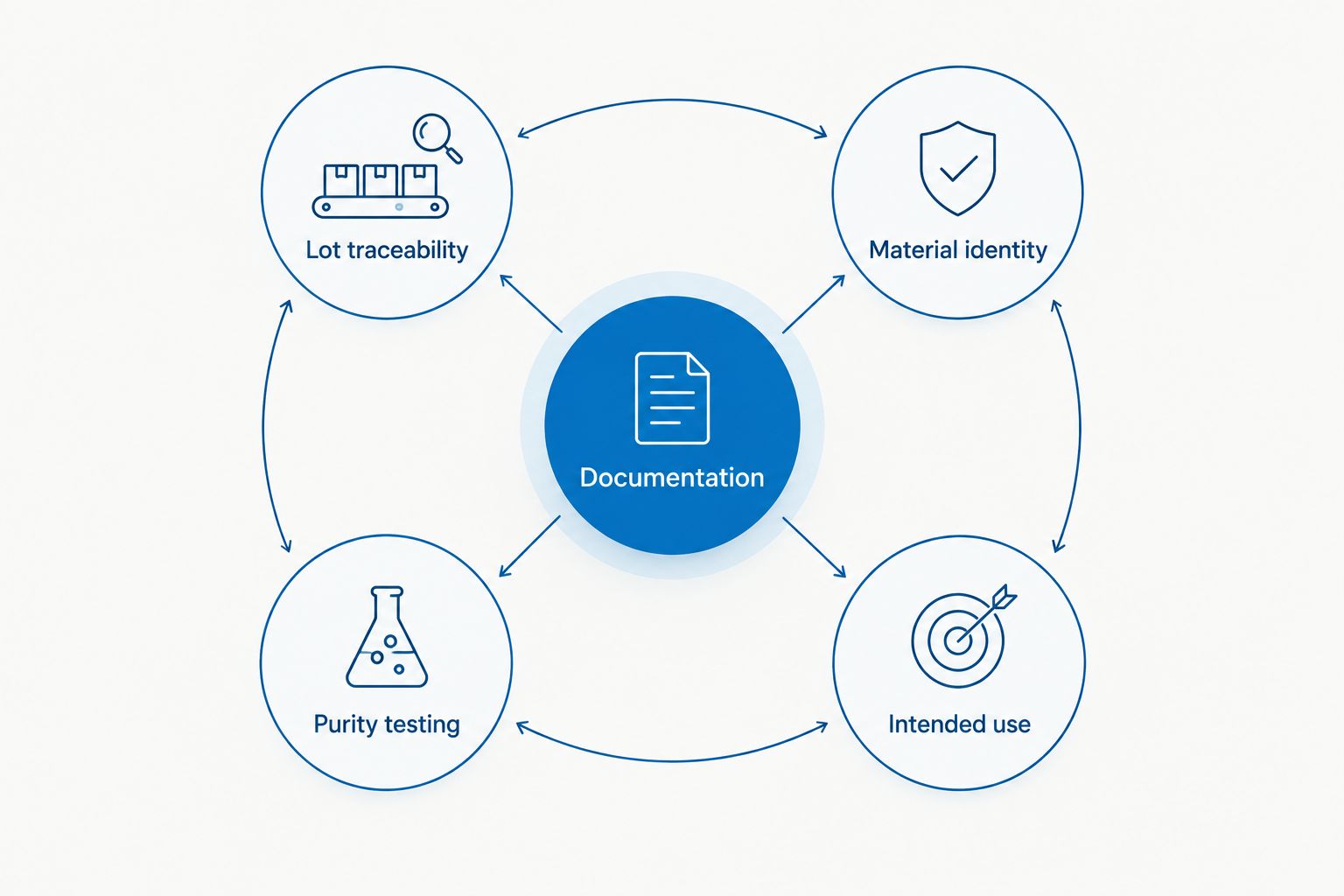
Keep these distinctions clear:
- Lot traceability: Does the report identify the relevant lot?
- Material identity: What evidence addresses the stated compound?
- Purity testing: What method and result does the report present?
- Intended use: What restriction applies to the supplied material?
Third-party testing is meaningful because it identifies an external testing role. It is not a blanket statement that every possible contaminant, property, or research requirement has been assessed. Avoid assigning the certificate a broader scope than its contents support.
This is a documentation advantage for the stated research offering, not a finding that Swolverine lacks testing. There is no basis here for ranking the competitor’s analytical program or declaring one brand universally purer.
Neither category wins purity without a defined comparison
Purity is not a self-contained verdict. An analytical result has meaning in relation to the material, the method, and the question being asked. A comparison that removes those details reduces an evidence claim to a marketing label.
Research-material purity and finished-supplement evaluation also address different objects. A finished supplement can contain multiple declared ingredients; that does not make its composition directly comparable to an isolated research material. Conversely, a research-material purity result does not establish that the material is appropriate for consumption.
For a defensible 2026 review, compare evidence only where its scope matches:
- The same material or a clearly defined equivalent.
- A stated analytical method relevant to the question.
- Documentation tied to the item being evaluated.
- A consistent interpretation of what the result proves.
There is no supported overall purity winner in this comparison. That is an evidence boundary, not an assertion that the brands are equal. A tie in the scorecard means the available category-level facts do not justify a ranking.
Manufacturing origin and analytical verification answer different questions
The client’s stated offering includes U.S.-manufactured research peptides. Origin identifies a manufacturing location; analytical documentation addresses characteristics of a material. Neither statement replaces the other.
Do not turn a country-of-origin claim into a purity, safety, or suitability conclusion. Likewise, third-party purity testing does not independently establish manufacturing location. Keep origin evidence and analytical evidence in separate parts of a procurement assessment.
This distinction matters when evaluating claims from either category. A brand-level manufacturing statement is not automatically a statement about every item in a catalog. A product-level conclusion needs evidence tied to that product.
For this dimension, neither category receives an automatic advantage from origin alone. The relevant outcome is documented alignment with the purchasing requirement, not a geography-based quality ranking.
Product format does not change the research-only restriction
The stated research catalog extends beyond research peptides to related research chemicals, oral peptides, dissolvable strips, aminos, and immunomodulatory compounds. These format and category names describe the offering; they do not create permission for human use.
Words such as oral and dissolvable can sound familiar from consumer products. Here, the research-only restriction remains controlling. This article provides no ingestion, preparation, administration, or combination guidance for those materials.
The company also describes an expanded platform, Simple Life Science, offering bulk API and custom peptide synthesis for research accounts. That is a separate research-account capability, not evidence of a consumer supplement program or a clinical service.
For Swolverine, consumer category alignment remains the relevant distinction. A supplement format does not establish equivalence to a research chemical, just as a research format does not establish consumer suitability. Format is not intended use.
Pricing belongs after category and documentation
A meaningful commercial comparison starts with a defined item and purpose. Comparing unlike materials on cost alone creates a false value judgment: the orders can differ in composition, documentation, scope, and intended use.
For a research-material order, evaluate the commercial terms alongside the requested material specification and supporting records. For a consumer supplement order, evaluate the terms attached to the specific finished product. Do not assume that a catalog listing establishes the same purchasing model across both businesses.
Predictability and flexibility are useful considerations only when the actual terms support them. Determine what is included, whether the order is a standard catalog transaction or an account-specific request, and which documentation accompanies it. No subscription, discount, minimum-order, or delivery model is established by this comparison.
For 2026 purchasing reviews, settle the category first, the evidence second, and the commercial terms third. A lower-cost item in the wrong category does not satisfy the original requirement.
Final verdict: choose the comparison that matches your role
Choose Simple Peptide for a research-supplier review
The relevant profile is a laboratory researcher, scientific professional, or research-account procurement lead evaluating research-only materials. The named winner for that comparison scope is the research supplier because its stated offering addresses research procurement and includes lot-specific documentation.
This is not a recommendation to select a particular peptide. The boundary remains non-human research use, and the assessment of any material belongs within the research account’s requirements and documentation review.
Choose Swolverine for a consumer supplement review
The relevant profile is a consumer comparing sports-nutrition supplements. The named winner for that comparison scope is Swolverine because consumer sports nutrition is the relevant category—not because this article establishes better effects, purity, or value.
Do not transfer that category verdict into laboratory procurement. A consumer supplement comparison cannot answer a research-material specification without separate evidence.
One-glance scorecard
| Dimension | Winner |
|---|---|
| Laboratory procurement context | Research supplier |
| Consumer sports-nutrition context | Swolverine |
| Explicit lot-specific documentation in this comparison | Research supplier |
| Overall purity | No supported winner |
| Manufacturing origin as a quality verdict | Neither; origin is not analytical verification |
| Product format as proof of suitability | Neither; intended use controls |
| Commercial value across unlike categories | No supported winner |
FAQ
Is Simple Peptide better than Swolverine in 2026?
Simple Peptide matches a laboratory research-supplier comparison, while Swolverine matches a consumer sports-nutrition comparison. Neither is an overall winner across those different purposes, and research-only materials are not for human use.
Are research peptides the same as sports-nutrition supplements?
No, research-only peptides and consumer sports-nutrition supplements are different purchasing categories. Similar terminology does not establish equivalent composition, documentation, or intended use.
Does a Certificate of Analysis mean a research peptide is safe to take?
No, a Certificate of Analysis does not establish suitability for ingestion. It reports analytical information within its stated scope, and it does not override a research-only restriction.
Which brand has better purity?
This category-level comparison does not establish a purity winner. A defensible purity comparison requires a defined material, relevant analytical methods, and documentation tied to the products being compared.
Does U.S. manufacturing prove better quality?
Manufacturing origin alone does not prove better analytical quality. Origin and material verification answer different questions and require their own supporting evidence.
Do oral or dissolvable formats permit personal use of research materials?
No, a format name does not override a research-only restriction. This comparison provides no guidance on ingestion, administration, or personal use of research materials.
How should I compare commercial terms between the brands?
Compare commercial terms only after establishing the intended-use category and the specific item under review. Research-material documentation and finished-supplement information are not interchangeable measures of value.
One last thing
The most consequential detail is not the most impressive claim on a product page. It is whether the evidence answers your actual question. A lot identifier, an analytical result, a manufacturing statement, and an intended-use restriction each do different work.
For your 2026 comparison record, keep those fields separate. Do not let purity stand in for suitability, and do not let a familiar format stand in for permission to consume a research material. That distinction prevents a supplier comparison from becoming an unsupported product recommendation.
Related guides
{"@context":"https://schema.org","@type":"FAQPage","mainEntity":[{"@type":"Question","name":"Is Simple Peptide better than Swolverine in 2026?","acceptedAnswer":{"@type":"Answer","text":"Simple Peptide matches a laboratory research-supplier comparison, while Swolverine matches a consumer sports-nutrition comparison. Neither is an overall winner across those different purposes, and research-only materials are not for human use."}},{"@type":"Question","name":"Are research peptides the same as sports-nutrition supplements?","acceptedAnswer":{"@type":"Answer","text":"No, research-only peptides and consumer sports-nutrition supplements are different purchasing categories. Similar terminology does not establish equivalent composition, documentation, or intended use."}},{"@type":"Question","name":"Does a Certificate of Analysis mean a research peptide is safe to take?","acceptedAnswer":{"@type":"Answer","text":"No, a Certificate of Analysis does not establish suitability for ingestion. It reports analytical information within its stated scope, and it does not override a research-only restriction."}},{"@type":"Question","name":"Which brand has better purity?","acceptedAnswer":{"@type":"Answer","text":"This category-level comparison does not establish a purity winner. A defensible purity comparison requires a defined material, relevant analytical methods, and documentation tied to the products being compared."}},{"@type":"Question","name":"Does U.S. manufacturing prove better quality?","acceptedAnswer":{"@type":"Answer","text":"Manufacturing origin alone does not prove better analytical quality. Origin and material verification answer different questions and require their own supporting evidence."}},{"@type":"Question","name":"Do oral or dissolvable formats permit personal use of research materials?","acceptedAnswer":{"@type":"Answer","text":"No, a format name does not override a research-only restriction. This comparison provides no guidance on ingestion, administration, or personal use of research materials."}},{"@type":"Question","name":"How should I compare commercial terms between the brands?","acceptedAnswer":{"@type":"Answer","text":"Compare commercial terms only after establishing the intended-use category and the specific item under review. Research-material documentation and finished-supplement information are not interchangeable measures of value."}}]}