
No safe daily-use level has been established for 5-Amino-1MQ in humans, and the published record contains no data that could set one. The compound has a preclinical research base in cell assays and rodent models, but no completed human safety dataset. Simple Peptide supplies 5-Amino-1MQ strictly as a research chemical for laboratory work, and this page gives no intake guidance of any kind.
- Is 5-Amino-1MQ safe daily? No human safety profile or daily-use level exists as of 2026.
- Published 5-Amino-1MQ work is preclinical: in-vitro and rodent studies of NNMT inhibition.
- Preclinical findings characterize mechanism and do not transfer to statements about human exposure.
- Simple Peptide supplies 5-Amino-1MQ for laboratory research only, with lot-specific COA documentation.
- For lab buyers, quality means documentation: identity data, HPLC purity, matched lot numbers.
Why this question matters in 2026
Search interest in 5-Amino-1MQ runs well ahead of the evidence. Retail listings, forum threads and social posts frame the compound as something to take every day. The published scientific record does not support that framing.
For a laboratory buyer, the accurate question is narrower and more useful. What has actually been studied? Under what conditions? And what documentation proves the material in a given vial is what the label says it is?
Those three questions define responsible sourcing of 5-Amino-1MQ in 2026. This page answers each of them.
Is 5-Amino-1MQ safe to take daily?
The 2026 answer is that no one can document 5-Amino-1MQ as safe for daily human exposure, because the data required to do so does not exist. Three facts define the position:
- No regulatory approval. 5-Amino-1MQ is not an approved drug for any indication.
- No established human safety profile. There is no published, completed human safety dataset that sets a daily-exposure level.
- Preclinical origin. The research base consists of in-vitro and animal work, designed to probe mechanism rather than establish tolerability in people.
| Question | Status in 2026 |
|---|---|
| Approved by a regulator for any use | No |
| Human safety profile established | No |
| Daily-exposure level established | No |
| Published preclinical mechanism research | Yes, NNMT inhibition |
| Available as a laboratory research chemical | Yes, with lot documentation |
Any listing that states a safe daily amount for 5-Amino-1MQ is asserting something no published source contains. That single observation is the most useful filter a research buyer can apply to a vendor page.
What 5-Amino-1MQ is
5-Amino-1MQ is 5-amino-1-methylquinolinium, a small-molecule quinolinium cation. It is not a peptide, even though research suppliers frequently list it alongside peptides.
The molecule is a quinoline ring system carrying a methyl group on the ring nitrogen and an amino group at the 5-position. The methylated nitrogen gives the molecule a permanent positive charge, so the compound is supplied as a salt. The counterion depends on the manufacturer's synthesis route, and the COA for each lot should state the exact salt form.
That distinction matters in the lab:
- Molecular weight calculations change with the salt form, which affects how a researcher prepares stock solutions.
- Analytical methods for small molecules differ from those used for peptides, so the COA format will look different from a peptide COA.
- Stability and solubility follow small-molecule behavior, not peptide behavior.
What the published research covers
Published work on NNMT inhibitors, including quinolinium-based compounds such as 5-Amino-1MQ, comes from cell-based assays and rodent models. Nicotinamide N-methyltransferase (NNMT) is an enzyme that methylates nicotinamide and sits at the junction of cellular methylation and NAD+ metabolism, which is why it attracts research attention.
A frequently cited 2018 paper by Neelakantan and colleagues in Biochemical Pharmacology described selective, membrane-permeable small-molecule NNMT inhibitors and tested them in mice. Researchers reading this literature in 2026 should note two things:
- The studies characterize mechanism: enzyme inhibition, cellular uptake and metabolic pathway readouts under controlled conditions.
- They were not designed to determine tolerability in people, and the authors do not present them that way.
Citing a mouse study as evidence that daily human exposure is safe is a category error. The literature does not support it, and a credible supplier will not imply otherwise.
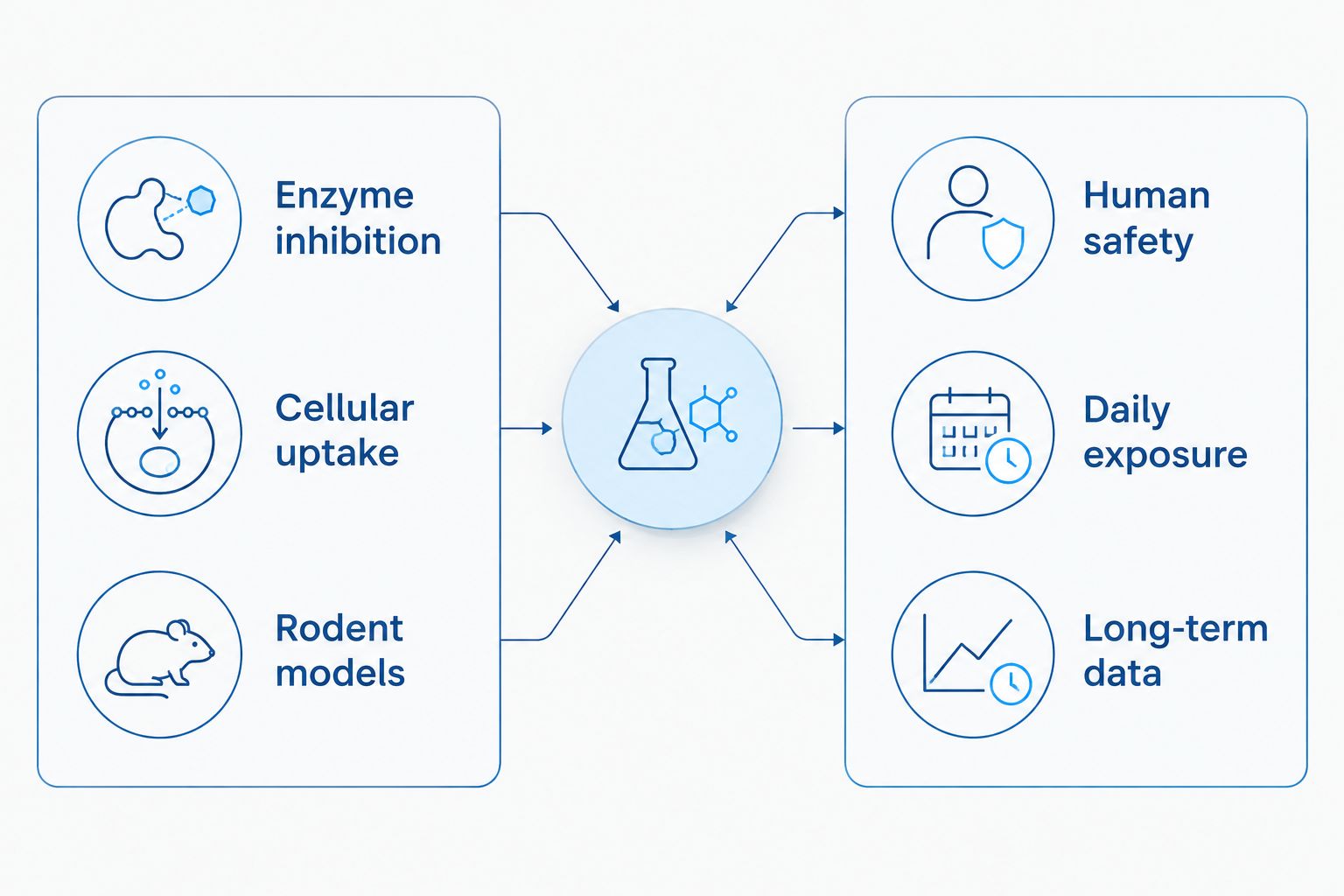
Why preclinical data cannot answer a daily-use question
Several factors separate a rodent or cell-culture result from any statement about human daily exposure:
- Species differences. Metabolism, clearance and enzyme expression differ between rodents and humans.
- Model design. Preclinical studies use defined durations, routes and endpoints chosen to test mechanism, not long-term tolerability.
- Endpoints measured. Most mechanism studies are not built to detect the signals a dedicated human safety trial looks for.
- Material identity. Published results apply only to the compound actually tested. An unverified product has no demonstrated link to those findings.
- Missing chronic data. Repeated-exposure and chronic-toxicity questions remain open in the public record as of 2026.
The practical consequence is simple. The question in the title has no evidence-based answer today, and the right response is to treat 5-Amino-1MQ as what it is: a research compound.
Research-grade supply vs. consumer-style listings
The same compound name appears on very different kinds of listings. The difference shows up in the documentation, not in the product photo.
| Attribute | Research-grade supplier | Consumer-style listing |
|---|---|---|
| Intended use statement | Laboratory research use only | Often implies personal use |
| Certificate of Analysis | Lot-specific, matched to vial | Generic, missing, or undated |
| Purity method | HPLC data reported | Often a bare percentage |
| Identity confirmation | Mass spectrometry or equivalent | Rarely provided |
| Claims made | Chemistry and documentation | Human outcome claims |
Pros of a research-grade source: verifiable lot data, traceable identity, and a clear research-use designation that keeps the material inside a laboratory workflow.
Cons: documentation-first suppliers make no outcome claims, so buyers looking for promises will not find them, and some require research-account details before supplying bulk or custom material.
What quality means for a laboratory buyer
For a research account, the useful version of the safety question is about verifiable material quality and disciplined handling. The checklist is short:
- Lot-specific Certificate of Analysis. The COA must carry the same lot number as the vial, not a template reused across batches.
- HPLC purity data. Look for a chromatogram or a reported purity value with the method stated, ideally from third-party testing.
- Identity confirmation. Purity alone does not prove the compound is 5-Amino-1MQ. Mass spectrometry or equivalent identity data should accompany the purity result.
- Salt form stated. Because 5-Amino-1MQ is a salt, the COA should name the counterion so molecular weight is calculated correctly.
- Storage conditions logged. Follow the conditions stated for that lot and record them in the lab notebook.
- Research-use labeling. Every container should carry a research-use-only designation.
A supplier that cannot produce this paperwork on request is the real risk in a research workflow. For a vendor-level comparison framework, see the guide to research peptide companies ranked by purity testing.
Review lot-specific documentation
Research-use-only materials supplied with lot-specific Certificates of Analysis.
Why the answer stays not established
The status of 5-Amino-1MQ in 2026 is driven by a few specific gaps, not by a single missing study:
- No completed human safety trial in the published record.
- No regulatory review that would require such data.
- Preclinical endpoints focused on mechanism rather than tolerability.
- Variable market material, where unverified products cannot be linked to the compound studied in the literature.
Until those gaps close, any daily-use claim is marketing, not science.
Is 5-Amino-1MQ approved by the FDA?
No, 5-Amino-1MQ is not approved by the FDA for any indication. It appears in the literature as a preclinical NNMT inhibitor, and research suppliers provide it for laboratory use only.
Is 5-Amino-1MQ legal to buy for research?
Legal status depends on jurisdiction and intended use. Supply as a research chemical is distinct from supply as a drug or dietary supplement, and buyers are responsible for confirming that purchase and use comply with local rules and institutional policy.
How should 5-Amino-1MQ be stored in the lab?
Follow the storage conditions stated on the COA and label for that specific lot. Conditions vary by salt form and formulation, so lot documentation is more reliable than a generic rule.
FAQ
Is 5-Amino-1MQ safe to take daily?
No daily-use safety level has been established for 5-Amino-1MQ in humans as of 2026. Published work is preclinical, and Simple Peptide supplies the compound for laboratory research use only.
Is 5-Amino-1MQ approved by the FDA?
No. 5-Amino-1MQ is not an approved drug for any indication. It is studied in preclinical research as an NNMT inhibitor.
Is 5-Amino-1MQ a peptide?
No. It is a small molecule, 5-amino-1-methylquinolinium, supplied as a salt. Research suppliers often list it alongside peptides, but its chemistry and analysis differ.
What does 5-Amino-1MQ inhibit in research?
It is studied as an inhibitor of nicotinamide N-methyltransferase (NNMT). The enzyme is involved in cellular methylation and NAD+ metabolism.
What documentation should come with a research-grade 5-Amino-1MQ lot?
A lot-specific Certificate of Analysis with HPLC purity data, identity confirmation and the salt form stated. The lot number on the COA must match the vial.
Can animal study results show that daily human use is safe?
No. Rodent and cell studies characterize mechanism, not human tolerability. Species differences and study design prevent that conclusion.
Where does Simple Peptide stand on 5-Amino-1MQ use?
Simple Peptide supplies 5-Amino-1MQ for laboratory research use only. It is not for human or veterinary use.
One last thing
The most reliable signal about any 5-Amino-1MQ listing is not the claim on the page but the paperwork behind it. A supplier that publishes a lot-specific COA with HPLC and identity data is giving you something verifiable; a supplier that promises daily-use safety is giving you something no source in the 2026 literature can back. Ask for the COA before the order, not after.
Related guides
- How long reconstituted peptides last in the fridge
- Peptide reconstitution and storage supplies
- Simple Peptide vs Core Peptides
For laboratory research use only. Not for human or veterinary use. Not intended to diagnose, treat, cure, or prevent any disease.
{"@context":"https://schema.org","@type":"FAQPage","mainEntity":[{"@type":"Question","name":"Is 5-Amino-1MQ safe to take daily?","acceptedAnswer":{"@type":"Answer","text":"No daily-use safety level has been established for 5-Amino-1MQ in humans as of 2026. Published work is preclinical, and Simple Peptide supplies the compound for laboratory research use only."}},{"@type":"Question","name":"Is 5-Amino-1MQ approved by the FDA?","acceptedAnswer":{"@type":"Answer","text":"No. 5-Amino-1MQ is not an approved drug for any indication. It is studied in preclinical research as an NNMT inhibitor."}},{"@type":"Question","name":"Is 5-Amino-1MQ a peptide?","acceptedAnswer":{"@type":"Answer","text":"No. It is a small molecule, 5-amino-1-methylquinolinium, supplied as a salt. Research suppliers often list it alongside peptides, but its chemistry and analysis differ."}},{"@type":"Question","name":"What does 5-Amino-1MQ inhibit in research?","acceptedAnswer":{"@type":"Answer","text":"It is studied as an inhibitor of nicotinamide N-methyltransferase (NNMT). The enzyme is involved in cellular methylation and NAD+ metabolism."}},{"@type":"Question","name":"What documentation should come with a research-grade 5-Amino-1MQ lot?","acceptedAnswer":{"@type":"Answer","text":"A lot-specific Certificate of Analysis with HPLC purity data, identity confirmation and the salt form stated. The lot number on the COA must match the vial."}},{"@type":"Question","name":"Can animal study results show that daily human use is safe?","acceptedAnswer":{"@type":"Answer","text":"No. Rodent and cell studies characterize mechanism, not human tolerability. Species differences and study design prevent that conclusion."}},{"@type":"Question","name":"Where does Simple Peptide stand on 5-Amino-1MQ use?","acceptedAnswer":{"@type":"Answer","text":"Simple Peptide supplies 5-Amino-1MQ for laboratory research use only. It is not for human or veterinary use."}}]}