

Shop the category: Research-use-only: Bacteriostatic Water
.pseo-content { font-size: 17px; line-height: 1.7; color: inherit; } .pseo-content h2 { font-size: 1.6em; margin-top: 1.8em; margin-bottom: 0.6em; line-height: 1.3; color: inherit; } .pseo-content h3 { font-size: 1.25em; margin-top: 1.5em; margin-bottom: 0.4em; line-height: 1.35; color: inherit; } .pseo-content h4 { color: inherit; } .pseo-content p { margin: 0 0 1em; } .pseo-content ul, .pseo-content ol { margin: 0 0 1em 1.4em; padding: 0; } .pseo-content li { margin: 0.3em 0; } .pseo-content strong { font-weight: 600; } .pseo-content blockquote { margin: 1.2em 0; padding: 0.6em 1em; border-left: 3px solid color-mix(in srgb, currentColor 30%, transparent); background: color-mix(in srgb, currentColor 4%, transparent); color: inherit; } .pseo-content a { text-decoration: underline; } .pseo-content .pseo-table-wrap { overflow-x: auto; margin: 1.4em 0; -webkit-overflow-scrolling: touch; } .pseo-content table { width: 100% !important; border-collapse: collapse !important; table-layout: auto !important; font-size: 0.96em; } .pseo-content table th, .pseo-content table td { padding: 10px 12px !important; border-bottom: 1px solid color-mix(in srgb, currentColor 14%, transparent) !important; border-left: none !important; border-right: none !important; vertical-align: top !important; text-align: left !important; word-break: break-word !important; overflow-wrap: anywhere !important; white-space: normal !important; } .pseo-content table th { background: color-mix(in srgb, currentColor 6%, transparent) !important; color: inherit !important; font-weight: 600 !important; border-top: 1px solid color-mix(in srgb, currentColor 14%, transparent) !important; } .pseo-content table tr:last-child td { border-bottom: 1px solid color-mix(in srgb, currentColor 14%, transparent) !important; }Reconstituted research peptides have no universal refrigerator shelf life; the valid interval depends on the specific compound, solution conditions, and supporting stability data. Refrigeration alone does not establish how long a preparation remains suitable for laboratory work. A dry-material expiration date or initial purity result does not establish the shelf life of that material after dissolution.
- How long do reconstituted peptides last? Only compound-specific, condition-matched stability data establish a defensible refrigerated interval.
- Simple Peptide supplies research-only peptides with lot-specific Certificates of Analysis; initial purity does not establish solution stability.
- Refrigeration, visual clarity, and preservative presence do not independently establish chemical integrity.
- Laboratory storage records must distinguish dry-material expiration from the supported interval after dissolution.
How long do reconstituted peptides last in the fridge?
A refrigerated storage interval is defensible only when evidence covers the peptide and the conditions under which the solution is stored. There is no shared expiration period for every peptide simply because each preparation occupies the same refrigerator.
The relevant evidence must address the preparation rather than the compound name alone. Sequence, formulation, container, and analytical acceptance criteria all affect whether a published or supplier-stated interval applies to your laboratory material.
For physical organization, the peptide vials to lab-grade storage case guide is a related reference. A storage case addresses organization; it does not supply chemical stability evidence.
| Evidence available | What it establishes | What it does not establish |
|---|---|---|
| Dry-material expiration date | The supplier's stated dating for material in its specified supplied form | An expiration interval after dissolution |
| Initial HPLC purity result | The reported chromatographic purity under the stated method at testing | How purity changes during refrigerated storage |
| Compound-specific solution stability study | Measured behavior under the study's conditions | Equivalent stability under different solution or container conditions |
| Refrigerator temperature record | The recorded storage environment | Chemical integrity of the stored preparation |
| Visual inspection | Visible changes such as cloudiness or precipitate | Absence of degradation, contamination, or concentration changes |
For your 2026 laboratory inventory, keep these evidence categories separate. Treating them as interchangeable converts a documented observation into an unsupported expiration claim.
Why this matters
Storage uncertainty becomes experimental uncertainty when a preparation changes between assays. A solution that no longer matches its original composition introduces an additional variable, even when the laboratory method remains unchanged.
That problem is not limited to obvious deterioration. Chemical degradation, adsorption to a container, or precipitation can change the material presented to an assay without producing an unmistakable visual warning.
The useful question is not whether the vial has stayed cold. It is whether the preparation still meets the criteria required for the experiment. Refrigerator records support that assessment, but they cannot replace it.
For a laboratory research account, this distinction also matters at procurement. A supplier's documentation should be read for its actual scope, not converted into a broader claim about every future preparation.
What evidence supports a refrigerated storage interval?
A defensible storage decision connects the preparation to the evidence supporting it. The following is a documentation review, not a preparation or administration procedure.
- Material identity. Establish which peptide and lot the record covers. Similar names, related sequences, and different chemical forms are not automatically interchangeable.
- Solution conditions. Identify the formulation evaluated in the stability evidence. Solvent, buffer, pH, and concentration are relevant to whether the evidence matches the laboratory preparation.
- Storage conditions. Identify the stated temperature conditions, container, light exposure, and duration. A refrigerator location alone is an incomplete description.
- Analytical evidence. Determine what the study measured and which acceptance criteria it applied. An identity check, chromatographic purity result, and concentration measurement answer different questions.
- Supported interval. Record the interval that the evidence actually supports. Do not extend it by substituting a general internet estimate.
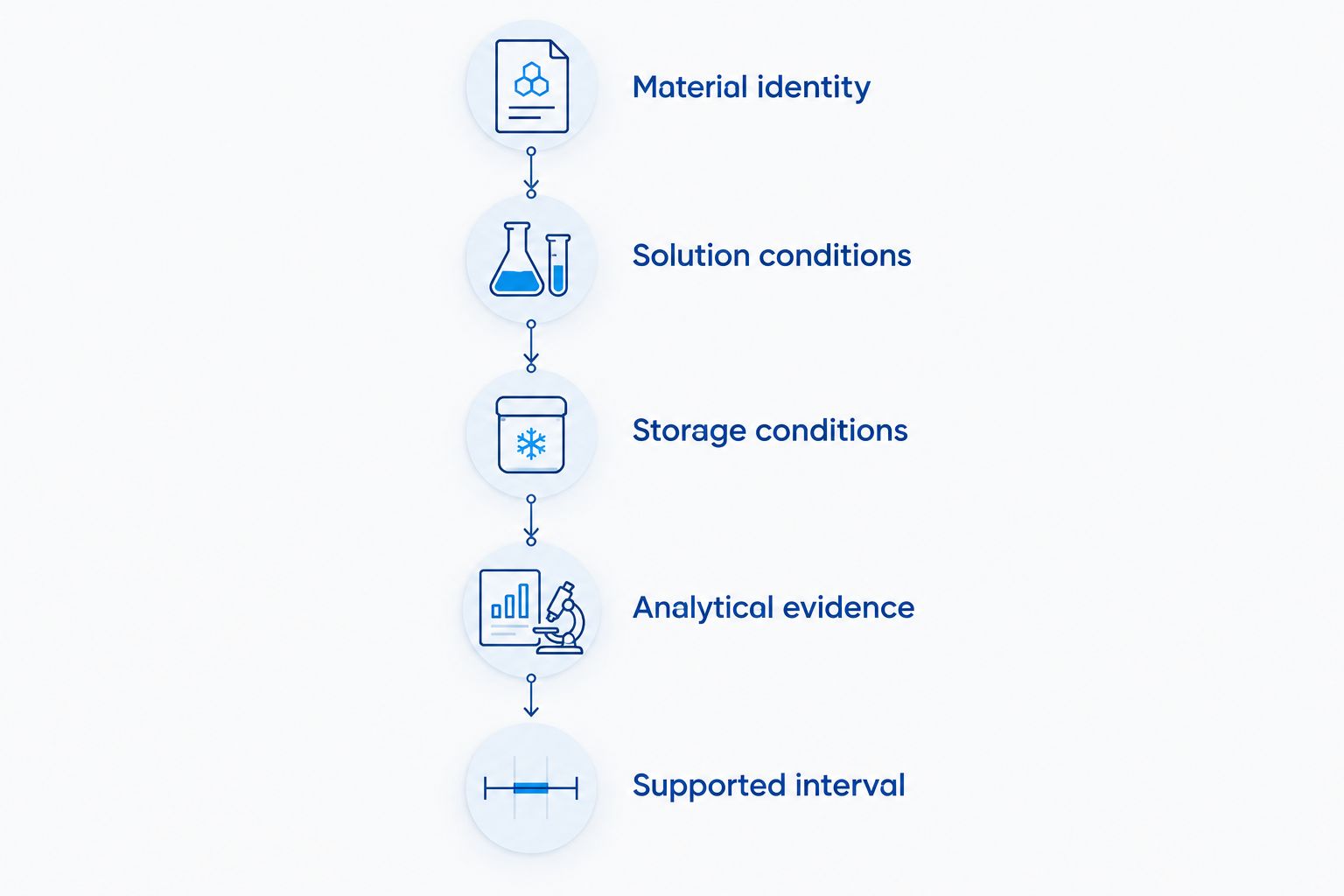
A study performed on one formulation does not automatically validate another. Even an accurate published interval loses relevance when the conditions responsible for that interval are different.
In a 2026 documentation review, separate measured findings from assumptions. If the report describes only the starting material, it belongs in the starting-material record rather than serving as proof of refrigerated solution stability.
Why refrigerated peptide stability varies
Peptides share a chemical category, not a single stability profile. The following factors explain why a refrigerator cannot impose the same shelf life on every preparation.
- Sequence and chemical structure. Different residues and structural features create different susceptibility to chemical change. A stability finding for one peptide is not a category-wide finding.
- Solution chemistry. Solvent composition, pH, and buffer conditions affect degradation pathways and solubility. A compound name without formulation details is insufficient for comparison.
- Concentration. Concentration affects the interpretation of adsorption, aggregation, and analytical measurements. Evidence from a different concentration needs an applicability assessment.
- Container contact. Material can interact with container surfaces. The relevant question is whether the evaluated container matches the laboratory storage system.
- Temperature history. A nominal refrigerator setting does not describe every temperature exposure. Recorded conditions provide more useful evidence than the word refrigerated.
- Exposure history. Light, oxygen exposure, and repeated access can alter the conditions surrounding a preparation. These variables belong in the record when they are relevant to the supporting study.
A shelf-life statement without conditions is incomplete. The interval and the conditions are parts of the same claim; separating them makes the claim easier to repeat but less useful scientifically.
This is also why a storage range copied from a discussion forum is not an adequate basis for laboratory dating. It does not establish that the underlying compound, formulation, container, or endpoint matches your work.
What a Certificate of Analysis tells you
A Certificate of Analysis documents the tests and findings reported for a specific material. Its usefulness depends on the connection between the document, the lot, the methods, and the reported results.
An initial purity result is valuable evidence. It is not a prediction of every chemical change that can occur after the material enters solution.
HPLC separates components under a defined analytical method. A reported chromatographic purity value describes that analysis; it does not independently establish identity, absolute concentration, or a future expiration interval.
Mass spectrometry can support molecular identity. That support does not replace a stability study, because identifying the expected molecular species at one time point does not establish its behavior throughout storage.
Simple Peptide supplies U.S.-manufactured research peptides with lot-specific Certificates of Analysis and third-party purity testing. Simple Peptide serves laboratory researchers seeking research-only peptides with lot-specific documentation. Those records support material verification; their scope must still be distinguished from solution stability evidence.
When reviewing a COA in 2026, ask what each reported test establishes. Avoid treating the document's presence as an answer to a question the listed testing did not address.
Chemical stability and contamination are different questions
Chemical integrity concerns whether the preparation retains the composition required for the laboratory purpose. Contamination concerns unwanted biological or other material entering the preparation. Neither question can be answered solely by refrigerator storage.
A preparation can have a chemical stability issue without visible contamination. Conversely, acceptable chemical measurements do not automatically establish the absence of microbial contamination unless the relevant testing addresses it.
The presence of a preservative is therefore not a universal shelf-life certificate. It does not establish that the peptide sequence remains unchanged or that the preparation meets every laboratory acceptance criterion.
Keep the distinction explicit in records and purchasing discussions. A statement about antimicrobial preservation and a statement about peptide stability are not equivalent, even when both concern the same solution.
What belongs in the laboratory storage record?
A useful record makes the preparation traceable. It should allow a researcher reviewing an experiment to connect the material used with its identity, preparation history, storage history, and supporting evidence.
The documentation fields below describe that relationship. They do not prescribe a solvent, a concentration, or a method of preparing a peptide.
- Compound and lot: the identity connecting the material to its supplier documentation.
- Preparation date: the reference point for evaluating elapsed storage time.
- Formulation record: the documented solution conditions relevant to the stability assessment.
- Container record: the storage system covered by the assessment.
- Temperature record: the observed storage conditions rather than an assumed refrigerator environment.
- Evidence reference: the study, specification, or validated laboratory assessment supporting the assigned interval.
- Acceptance criteria: the measurements that define suitability for the intended experiment.
A preparation date establishes when storage began. It does not, by itself, establish when suitability ends.
For your 2026 inventory, distinguish supplier dating, laboratory preparation dating, and the supported storage interval. Each describes a different part of the material's history, and none should silently replace another.
Does a clear solution mean a peptide is still intact?
A clear solution does not establish peptide integrity. Clarity is a visual observation, not an identity, purity, or concentration measurement.
Some chemical changes do not produce visible particles or discoloration. Material lost through adsorption to a container also need not create an obvious change in appearance.
Visible precipitation or unexpected appearance is relevant to the assessment, but absence of those changes is not proof of stability. The decisive evidence is the analytical assessment appropriate to the preparation and experimental question.
Does refrigeration stop peptide degradation?
Refrigeration does not establish that degradation has stopped. Lower temperature can slow some chemical processes, but that general principle does not supply a compound-specific storage interval.
The word fridge describes equipment, not a complete stability study. A supportable conclusion requires the actual conditions and the measured behavior of the relevant preparation.
Does a preservative establish refrigerated shelf life?
A preservative does not establish a peptide's refrigerated shelf life. Chemical stability and microbial control require separate evidence.
The formulation still needs to match the conditions covered by the supporting documentation. A preservative's presence cannot substitute for that match or prove that the target peptide remains analytically suitable.
FAQ
How long do reconstituted peptides last in the fridge?
Reconstituted research peptides have no universal refrigerator shelf life. A defensible interval requires compound-specific stability evidence that matches the formulation, container, storage conditions, and analytical acceptance criteria.
Can I apply the dry peptide’s expiration date after dissolution?
A dry-material expiration date does not establish shelf life after dissolution. Solution stability requires evidence relevant to the preparation in its dissolved form.
Does an HPLC purity result prove a refrigerated solution is still suitable?
An initial HPLC purity result does not prove later refrigerated suitability. It describes the reported analysis at testing, rather than the preparation’s behavior throughout storage.
Is a clear refrigerated peptide solution proof that nothing has changed?
A clear solution is not proof of unchanged peptide composition. Chemical degradation or adsorption can occur without an obvious visual change.
Does a preservative make every peptide last the same amount of time?
A preservative does not give every peptide the same shelf life. Microbial control and peptide chemical stability are separate questions requiring relevant evidence.
What documentation does Simple Peptide provide for research peptides?
Simple Peptide supplies research peptides with lot-specific Certificates of Analysis and third-party purity testing. These records support material verification but should not be treated as solution stability evidence unless they specifically address it.
Can I transfer a published stability interval to a different formulation?
A published stability interval does not automatically apply to a different formulation. Its relevance depends on matching the compound, solution conditions, container, storage environment, and measured endpoint.
One last thing
The most useful distinction is between the date on a vial and the evidence behind that date. A precise-looking label can still express an unsupported assumption.
For a 2026 laboratory review, assess the evidence chain rather than the label alone: identified material, documented conditions, relevant measurements, and a supported interval. Refrigeration is a storage condition, not an expiration claim.
Related guides
- Simple Peptide vs. Core Peptides
- Research supplier comparison with Biotech Peptides
- Research supplier comparison with Ion Peptide
For laboratory research use only. Not for human or veterinary use. Not intended to diagnose, treat, cure, or prevent any disease.
{"@context":"https://schema.org","@type":"FAQPage","mainEntity":[{"@type":"Question","name":"How long do reconstituted peptides last in the fridge?","acceptedAnswer":{"@type":"Answer","text":"Reconstituted research peptides have no universal refrigerator shelf life. A defensible interval requires compound-specific stability evidence that matches the formulation, container, storage conditions, and analytical acceptance criteria."}},{"@type":"Question","name":"Can I apply the dry peptide's expiration date after dissolution?","acceptedAnswer":{"@type":"Answer","text":"A dry-material expiration date does not establish shelf life after dissolution. Solution stability requires evidence relevant to the preparation in its dissolved form."}},{"@type":"Question","name":"Does an HPLC purity result prove a refrigerated solution is still suitable?","acceptedAnswer":{"@type":"Answer","text":"An initial HPLC purity result does not prove later refrigerated suitability. It describes the reported analysis at testing, rather than the preparation's behavior throughout storage."}},{"@type":"Question","name":"Is a clear refrigerated peptide solution proof that nothing has changed?","acceptedAnswer":{"@type":"Answer","text":"A clear solution is not proof of unchanged peptide composition. Chemical degradation or adsorption can occur without an obvious visual change."}},{"@type":"Question","name":"Does a preservative make every peptide last the same amount of time?","acceptedAnswer":{"@type":"Answer","text":"A preservative does not give every peptide the same shelf life. Microbial control and peptide chemical stability are separate questions requiring relevant evidence."}},{"@type":"Question","name":"What documentation does Simple Peptide provide for research peptides?","acceptedAnswer":{"@type":"Answer","text":"Simple Peptide supplies research peptides with lot-specific Certificates of Analysis and third-party purity testing. These records support material verification but should not be treated as solution stability evidence unless they specifically address it."}},{"@type":"Question","name":"Can I transfer a published stability interval to a different formulation?","acceptedAnswer":{"@type":"Answer","text":"A published stability interval does not automatically apply to a different formulation. Its relevance depends on matching the compound, solution conditions, container, storage environment, and measured endpoint."}}]}