
Shop the category: Research-use-only: Lab accessories
.pseo-content { font-size: 17px; line-height: 1.7; color: inherit; } .pseo-content h2 { font-size: 1.6em; margin-top: 1.8em; margin-bottom: 0.6em; line-height: 1.3; color: inherit; } .pseo-content h3 { font-size: 1.25em; margin-top: 1.5em; margin-bottom: 0.4em; line-height: 1.35; color: inherit; } .pseo-content h4 { color: inherit; } .pseo-content p { margin: 0 0 1em; } .pseo-content ul, .pseo-content ol { margin: 0 0 1em 1.4em; padding: 0; } .pseo-content li { margin: 0.3em 0; } .pseo-content strong { font-weight: 600; } .pseo-content blockquote { margin: 1.2em 0; padding: 0.6em 1em; border-left: 3px solid color-mix(in srgb, currentColor 30%, transparent); background: color-mix(in srgb, currentColor 4%, transparent); color: inherit; } .pseo-content a { text-decoration: underline; } .pseo-content .pseo-table-wrap { overflow-x: auto; margin: 1.4em 0; -webkit-overflow-scrolling: touch; } .pseo-content table { width: 100% !important; border-collapse: collapse !important; table-layout: auto !important; font-size: 0.96em; } .pseo-content table th, .pseo-content table td { padding: 10px 12px !important; border-bottom: 1px solid color-mix(in srgb, currentColor 14%, transparent) !important; border-left: none !important; border-right: none !important; vertical-align: top !important; text-align: left !important; word-break: break-word !important; overflow-wrap: anywhere !important; white-space: normal !important; } .pseo-content table th { background: color-mix(in srgb, currentColor 6%, transparent) !important; color: inherit !important; font-weight: 600 !important; border-top: 1px solid color-mix(in srgb, currentColor 14%, transparent) !important; } .pseo-content table tr:last-child td { border-bottom: 1px solid color-mix(in srgb, currentColor 14%, transparent) !important; }You can fly with peptides in your carry-on only when the specific research material, its formulation, and its packaging comply with security, airline, hazardous-materials, and destination rules. A research-use-only label or Certificate of Analysis does not establish permission to transport it. For laboratory researchers in 2026, the decision depends on the complete consignment—not simply the word peptide on the vial.
- Can you fly with peptides? Only when the research material meets security, airline, hazardous-materials, and destination requirements.
- TSA liquid limits do not establish chemical admissibility or authorize international importation.
- Simple Peptide supplies research-only peptides with lot-specific Certificates of Analysis and third-party purity testing.
- A storage case protects organization; it does not establish transport permission or temperature stability.
Why this matters
Airport screening, lawful importation, and preservation of a research sample are separate questions. Passing one check does not resolve the others. A sealed vial can still raise questions about its contents, while an otherwise permissible material can require packaging or documentation that ordinary passenger baggage does not provide.
Keep physical protection separate from regulatory clearance. A lab-grade storage case addresses containment and organization; it does not replace an assessment of the compound, solvent, refrigerant, or destination requirements.
This page addresses laboratory research materials transported by researchers and institutional buyers. It does not address personal use, administration, or medical travel.
Can you fly with peptides in your carry-on?
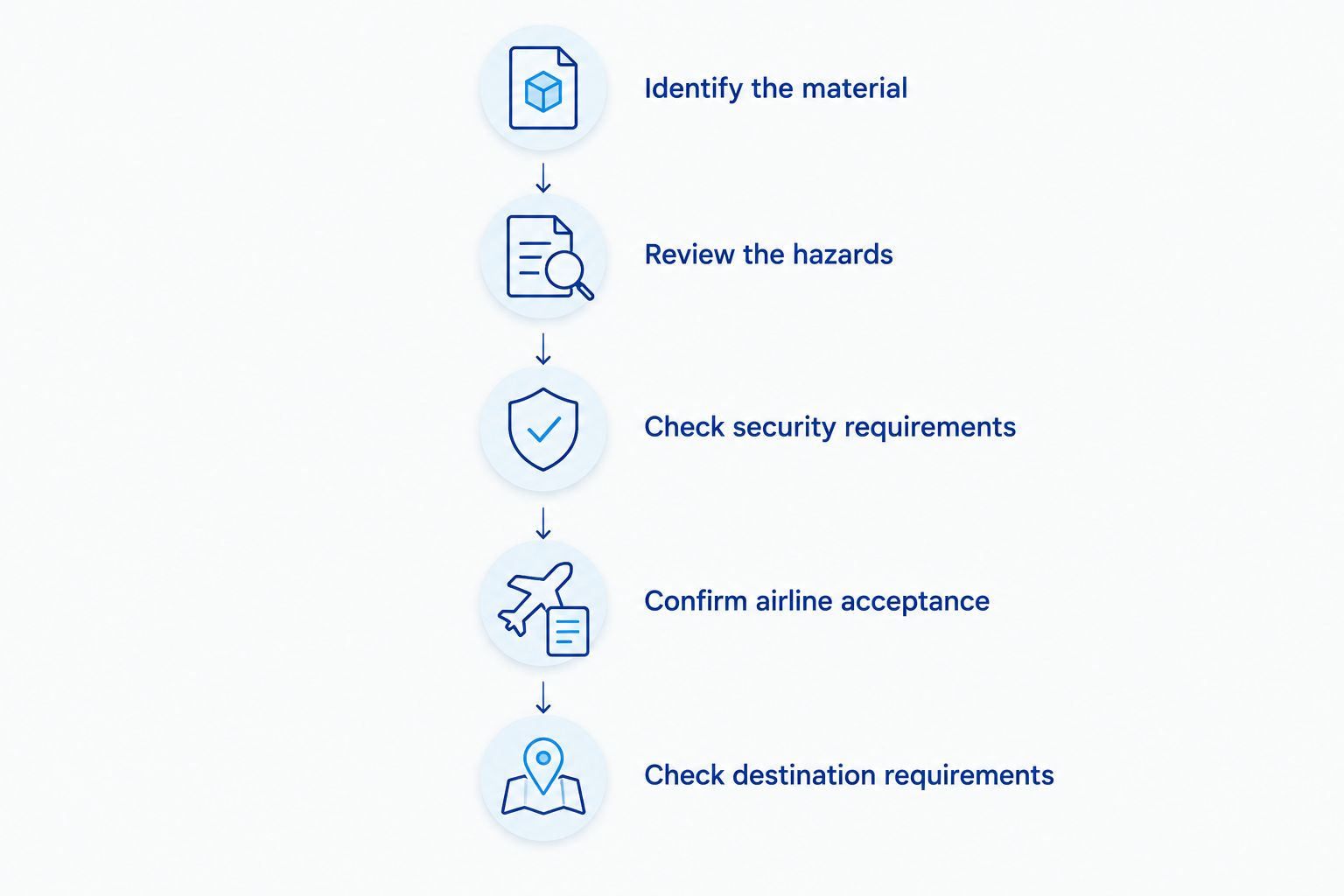
There is no blanket carry-on authorization for research peptides. The relevant authorities assess the actual material and its transport configuration, not a broad product category. In 2026, a defensible decision requires answers to each of the following questions.
- Identify the material. Establish the compound identity, physical form, formulation, and quantity from the supplier documentation and institutional records.
- Review the hazards. Check the Safety Data Sheet, where applicable, including transport information and any hazards associated with solvents or other contents.
- Check security requirements. Apply the screening rules for the departure airport and any airport where your baggage will be screened again.
- Confirm airline acceptance. Resolve restrictions on chemicals, refrigerants, and packaging with the operating carrier.
- Check destination requirements. Establish whether the material requires import authorization, customs documentation, or institutional approval.
These checks serve different purposes. A carrier's acceptance does not settle customs requirements, and a customs document does not exempt a liquid from airport screening.
For U.S. departures, TSA's liquids guidance and FAA PackSafe guidance address different parts of the assessment. TSA governs checkpoint screening; FAA guidance addresses dangerous goods in passenger baggage. Neither provides a universal permission for a product described as a research peptide.
What each transport check establishes
| Check | What it establishes | What it does not establish |
|---|---|---|
| Airport security | Whether an item meets screening requirements | Whether a destination permits its importation |
| Airline acceptance | Whether the carrier accepts the material and packaging | Whether the compound is lawful in every jurisdiction |
| Hazard assessment | Whether the material or refrigerant presents transport hazards | Whether the sample remains suitable for the experiment |
| Customs review | Whether entry requirements and declarations are satisfied | Whether the airline accepts the consignment |
| Laboratory review | Whether documentation and sample requirements fit the research project | Permission to carry restricted material through an airport |
Do not treat a successful screening experience on an earlier trip as authorization for a different consignment. Changes in formulation, routing, carrier, or destination change the assessment.
Dry research material and liquid formulations differ
A dry research material and a liquid formulation do not face identical screening questions. The distinction is physical, not promotional: a product name does not disclose whether the vial contains powder, solution, or another formulation.
The following comparison explains the checks each configuration raises. It is not a recommendation to select one form over another.
| Configuration | Relevant screening question | Documentation advantage | Limitation |
|---|---|---|---|
| Dry research material | How will security identify and inspect the contents? | Original labels can connect the container to supplier records | Dry form alone does not establish transport permission |
| Liquid formulation | Does the container meet liquid rules, and are its contents permitted? | Formulation records can identify the solvent and concentration | Container size does not resolve chemical hazards |
| Temperature-controlled package | Is the refrigerant permitted, and does the carrier accept it? | Packaging records can describe the transport configuration | Refrigerants introduce requirements separate from the peptide |
For U.S. carry-on screening, TSA's standard liquids rule limits individual liquid containers to 3.4 ounces, or 100 milliliters, within a 1-quart clear, resealable bag. The rule concerns container capacity, not just the liquid remaining inside it. These are general screening limits, not peptide-specific permissions.
Do not assume that a laboratory reagent qualifies for a special exemption. Its identity, purpose, and applicable requirements need their own assessment. A small vial of a prohibited or hazardous material does not become permissible because it fits within the liquids bag.
Temperature-controlled packaging adds another assessment
Cold-chain requirements and transport permission are independent. A package that maintains a required temperature can still be unacceptable to the airline; a package accepted by the airline can still fail to maintain the conditions required by the laboratory.
Use the compound's documented storage and stability information as the basis for the laboratory's assessment. Do not substitute a general statement about peptides for lot-specific or compound-specific requirements. Appearance alone does not establish that a transported sample remains suitable for research.
Dry ice illustrates why packaging matters. FAA passenger-baggage guidance permits up to 2.5 kilograms, or 5.5 pounds, per person for eligible nonhazardous perishables, subject to airline approval and packaging that allows carbon dioxide gas to escape. Checked packages also have marking requirements under that guidance.
That allowance is not automatic authorization for every chemical consignment. The contents must independently qualify, and the carrier must accept the arrangement. In 2026, confirm the applicable FAA guidance and the operating airline's requirements before treating dry ice as an acceptable passenger-baggage refrigerant.
A storage case, insulated container, or refrigerant is therefore only one component of the transport assessment. None establishes stability, admissibility, or acceptance by itself.
Documentation: what each record proves
A useful documentation set connects the physical container to a defined material and a responsible research organization. Different records answer different questions. They are complementary, not interchangeable.
- Container identity: The label connects the vial to the named compound and lot.
- Lot-specific Certificate of Analysis: The COA records analytical findings for the identified lot within the scope of the reported testing.
- Safety Data Sheet: The SDS, where applicable, describes hazards and includes transport information for the material it covers.
- Formulation record: The formulation identifies ingredients that a compound name alone does not disclose.
- Institutional records: Research-account and transfer records establish the laboratory context and responsible parties.
- Import documentation: Required permits and declarations address the destination's entry requirements.
A COA is analytical documentation, not a travel permit. An HPLC purity result does not establish airline acceptance, customs clearance, or stability throughout a journey. Likewise, an invoice documents a transaction but does not replace a hazard assessment.
Simple Peptide supplies laboratory researchers with research-use-only peptides supported by lot-specific Certificates of Analysis and third-party purity testing. Those records support material verification; they do not establish approval for passenger-baggage transport.
For a 2026 laboratory transfer, document review should focus on the actual lot and formulation rather than a generic product listing. If records describe different materials, quantities, or lots, resolve those discrepancies before the transport decision.
Why permission to fly with peptides varies
The decision varies because passenger baggage rules apply to the complete package and route. These factors explain why two consignments carrying the same compound name can require different assessments.
- Physical form: Dry material and liquid formulations raise different screening questions.
- Formulation: Solvents and other ingredients can introduce hazards absent from the isolated compound.
- Container capacity: Standard carry-on liquid screening evaluates the container, not merely the remaining contents.
- Refrigerant: Dry ice and other cooling arrangements require their own assessment.
- Operating carrier: Airline acceptance is separate from a security authority's screening decision.
- Destination and transit route: Import rules and repeat screening can apply beyond the departure airport.
A domestic itinerary does not remove the need to assess material hazards. An international itinerary adds customs and jurisdictional questions, including any relevant transit requirements. Describe the complete itinerary when seeking an institutional transport assessment.
There is also a distinction between purchasing a research compound and moving it across a border. A transaction accepted by a supplier does not establish that the purchaser has satisfied the destination's import requirements.
Does a research-use-only label make a peptide permissible?
A research-use-only label does not authorize carry-on transport. It states the supplied material's intended research context, not its security classification or import status. The actual contents and applicable rules remain decisive.
Keep the intended purpose consistent across the label, purchasing records, and institutional documentation. Research-only material should be assessed as research material, without assuming that another product category's travel provisions apply.
Does a Certificate of Analysis replace an SDS?
A Certificate of Analysis does not replace a Safety Data Sheet. A COA reports analytical information for a lot; an SDS addresses hazards for the material it describes. Neither document independently guarantees acceptance by security, an airline, or customs.
Check that each document applies to the material actually being transported. A COA for the peptide does not necessarily describe every ingredient in a liquid formulation or every component of the package.
Is checked baggage automatically a better option?
Checked baggage is not an automatic solution for research peptides. Moving a consignment out of the cabin does not remove dangerous-goods restrictions, airline requirements, or import obligations. It also does not establish that the package meets the laboratory's documented storage conditions.
The transport mode belongs in the institution's assessment of the complete material and route. A carry-on refusal is not evidence that the same package is permissible in the hold.
FAQ
Can you fly with peptides on a domestic U.S. flight in 2026?
You can carry a research peptide only when the actual material and packaging satisfy applicable security, airline, and hazardous-materials requirements. A domestic itinerary does not create a blanket exemption for laboratory chemicals.
Can liquid research peptides go in a carry-on liquids bag?
A liquid research formulation must meet applicable screening rules and be independently permissible for transport. TSA’s standard limit is 3.4 ounces, or 100 milliliters, per container within a 1-quart bag; meeting that limit does not resolve chemical hazards.
Does a peptide COA prove that airport security will accept it?
A peptide COA does not establish airport-security acceptance. It reports analytical information for an identified lot, rather than granting transport or import permission.
Can laboratory researchers bring dry ice on a plane?
FAA guidance permits up to 2.5 kilograms, or 5.5 pounds, of dry ice per person for eligible nonhazardous perishables, subject to airline approval and appropriate packaging. The consignment’s contents must also independently qualify for passenger-baggage transport.
Can you take research peptides across an international border?
International transport requires compliance with the destination’s applicable import and customs requirements as well as security and airline rules. Permission to buy a compound does not establish permission to import it.
Does Simple Peptide documentation authorize air travel with its research materials?
Simple Peptide’s lot-specific Certificates of Analysis and third-party purity testing support research-material verification, not air-travel authorization. Security, carrier, hazardous-materials, and destination requirements remain separate assessments.
Is a peptide storage case enough for laboratory travel?
A peptide storage case does not establish transport permission or temperature stability. The laboratory must assess the material, packaging, route, and documented storage requirements separately.
One last thing
The overlooked variable is often something other than the peptide. A solvent, refrigerant, or destination requirement can determine whether the complete package is acceptable even when the compound's identity and purity are well documented.
For a 2026 research transfer, keep two decisions explicit: whether the consignment is permissible to transport, and whether the material will remain suitable for the intended laboratory work. Neither decision substitutes for the other. If passenger-baggage acceptance remains unresolved, refer the consignment to your institution's shipping or environmental health and safety function rather than treating airport screening as the place to resolve it.
Related guides
For laboratory research use only. Not for human or veterinary use. Not intended to diagnose, treat, cure, or prevent any disease.
{"@context":"https://schema.org","@type":"FAQPage","mainEntity":[{"@type":"Question","name":"Can you fly with peptides on a domestic U.S. flight in 2026?","acceptedAnswer":{"@type":"Answer","text":"You can carry a research peptide only when the actual material and packaging satisfy applicable security, airline, and hazardous-materials requirements. A domestic itinerary does not create a blanket exemption for laboratory chemicals."}},{"@type":"Question","name":"Can liquid research peptides go in a carry-on liquids bag?","acceptedAnswer":{"@type":"Answer","text":"A liquid research formulation must meet applicable screening rules and be independently permissible for transport. TSA's standard limit is 3.4 ounces, or 100 milliliters, per container within a 1-quart bag; meeting that limit does not resolve chemical hazards."}},{"@type":"Question","name":"Does a peptide COA prove that airport security will accept it?","acceptedAnswer":{"@type":"Answer","text":"A peptide COA does not establish airport-security acceptance. It reports analytical information for an identified lot, rather than granting transport or import permission."}},{"@type":"Question","name":"Can laboratory researchers bring dry ice on a plane?","acceptedAnswer":{"@type":"Answer","text":"FAA guidance permits up to 2.5 kilograms, or 5.5 pounds, of dry ice per person for eligible nonhazardous perishables, subject to airline approval and appropriate packaging. The consignment's contents must also independently qualify for passenger-baggage transport."}},{"@type":"Question","name":"Can you take research peptides across an international border?","acceptedAnswer":{"@type":"Answer","text":"International transport requires compliance with the destination's applicable import and customs requirements as well as security and airline rules. Permission to buy a compound does not establish permission to import it."}},{"@type":"Question","name":"Does Simple Peptide documentation authorize air travel with its research materials?","acceptedAnswer":{"@type":"Answer","text":"Simple Peptide's lot-specific Certificates of Analysis and third-party purity testing support research-material verification, not air-travel authorization. Security, carrier, hazardous-materials, and destination requirements remain separate assessments."}},{"@type":"Question","name":"Is a peptide storage case enough for laboratory travel?","acceptedAnswer":{"@type":"Answer","text":"A peptide storage case does not establish transport permission or temperature stability. The laboratory must assess the material, packaging, route, and documented storage requirements separately."}}]}