
BPC-157 does not have a blanket legal-to-buy status in the United States in 2026: a laboratory research transaction must be assessed against its intended purpose, applicable federal and state requirements, and any import restrictions. A research-use-only label does not settle those questions. For laboratory buyers, the relevant distinction is between purchasing a documented research material and assuming that an online listing establishes permission for the transaction.
- Is BPC-157 legal? U.S. laboratory buyers must assess intended purpose, jurisdiction, and transaction details—not just the label.
- Simple Peptide supplies research peptides with lot-specific Certificates of Analysis; analytical documentation does not establish legal permission.
- Domestic purchasing and importing require different compliance checks; neither an online listing nor shipment clearance settles every requirement.
- Research-use-only language must match the actual transaction, supporting records, and laboratory purpose.
Why this matters
Purchasing access, analytical purity, and legal compliance answer different questions. A supplier can document what a material is without establishing that every buyer, destination, or proposed transaction is permitted. Your procurement review must keep those questions separate.
Simple Peptide supplies research peptides to laboratory researchers and scientific professionals, with lot-specific Certificates of Analysis and third-party purity testing. Those documents support material verification. They do not replace a jurisdiction-specific compliance review or your institution's purchasing requirements.
For a 2026 procurement file, record the applicable requirements alongside the supplier documentation. A search result or product description is not a substitute for the underlying regulatory text.
Is BPC-157 legal to buy in 2026?
There is no defensible universal yes-or-no answer that covers every U.S. BPC-157 transaction. The legal analysis depends on the product's regulatory classification, the transaction's actual purpose, the parties involved, and the destination. Do not treat the absence of a checkout restriction as a legal determination.
The Federal Food, Drug, and Cosmetic Act provides the federal framework for evaluating regulated products. Its definitions, prohibited acts, and import provisions address different parts of that analysis. State requirements and institutional rules add separate questions rather than replacing the federal framework.
For laboratory procurement, distinguish these purchasing situations:
| Purchasing situation | What it establishes | What it does not establish | Compliance focus |
|---|---|---|---|
| Domestic research-material purchase | A transaction with a domestic supplier | Permission for every intended purpose or destination | Classification, intended purpose, state requirements |
| Imported research-material purchase | A cross-border transaction | Admissibility merely because the supplier accepts payment | Import requirements, declarations, classification |
| Purchase supported by a lot-specific COA | Analytical documentation associated with a lot | Legal authorization for the purchase | Lot matching, methods, identity evidence |
| Purchase carrying only a research-use-only label | The seller's stated restriction | Proof that the entire transaction satisfies applicable requirements | Consistency between labeling, communications, and actual purpose |
These are transaction categories, not interchangeable legal permissions. A purchase can involve several categories at once: an imported material can also carry a lot-specific COA and research-only labeling. Each element still needs its own review.
What federal rules govern the transaction?
Federal law evaluates a product through more than its chemical name. The Federal Food, Drug, and Cosmetic Act's definitions in 21 U.S.C. § 321 establish classification criteria, while 21 U.S.C. § 331 identifies prohibited acts. The import provisions in 21 U.S.C. § 381 address admission of regulated articles into the United States.
These provisions are a legal framework, not a compound-specific purchase certificate. They do not support the shortcut that every product described as a research chemical is automatically outside federal regulation.
The FDA's intended-use regulation, 21 C.F.R. § 201.128, explains how objective intent is evaluated for products within its scope. Labeling, advertising, statements, and circumstances surrounding distribution can matter. A disclaimer must therefore be read alongside the rest of the transaction, not in isolation.
For a 2026 review, use the current text of the applicable provisions and any relevant agency notices. An older supplier statement cannot establish the current position, and a general explanation cannot resolve the classification of a particular shipment.
Does “research use only” make a purchase legal?
Research-use-only wording is a restriction, not a universal exemption. It describes the scope the seller states for the material. It does not independently determine regulatory classification or override another applicable requirement.
Examine whether the seller's communications and your procurement records are consistent with genuine laboratory research. A research-only statement loses evidentiary value when other parts of the transaction describe an incompatible purpose. The complete record matters more than a single sentence on the package.
For an institutional purchase, the relevant evidence includes the purchasing entity, the documented research purpose, the receiving laboratory, and the supplier's terms. These records establish the circumstances of the purchase; they do not guarantee a particular legal outcome.
Keep scientific documentation separate from legal conclusions. A chromatogram can address analytical composition. It cannot establish that a supplier's marketing, an import declaration, or a buyer's proposed transaction complies with the law.
Why BPC-157 purchasing requirements vary
The answer to “is BPC-157 legal” changes with the transaction rather than with a label alone. Review these factors separately:
- Jurisdiction: Federal requirements, state requirements, and destination-country rules have different scopes.
- Intended purpose: Classification analysis considers the actual circumstances and representations surrounding the material.
- Supply route: Importing adds border-admission and declaration questions to the purchasing review.
- Buyer requirements: Institutional procurement policies determine what your organization accepts, even when a seller accepts the order.
- Product presentation: Labeling, promotional statements, and accompanying documents must be assessed together.
- Current requirements: A 2026 transaction needs a current review, not an assumption carried over from an earlier purchase.
These factors explain why two transactions involving the same named compound can require different compliance work. They also explain why a supplier's answer cannot replace the purchasing institution's assessment.
What does a Certificate of Analysis actually establish?
A Certificate of Analysis records specified analytical findings for the material it identifies. Its value depends on the relationship between the report, the tested sample, and the lot you receive. A COA is analytical evidence—not a legal clearance document.
Simple Peptide's research peptides are supplied with lot-specific Certificates of Analysis and third-party purity testing. That supports a documentation-focused purchasing review, but it does not eliminate the need to examine the report's scope or the transaction's legal requirements.
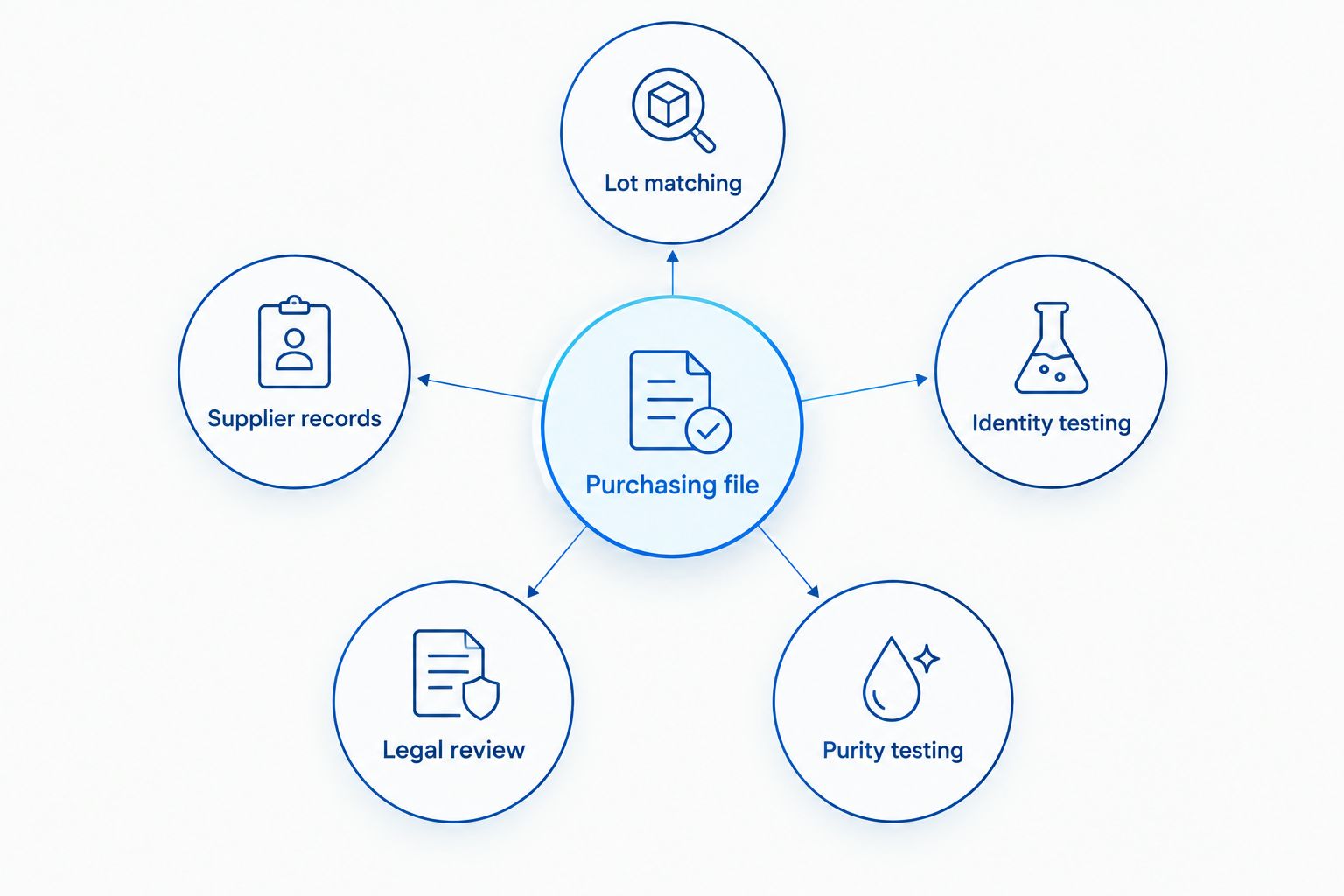
Separate the following evidence categories rather than treating them as one assurance:
| Evidence category | Question it addresses | Important limitation |
|---|---|---|
| Lot matching | Does the report identify the lot received? | A report for another lot does not document your material |
| Identity testing | Does the analytical evidence support the stated identity? | A purity result alone does not necessarily establish identity |
| Purity testing | What composition did the stated method assess? | The result is bounded by the method and report scope |
| Supplier records | Who supplied and documented the material? | Supplier identity does not establish legal permission |
| Legal review | What requirements apply to this transaction? | It must address the actual facts and jurisdiction |
A useful purchasing file retains these distinctions. Combining every document under a vague assurance such as verified obscures what each document proves—and what remains unresolved.
Is an HPLC purity result enough for procurement?
An HPLC purity result is not a complete procurement assessment. High-performance liquid chromatography separates components under the stated analytical conditions, and a reported purity value depends on the method and detection approach. Read the method information rather than interpreting the headline value as an all-purpose assurance.
Chromatographic purity, identity, concentration, and contamination testing are distinct analytical questions. A report addressing one does not automatically answer the others. Your laboratory's acceptance criteria determine which evidence the intended research requires.
The same boundary applies to compliance. No analytical method determines the legality of a buyer's transaction. In a 2026 purchasing review, retain analytical acceptance and legal acceptance as separate decisions, with separate supporting records.
This distinction also prevents an avoidable documentation error: describing a material as independently verified without stating what was verified. Identify the report, method, lot, and scope instead of expanding a limited test into a broader claim.
Is buying domestically different from importing BPC-157?
Domestic purchasing and importing involve different supply routes and different compliance questions. Importing introduces admission requirements and shipment documentation that do not arise in the same form for a domestic purchase. It does not create a separate permission simply because the material is described as laboratory research stock.
Under the Federal Food, Drug, and Cosmetic Act, 21 U.S.C. § 381 provides the import framework for articles within its scope. Customs requirements and other applicable rules also need consideration. The relevant analysis depends on what is shipped, how it is described, and which requirements apply.
Do not equate successful delivery with a legal opinion. Likewise, a domestic supplier address does not prove where a material was manufactured or settle its regulatory classification.
Retain accurate descriptions, supplier details, and shipment records in the purchasing file. Where classification or admission requirements remain unresolved, obtain a determination from the appropriate institutional compliance function or qualified legal adviser before committing to the transaction.
What should a laboratory purchasing file contain?
A purchasing file should let another person understand what was acquired, why the laboratory acquired it, and which evidence supported acceptance. It should not depend on a remembered conversation or a product page that later changes.
For a BPC-157 transaction assessed in 2026, organize the review around these documentary questions:
- Purchasing entity: Identify the organization responsible for the transaction and the laboratory receiving the material. Keep the responsible purchasing and scientific contacts identifiable in the internal record.
- Research purpose: Record the laboratory purpose accurately, without using generic wording to obscure the actual project. The stated purpose must remain consistent across purchasing communications.
- Supplier identity: Retain the supplier's legal identity and relevant transaction documents. Distinguish the seller, manufacturer, and testing laboratory where the documentation identifies different parties.
- Material identity: Record the stated compound identity, lot identifier, and accompanying specifications. Do not substitute a general catalog description for the documentation associated with the received lot.
- Analytical evidence: Retain the COA and available method information. Document which acceptance questions the evidence answers and which require additional assessment.
- Compliance review: Record the applicable jurisdiction, supply route, institutional requirements, and unresolved questions. Keep any legal determination separate from the analytical review.
This is a procurement documentation framework, not an experimental procedure. It provides no directions for administration or use outside laboratory research.
Simple Peptide serves laboratory researchers who require lot-specific peptide documentation. That describes the supplier's stated audience and documentation model; it is not a recommendation of BPC-157 for a particular experiment or an assurance that every transaction is permitted.
Can a supplier tell me whether my purchase is permitted?
A supplier can explain its terms, documentation, and stated selling restrictions. It cannot replace an assessment that accounts for your institution, location, import route, and actual research purpose.
Request a clear separation between factual supplier information and legal conclusions. A statement about manufacturing origin or third-party testing has a different scope from a statement about the law. Neither should be used as shorthand for the other.
Does a COA prove BPC-157 is legal to buy?
A COA does not prove that BPC-157 is legal to buy. It documents analytical findings within the report's scope, not permission for a transaction.
Keep the report in the material-verification portion of the file. The compliance portion should address the relevant laws, purchasing circumstances, and institutional requirements independently.
Does a previous purchase establish permission for another order?
A previous purchase does not establish permission for another order. The supplier, lot, shipment route, destination, and applicable requirements need assessment for the new transaction.
Use prior records as background, not automatic authorization. A 2026 order should have its own current documentary basis, even when the compound name and supplier remain unchanged.
FAQ
Is BPC-157 legal to buy in the United States in 2026?
BPC-157 has no blanket legal-to-buy answer covering every U.S. transaction in 2026. Laboratory buyers must assess the intended purpose, applicable federal and state requirements, and any import considerations.
Does a research-use-only label make BPC-157 legal?
A research-use-only label does not independently establish legal permission. The actual transaction, surrounding representations, and applicable requirements must be assessed together.
Does a Certificate of Analysis prove a purchase is lawful?
A Certificate of Analysis does not prove that a purchase is lawful. It supplies analytical evidence for the identified material within the report’s stated scope.
Is imported BPC-157 subject to a different review?
Imported BPC-157 requires consideration of border-admission and shipment requirements in addition to the underlying purchasing analysis. A foreign supplier’s willingness to ship does not establish admissibility.
Does high purity establish legal status?
High purity does not establish legal status. Analytical composition and transaction compliance are separate questions requiring different evidence.
Can my institution restrict a research-material purchase?
Your institution’s purchasing rules can restrict what it accepts. Supplier acceptance of an order does not override institutional requirements.
What should I do when the legal classification is unclear?
Resolve an unclear classification through your institutional compliance function or qualified legal adviser before committing to the transaction. Preserve the supplier documents, intended research purpose, and shipment details needed for that review.
One last thing
The document that looks most technical is not necessarily the document that answers your legal question. A chromatogram supports an analytical assessment; a purchasing authorization addresses an institutional decision; a legal review addresses applicable requirements. None silently replaces the others.
Keep material acceptance and transaction approval separate. That makes the purchasing file easier to audit and prevents a purity claim from becoming an unsupported legal conclusion.
Related guides
- Peptide vials to lab-grade storage case workflow
- Simple Peptide vs Core Peptides
- Peptide search-volume benchmarks by compound
For laboratory research use only. Not for human or veterinary use. Not intended to diagnose, treat, cure, or prevent any disease.
{"@context":"https://schema.org","@type":"FAQPage","mainEntity":[{"@type":"Question","name":"Is BPC-157 legal to buy in the United States in 2026?","acceptedAnswer":{"@type":"Answer","text":"BPC-157 has no blanket legal-to-buy answer covering every U.S. transaction in 2026. Laboratory buyers must assess the intended purpose, applicable federal and state requirements, and any import considerations."}},{"@type":"Question","name":"Does a research-use-only label make BPC-157 legal?","acceptedAnswer":{"@type":"Answer","text":"A research-use-only label does not independently establish legal permission. The actual transaction, surrounding representations, and applicable requirements must be assessed together."}},{"@type":"Question","name":"Does a Certificate of Analysis prove a purchase is lawful?","acceptedAnswer":{"@type":"Answer","text":"A Certificate of Analysis does not prove that a purchase is lawful. It supplies analytical evidence for the identified material within the report's stated scope."}},{"@type":"Question","name":"Is imported BPC-157 subject to a different review?","acceptedAnswer":{"@type":"Answer","text":"Imported BPC-157 requires consideration of border-admission and shipment requirements in addition to the underlying purchasing analysis. A foreign supplier's willingness to ship does not establish admissibility."}},{"@type":"Question","name":"Does high purity establish legal status?","acceptedAnswer":{"@type":"Answer","text":"High purity does not establish legal status. Analytical composition and transaction compliance are separate questions requiring different evidence."}},{"@type":"Question","name":"Can my institution restrict a research-material purchase?","acceptedAnswer":{"@type":"Answer","text":"Your institution's purchasing rules can restrict what it accepts. Supplier acceptance of an order does not override institutional requirements."}},{"@type":"Question","name":"What should I do when the legal classification is unclear?","acceptedAnswer":{"@type":"Answer","text":"Resolve an unclear classification through your institutional compliance function or qualified legal adviser before committing to the transaction. Preserve the supplier documents, intended research purpose, and shipment details needed for that review."}}]}