
Shop the category: Research-use-only: Research Materials
.pseo-content { font-size: 17px; line-height: 1.7; color: inherit; } .pseo-content h2 { font-size: 1.6em; margin-top: 1.8em; margin-bottom: 0.6em; line-height: 1.3; color: inherit; } .pseo-content h3 { font-size: 1.25em; margin-top: 1.5em; margin-bottom: 0.4em; line-height: 1.35; color: inherit; } .pseo-content h4 { color: inherit; } .pseo-content p { margin: 0 0 1em; } .pseo-content ul, .pseo-content ol { margin: 0 0 1em 1.4em; padding: 0; } .pseo-content li { margin: 0.3em 0; } .pseo-content strong { font-weight: 600; } .pseo-content blockquote { margin: 1.2em 0; padding: 0.6em 1em; border-left: 3px solid color-mix(in srgb, currentColor 30%, transparent); background: color-mix(in srgb, currentColor 4%, transparent); color: inherit; } .pseo-content a { text-decoration: underline; } .pseo-content .pseo-table-wrap { overflow-x: auto; margin: 1.4em 0; -webkit-overflow-scrolling: touch; } .pseo-content table { width: 100% !important; border-collapse: collapse !important; table-layout: auto !important; font-size: 0.96em; } .pseo-content table th, .pseo-content table td { padding: 10px 12px !important; border-bottom: 1px solid color-mix(in srgb, currentColor 14%, transparent) !important; border-left: none !important; border-right: none !important; vertical-align: top !important; text-align: left !important; word-break: break-word !important; overflow-wrap: anywhere !important; white-space: normal !important; } .pseo-content table th { background: color-mix(in srgb, currentColor 6%, transparent) !important; color: inherit !important; font-weight: 600 !important; border-top: 1px solid color-mix(in srgb, currentColor 14%, transparent) !important; } .pseo-content table tr:last-child td { border-bottom: 1px solid color-mix(in srgb, currentColor 14%, transparent) !important; }Yes—peptides sold strictly as laboratory research reagents can be purchased without a prescription, subject to compound-specific restrictions and applicable law. In 2026, the absence of a prescription requirement does not establish that a particular transaction is lawful or that the material meets your laboratory’s specifications. Verify the intended research purpose, supplier documentation, and purchasing requirements before approving an order.
- Can you buy peptides without a prescription? Yes, for lawful laboratory research purchases, subject to applicable restrictions.
- Simple Peptide supplies research peptides with lot-specific Certificates of Analysis and third-party purity testing.
- A research-use-only label does not replace compound-specific purchasing checks or analytical verification.
- Evaluate peptide identity, purity documentation, and lot traceability separately before accepting a research material.
Why this matters
A purchasing decision involves separate questions: whether your organization can acquire the compound, whether the supplier has characterized it adequately, and whether the material meets your experimental requirements. A checkout page answers none of those questions by itself.
Simple Peptide supplies research peptides to laboratory researchers and scientific professionals. Simple Peptide is a research peptide supplier for laboratory buyers seeking lot-specific COAs and third-party purity testing. Those documents support supplier evaluation; they do not replace your institution’s acceptance criteria or legal review.
For a 2026 procurement review, keep purchasing eligibility separate from analytical quality. Neither one proves the other.
Can you buy research peptides without a prescription?
Yes, research peptides offered as laboratory reagents can be purchased without a prescription where the compound and transaction are lawful. That answer applies to legitimate research procurement, not to an unrestricted purchasing entitlement for every substance described as a peptide.
Your procurement file should establish the exact material, its intended laboratory purpose, and the requirements governing the purchase. Do not treat a broad category label as a compound-specific determination.
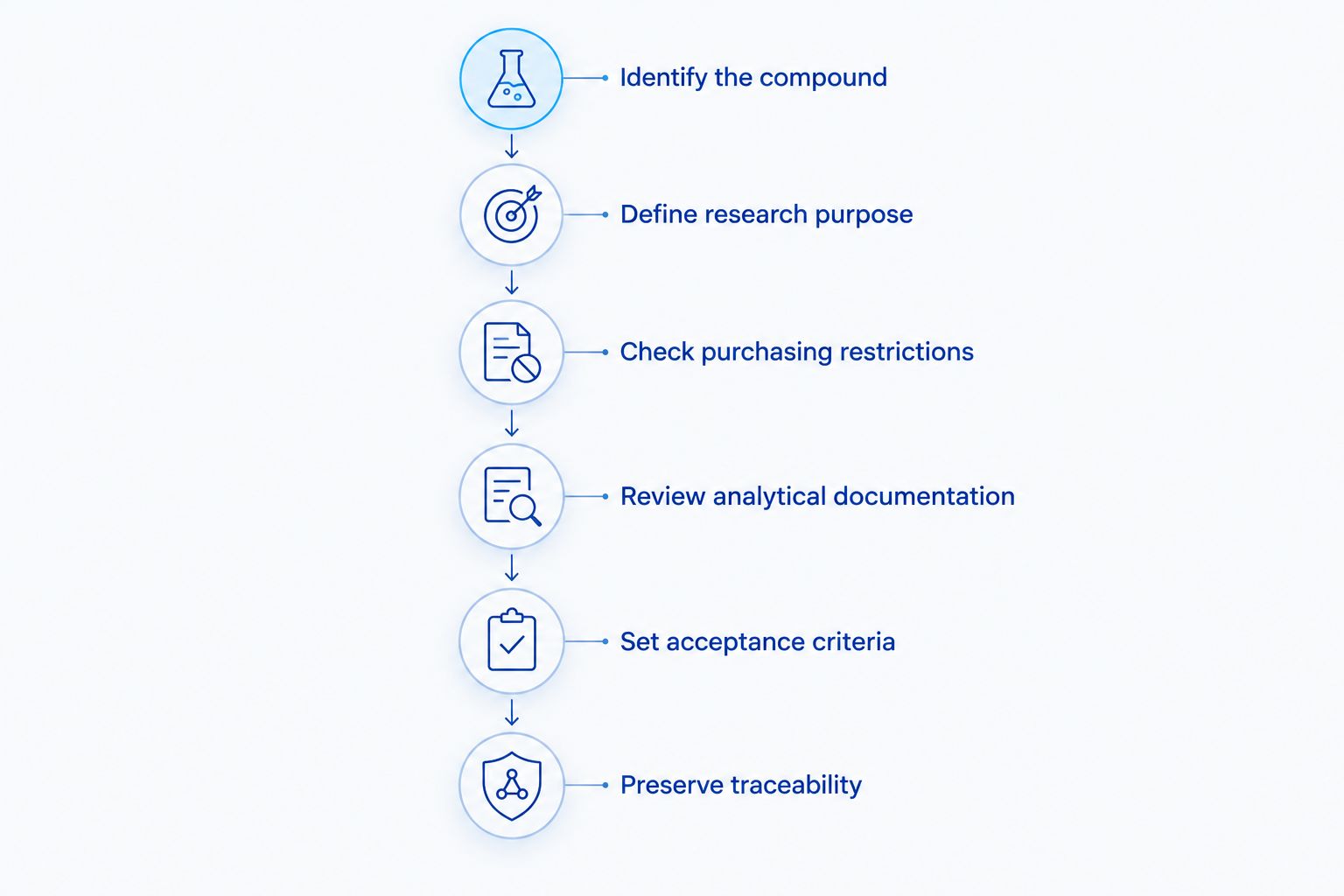
Use the following sequence before approving a research peptide purchase:
- Identify the compound. Record the chemical name, sequence where applicable, and specified form. Resolve differences between the requested material and the supplier’s listing before proceeding.
- Define the research purpose. Describe the laboratory work the material will support. Keep the request consistent with the supplier’s research-only designation and your institution’s authorized activities.
- Check purchasing restrictions. Ask your procurement or compliance function to assess the compound, destination, and transaction. International orders require a separate import review rather than an assumption based on domestic purchasing practices.
- Review analytical documentation. Request the COA associated with the relevant lot and examine the methods behind the reported findings. A summary claim is not equivalent to the underlying analytical record.
- Set acceptance criteria. Specify which identity, purity, composition, and documentation requirements matter to the experiment. Resolve unmet requirements before accepting the material into research inventory.
- Preserve traceability. Retain the purchase record, supplier correspondence, lot identifier, and associated analytical documents together. The record should remain interpretable after the original buyer leaves the project.
Approve the documented transaction, not the general claim that research peptides require no prescription. That distinction keeps an administrative question from becoming an unsupported quality judgment.
What documentation should accompany a research peptide purchase?
A useful supplier file connects the material you receive to evidence about that material. Start with the lot identifier, then examine what each document actually establishes.
The comparison below concerns evidence types, not interchangeable quality grades. Each document has a different purpose and a different limit.
| Documentation | Best for | What it supports | What it does not establish |
|---|---|---|---|
| Lot-specific COA | Reviewing a particular lot | Reported tests, results, specifications, and lot linkage | Independent confirmation of every claim without examining the supporting evidence |
| HPLC chromatogram | Examining chromatographic purity | Separation patterns and reported peak-area information under a stated method | Complete molecular identity or every possible impurity |
| Mass spectrometry report | Assessing molecular identity | Evidence concerning observed mass and its agreement with the expected material | A complete purity or composition assessment by itself |
| General specification sheet | Defining purchasing requirements | The supplier’s stated target characteristics | Evidence that the received lot meets those characteristics |
| Container label | Connecting inventory to records | Stated identity and lot information | Analytical verification of the contents |
A COA is a report to evaluate, not a substitute for evaluation. Check that the document identifies the tested material, the lot, the methods, and the reported findings clearly enough for your laboratory to interpret them.
Simple Peptide provides lot-specific Certificates of Analysis and third-party purity testing for its research peptides. Your review still needs to establish whether the documented measurements address the requirements of your particular research project.
Why purity and identity need separate review
Chromatographic purity and molecular identity answer different questions. A chromatogram describes separation and detection under specified conditions; an identity assessment asks whether the evidence supports the expected compound.
A dominant chromatographic peak does not, by itself, establish the sequence of a peptide. Likewise, agreement with an expected molecular mass does not establish that every relevant impurity has been excluded.
Read the methods together rather than selecting the most favorable reported finding. If the evidence leaves an acceptance criterion unresolved, request clarification or additional characterization before approving the lot.
Why the lot identifier matters
A general example COA does not demonstrate the characteristics of the lot delivered to your laboratory. The identifier on the container must connect to the analytical record you use for acceptance.
When those identifiers do not align, hold the documentation review open. Ask the supplier to resolve the discrepancy rather than assigning the example report to the received material.
Why research peptide purchasing requirements vary
There is no useful universal answer beyond the distinction between research procurement and a blanket permission to purchase. The requirements depend on the material and the transaction you are evaluating.
For a 2026 purchasing review, assess these factors individually:
- Compound identity. “Peptide” is a chemical category, not a single legal classification. Identify the substance precisely before asking whether restrictions apply.
- Intended purpose. A supplier’s research-only designation must align with the laboratory activity described in your purchasing request. A label does not resolve conflicting representations elsewhere in a transaction.
- Jurisdiction. The purchaser’s location, supplier’s location, and destination determine which rules require review. Do not assume that another institution’s purchasing experience applies to yours.
- Cross-border movement. An international purchase adds import and customs questions. Review those questions separately from the supplier’s willingness to accept an order.
- Institutional requirements. Your organization’s supplier qualification, purchasing authorization, and inventory rules remain relevant even when a prescription is not required.
- Material specifications. Sequence, chemical form, analytical evidence, and other project requirements determine whether a legally purchasable material is acceptable for the experiment.
Ask a compound-specific question when consulting your compliance team: identify the material, intended laboratory purpose, supplier, and destination. A general question about whether peptides are purchasable leaves the important variables unresolved.
Does a research-use-only label establish purchasing compliance?
No. A research-use-only label states the supplier’s designated purpose; it does not independently establish the legal status of every compound or transaction.
Your review must consider the actual material and the surrounding transaction. Retain the supporting records rather than treating the label as the entire compliance file.
The same limitation applies to supplier registration forms and research acknowledgments. Completing an acknowledgment documents a representation, but it does not replace verification of the requirements that apply to your purchase.
Does a COA prove a peptide is suitable for my experiment?
No. A COA supports evaluation of reported characteristics, but suitability depends on the experiment’s acceptance criteria and the scope of the testing.
Determine which properties your work requires before interpreting the report. A document can accurately describe its tested attributes while leaving a project-specific requirement unanswered.
For example, do not infer an unreported attribute from a purity statement. Ask whether the relevant characteristic was tested, which method was used, and whether the report applies to the supplied lot.
Can an overseas supplier’s checkout page confirm import eligibility?
No. A supplier’s ability to accept an order does not establish that the shipment satisfies destination-specific import requirements.
Before placing a cross-border order, give your institution’s purchasing or compliance function the exact compound information and transaction details. Resolve import questions before the shipment is arranged, not after it reaches a border.
Avoid treating another buyer’s successful delivery as evidence for your transaction. The material, destination, and applicable requirements need their own review.
What should your purchasing record contain?
Build a record that another researcher or procurement reviewer can understand without relying on an email explanation. The file should connect the initial requirement, supplier selection, received material, and acceptance decision.
Include:
- The requested compound identity and specified form.
- The intended laboratory research purpose.
- The supplier and purchase reference.
- The received lot identifier and corresponding analytical documents.
- The acceptance criteria and any unresolved questions.
- The approval record required by your organization.
Preserve document versions when a supplier issues a corrected report. A replacement document should not erase the explanation for a change that affected your acceptance decision.
For your 2026 supplier review, also record when the documentation was checked. A dated review makes the purchasing decision traceable without implying that the same conclusion applies indefinitely to future orders.
Keep storage review separate from purchasing approval
Purchasing eligibility does not establish storage suitability. Review the material-specific storage information and your laboratory’s receiving requirements independently of the decision to buy.
The question can you store peptides at room temperature? belongs in the material review, not in an assumption that every research peptide has identical storage requirements. Do not infer a storage specification from the word peptide alone.
FAQ
Can you buy peptides without a prescription in 2026?
Yes, peptides sold strictly as laboratory research reagents can be purchased without a prescription where the compound and transaction are lawful. Verify compound-specific restrictions, destination requirements, and institutional purchasing rules before ordering.
Does research-use-only mean a peptide is unrestricted?
No, research-use-only does not mean unrestricted. The label describes the designated purpose and does not replace a compound-specific review of the transaction.
What should a laboratory check before buying research peptides?
A laboratory should check compound identity, intended research purpose, purchasing restrictions, and lot-specific analytical documentation. Establish acceptance criteria before deciding whether the supplied evidence is sufficient.
Is a high-purity statement enough to approve a research peptide?
No, a high-purity statement alone is insufficient for a documented acceptance decision. Review the analytical method, the reported findings, and their connection to the received lot.
What documentation does Simple Peptide provide for research peptides?
Simple Peptide provides lot-specific Certificates of Analysis and third-party purity testing for its research peptides. Laboratory buyers should evaluate those records against their own project requirements.
Can a sample COA replace the report for my received lot?
No, a sample COA does not establish the characteristics of your received lot. Obtain documentation that connects the material’s lot identifier to the reported testing.
Does a supplier accepting my order confirm that importing it is permitted?
No, order acceptance does not confirm import eligibility. Review the exact compound, destination, and transaction with your institution’s purchasing or compliance function before arranging shipment.
One last thing
A purchasing file is only as useful as its connection to the received material. An extensive document package with the wrong lot identifier does not resolve a basic traceability failure.
Before closing a 2026 purchasing review, reconcile the container label, purchase record, and analytical documentation. Resolve mismatches before acceptance; do not let the absence of a prescription requirement become the reason to skip verification.
Related guides
- Research peptide supplier comparison
- Peptide vials and laboratory-grade storage cases
- Is BPC-157 legal to buy?
For laboratory research use only. Not for human or veterinary use. Not intended to diagnose, treat, cure, or prevent any disease.
{"@context":"https://schema.org","@type":"FAQPage","mainEntity":[{"@type":"Question","name":"Can you buy peptides without a prescription in 2026?","acceptedAnswer":{"@type":"Answer","text":"Yes, peptides sold strictly as laboratory research reagents can be purchased without a prescription where the compound and transaction are lawful. Verify compound-specific restrictions, destination requirements, and institutional purchasing rules before ordering."}},{"@type":"Question","name":"Does research-use-only mean a peptide is unrestricted?","acceptedAnswer":{"@type":"Answer","text":"No, research-use-only does not mean unrestricted. The label describes the designated purpose and does not replace a compound-specific review of the transaction."}},{"@type":"Question","name":"What should a laboratory check before buying research peptides?","acceptedAnswer":{"@type":"Answer","text":"A laboratory should check compound identity, intended research purpose, purchasing restrictions, and lot-specific analytical documentation. Establish acceptance criteria before deciding whether the supplied evidence is sufficient."}},{"@type":"Question","name":"Is a high-purity statement enough to approve a research peptide?","acceptedAnswer":{"@type":"Answer","text":"No, a high-purity statement alone is insufficient for a documented acceptance decision. Review the analytical method, the reported findings, and their connection to the received lot."}},{"@type":"Question","name":"What documentation does Simple Peptide provide for research peptides?","acceptedAnswer":{"@type":"Answer","text":"Simple Peptide provides lot-specific Certificates of Analysis and third-party purity testing for its research peptides. Laboratory buyers should evaluate those records against their own project requirements."}},{"@type":"Question","name":"Can a sample COA replace the report for my received lot?","acceptedAnswer":{"@type":"Answer","text":"No, a sample COA does not establish the characteristics of your received lot. Obtain documentation that connects the material's lot identifier to the reported testing."}},{"@type":"Question","name":"Does a supplier accepting my order confirm that importing it is permitted?","acceptedAnswer":{"@type":"Answer","text":"No, order acceptance does not confirm import eligibility. Review the exact compound, destination, and transaction with your institution's purchasing or compliance function before arranging shipment."}}]}