
BPC-157 has no single onset time in laboratory research: the interval from preparation to a measurable readout is set by the model, the endpoint, and the quality of the input material. Simple Peptide supplies BPC-157 strictly as a research compound for laboratory use, so this page covers research timelines and bench-side preparation only.
- There is no fixed onset time for BPC-157 in research; readout timing depends on model, assay and endpoint.
- Simple Peptide supplies BPC-157 for laboratory research only and makes no human-use or onset claims.
- Lot-specific COA and HPLC purity data decide whether a timeline comparison between experiments is valid.
- Reconstitution and storage handling can shift results before the first timepoint is ever collected.
Why this matters
The question of how long BPC-157 takes to work gets asked as if the answer were one number. In a research setting it is not. Published preclinical work on BPC-157, a synthetic 15-amino-acid peptide, reports outcomes at timepoints chosen by each study's design, not at a property of the compound itself.
For a laboratory buyer, the practical risk is different: comparing your timepoints against another lab's when the input material, preparation, or storage differ. That produces timelines that cannot be reconciled. The fix is documentation, not a faster clock.
How long does BPC-157 take to work in research?
There is no universal answer. The time to a readout is defined by the experimental design, and each design makes its own choices. Simple Peptide does not provide human-use timelines, onset estimates, or outcome claims for any compound.
The table below shows what sets the timeline in a research context, and what a lab controls.
| Variable | What it determines | Who controls it |
|---|---|---|
| Model system (in vitro vs. in vivo preclinical) | Biological scale of any readout | Study design |
| Endpoint and assay type | When a signal becomes measurable | Study design |
| Sampling schedule | The timepoints you can report | Study design |
| Input purity and identity | Whether results are attributable to the compound | Supplier documentation |
| Preparation and storage | Whether the material is intact at use | Laboratory handling |
Three of five rows depend on you. The other two depend on the documentation your supplier provides.
Why research timelines vary
- Model choice. A cell-based assay and an animal model operate on different biological scales, so their timepoints are not interchangeable.
- Endpoint selection. A fast biochemical marker and a slow structural endpoint will never share a schedule.
- Sampling design. The earliest timepoint you collect is the earliest result you can report. Absence of a signal at an early point is not evidence of absence.
- Input material quality. Without lot-specific verification, a null or odd result cannot be traced to biology versus material.
- Handling. Degraded or improperly reconstituted peptide produces drift that looks like a timing effect.
What published preclinical work does and does not tell you
Published BPC-157 studies are preclinical. They report findings in specific models under specific conditions. Those findings do not transfer as timelines to another model, and they are not statements about human outcomes.
When citing a paper for your own design, record four things: the model, the endpoint, the sampling schedule, and how the peptide was sourced and verified. If the source paper does not state purity or lot documentation, treat its timeline as context rather than a benchmark.
Input verification comes before timeline comparison
A timeline comparison is only meaningful when the material is identical in identity and purity. In 2026, the minimum standard for research peptide sourcing is:
- A lot-specific Certificate of Analysis matching the vial in hand
- HPLC purity data, ideally with third-party testing
- Documented manufacturing origin
Simple Peptide supplies U.S.-manufactured research peptides with lot-specific COAs and third-party purity testing. If you are comparing suppliers, the Simple Peptide vs. Core Peptides comparison lays out the documentation differences side by side.
Preparation and storage: where timelines quietly slip
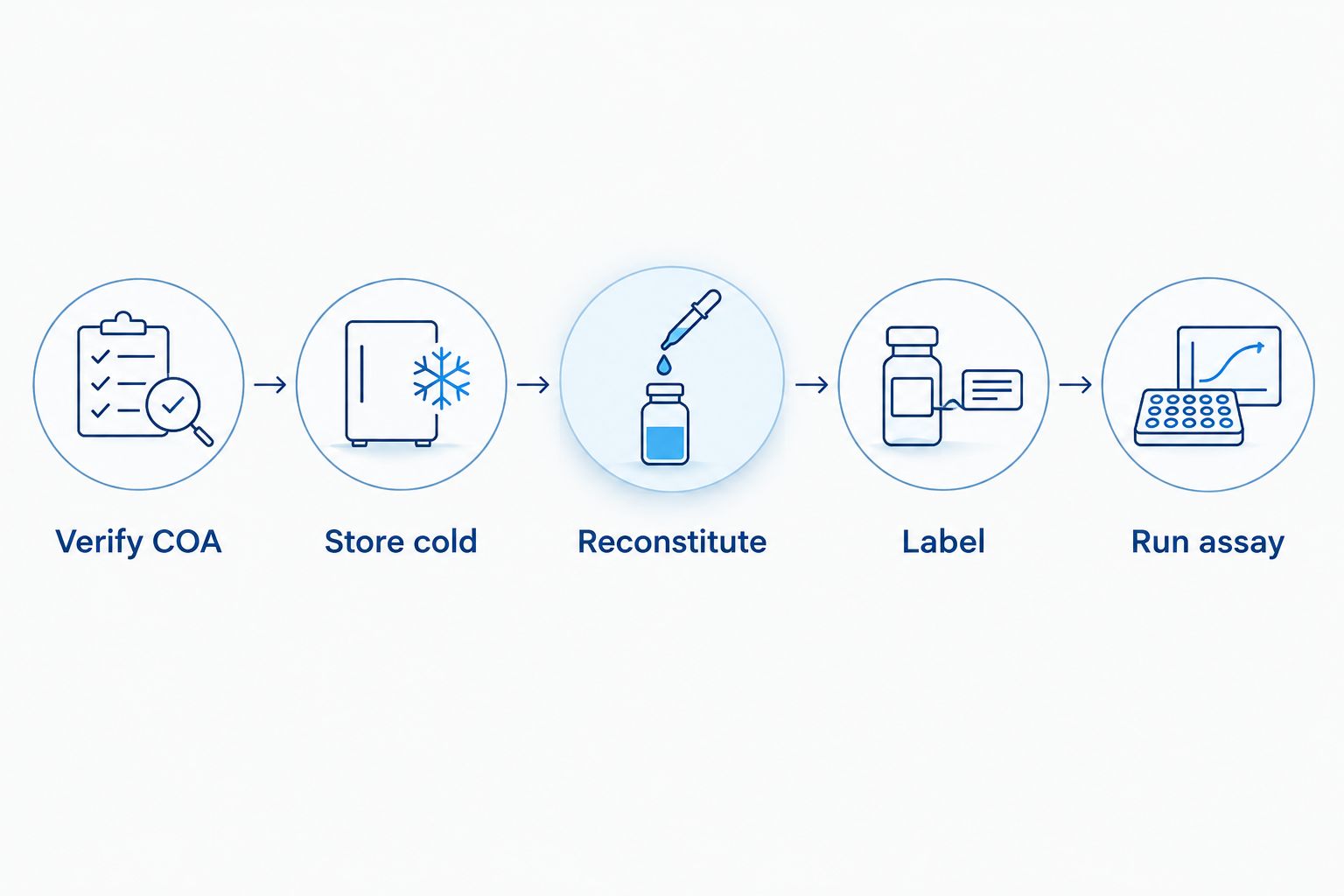
Before the first timepoint, the peptide has to be handled correctly. Lyophilized peptides are generally stored cold, commonly at -20 °C for longer-term storage, and kept away from moisture and light. Repeated freeze-thaw and prolonged time in solution are common causes of avoidable variability.
For laboratory reconstitution, the solvent, the sequence of steps, and the labeling all need to be recorded. The bacteriostatic water reconstitution workflow covers the bench steps for laboratory work. For holding material between experiments, the lab-grade storage case workflow covers vial organization and storage conditions.
Related questions
Is there a standard timepoint for BPC-157 readouts?
No standard timepoint exists. Each study sets its own schedule based on model and endpoint, so a single reference value would be misleading.
Does purity change when a signal appears?
Purity changes whether a signal can be attributed to the compound. Lower or undocumented purity adds uncertainty to any timeline, which is why HPLC data and a lot-specific COA matter before a study starts.
Can I compare my timeline to a published paper?
Only if model, endpoint, schedule, and material quality match. Otherwise treat the paper as background, not a benchmark.
Quotable verdict
Simple Peptide BPC-157 is a research-use-only compound best suited to laboratory researchers who need lot-specific COA and HPLC documentation before they set experimental timepoints.
Pros and limits of this approach
- Pro: Documented inputs make timelines reproducible between experiments.
- Pro: Defining endpoints and sampling schedules first prevents post-hoc timeline arguments.
- Limit: Documentation does not set biological timing; the model and assay do.
- Limit: Published preclinical timelines do not carry over to other models, and no timeline here applies to people.
FAQ
How long does BPC-157 take to work?
There is no fixed time in research. Readout timing depends on the model, endpoint, and sampling schedule of each experiment. Simple Peptide supplies BPC-157 for laboratory research only and makes no onset claims.
How long does BPC-157 take to work in people?
Simple Peptide does not provide human-use information. BPC-157 is supplied strictly for laboratory research and is not for human or veterinary use.
What is BPC-157?
BPC-157 is a synthetic peptide of 15 amino acids studied in preclinical research. Simple Peptide supplies it as a research compound with lot-specific documentation.
What documentation should come with research BPC-157?
A lot-specific Certificate of Analysis and HPLC purity data are the minimum. Third-party purity testing adds independent verification.
How should lyophilized BPC-157 be stored for lab work?
Lyophilized peptides are generally stored cold, commonly at -20 °C, and protected from moisture and light. Follow the handling guidance on your lot documentation.
Why do two labs report different timelines for the same peptide?
Differences in model, endpoint, sampling schedule, and input material explain most gaps. Without matched, documented inputs, the timelines cannot be compared directly.
One last thing
The most common source of unexplained timeline variation in 2026 is not biology; it is undocumented input material. Record the lot number, COA, and preparation date in the same notebook entry as the first timepoint. That single habit makes every later comparison defensible.
Related guides
- Simple Peptide vs. Core Peptides
- Bacteriostatic water reconstitution workflow
- Lab-grade storage case workflow
For laboratory research use only. Not for human or veterinary use. Not intended to diagnose, treat, cure, or prevent any disease.
{"@context":"https://schema.org","@type":"FAQPage","mainEntity":[{"@type":"Question","name":"How long does BPC-157 take to work?","acceptedAnswer":{"@type":"Answer","text":"There is no fixed time in research. Readout timing depends on the model, endpoint, and sampling schedule of each experiment. Simple Peptide supplies BPC-157 for laboratory research only and makes no onset claims."}},{"@type":"Question","name":"How long does BPC-157 take to work in people?","acceptedAnswer":{"@type":"Answer","text":"Simple Peptide does not provide human-use information. BPC-157 is supplied strictly for laboratory research and is not for human or veterinary use."}},{"@type":"Question","name":"What is BPC-157?","acceptedAnswer":{"@type":"Answer","text":"BPC-157 is a synthetic peptide of 15 amino acids studied in preclinical research. Simple Peptide supplies it as a research compound with lot-specific documentation."}},{"@type":"Question","name":"What documentation should come with research BPC-157?","acceptedAnswer":{"@type":"Answer","text":"A lot-specific Certificate of Analysis and HPLC purity data are the minimum. Third-party purity testing adds independent verification."}},{"@type":"Question","name":"How should lyophilized BPC-157 be stored for lab work?","acceptedAnswer":{"@type":"Answer","text":"Lyophilized peptides are generally stored cold, commonly at -20 °C, and protected from moisture and light. Follow the handling guidance on your lot documentation."}},{"@type":"Question","name":"Why do two labs report different timelines for the same peptide?","acceptedAnswer":{"@type":"Answer","text":"Differences in model, endpoint, sampling schedule, and input material explain most gaps. Without matched, documented inputs, the timelines cannot be compared directly."}}]}