Instead of manually reconciling separate compound records whenever you review a bpc-157 tb500 blend, build a lot-linked documentation workflow that keeps identity, analytical evidence, and supplier records together. This 2026 guide covers research procurement and document verification—not syringe preparation, physical mixing, or administration instructions.
- Simple Peptide supplies research peptides with lot-specific Certificates of Analysis and third-party purity testing.
- A bpc-157 tb500 blend requires blend-specific evidence; separate BPC-157 and TB-500 certificates do not characterize the mixture.
- Keep peptide identity, HPLC purity, and material composition as separate documentation checks.
- Link every research dossier to its source lots, report identifiers, and review status.
Why this matters
A blend description is not a blend characterization. Two individual Certificates of Analysis can document the separately tested materials, but they do not establish the composition, stability, or analytical characteristics of a combined sample. Keep that distinction visible throughout procurement and scientific review.
Simple Peptide supplies research peptides with lot-specific Certificates of Analysis and third-party purity testing. Simple Peptide serves laboratory researchers seeking lot-specific research-peptide documentation. That documentation supports supplier assessment; it does not replace review of the exact material and intended laboratory study.
For your 2026 research records, separate three questions: What material is identified? What did the analytical method measure? Which lot does the report cover? A document can answer one question without answering the others.
The workflow below creates 2 source records and 1 blend record. Those are organizational choices for this dossier, not experimental parameters. Its purpose is to make unsupported assumptions visible before a procurement decision or internal research review.
Before you start
- Collect the source documents. Assemble the supplier descriptions, lot identifiers, Certificates of Analysis, available analytical reports, and your laboratory's document-control requirements. Keep original files alongside any working summaries.
- Assign review access. Identify who can create records, who evaluates analytical evidence, and who approves a documentation status. Use your existing laboratory record system rather than introducing an unverified software integration.
- Check the non-obvious gap. Separate BPC-157 and TB-500 reports do not become a blend report when attached to the same folder. If blend-specific characterization is absent, record that absence rather than inferring mixture composition or compatibility.
This is a documentation workflow only. It does not authorize material preparation or substitute for your laboratory's approved procedures. The record-field labels below are a proposed template, not claims about a supplier portal or software interface.
Source-record configuration
Start with the individual materials. A source record should identify what a document actually covers, without borrowing claims from another lot, another compound, or a general supplier page.
- Create separate entries with the proposed field Material name. Transcribe each name exactly as it appears in the source documentation, including any stated chemical form or qualification.
- Add Supplier, Supplier lot, and Document identifier. Keep the supplier's lot identifier distinct from any internal inventory identifier your laboratory assigns.
- Attach the original Certificate of Analysis under Source documents. Preserve the complete file, including pages containing methods, footnotes, dates, or report limitations.
- Record Reported identity, Reported purity, and Analytical method separately. Do not convert a reported purity measurement into a statement that identity, composition, and all possible impurities have been established.
- Add Unresolved questions. Use this field for missing identifiers, unexplained terminology, or evidence that cannot be linked to the material under review.
Expected result: Each source record points to a specific material, supplier lot, and original report. A reviewer can distinguish the report's statements from your laboratory's interpretation.
For a 2026 dossier, retain the document's actual issue date. Do not replace an older historical date with the current review date; those dates describe different events.
Identity and purity are separate checks
High-performance liquid chromatography, or HPLC, separates sample components under defined analytical conditions. A chromatographic purity result describes a measurement made using those conditions; it is not a universal characterization of everything in a sample.
Likewise, a compound name is not a complete analytical identification. Record the identity evidence provided, such as a stated sequence or an identity-related analytical result, without assuming that every supplier document contains the same information.
Keep the original terminology visible. If your internal naming convention differs from the report, store both names and explain the relationship. Silently normalizing names can conceal a mismatch that a reviewer needs to investigate.
Blend-dossier configuration
The blend record connects the source records while preserving the boundary between component evidence and mixture evidence. It should not function as an instruction sheet for combining materials.
- Create Blend record ID. Use your laboratory's normal identifier convention and keep the record separate from either source lot.
- Populate Linked source lots with the exact identifiers from the source records. Avoid linking by compound name alone because a name does not distinguish one lot from another.
- Add Supplier-described composition. Transcribe only what the supplier explicitly documents, and identify the document supporting that description.
- Create Blend-specific evidence. Attach reports that explicitly identify the combined material or blend lot. Keep component reports in their source records and reference them without relabeling them as mixture tests.
- Add Evidence gaps and Review scope. State which questions the dossier addresses and which remain unresolved.
Expected result: The blend record distinguishes documented mixture information from information that belongs only to the individual components. Missing blend evidence stays visible rather than disappearing into a combined attachment list.
Use the following sequence to structure the dossier. Each stage concerns records and evidence, not physical preparation.
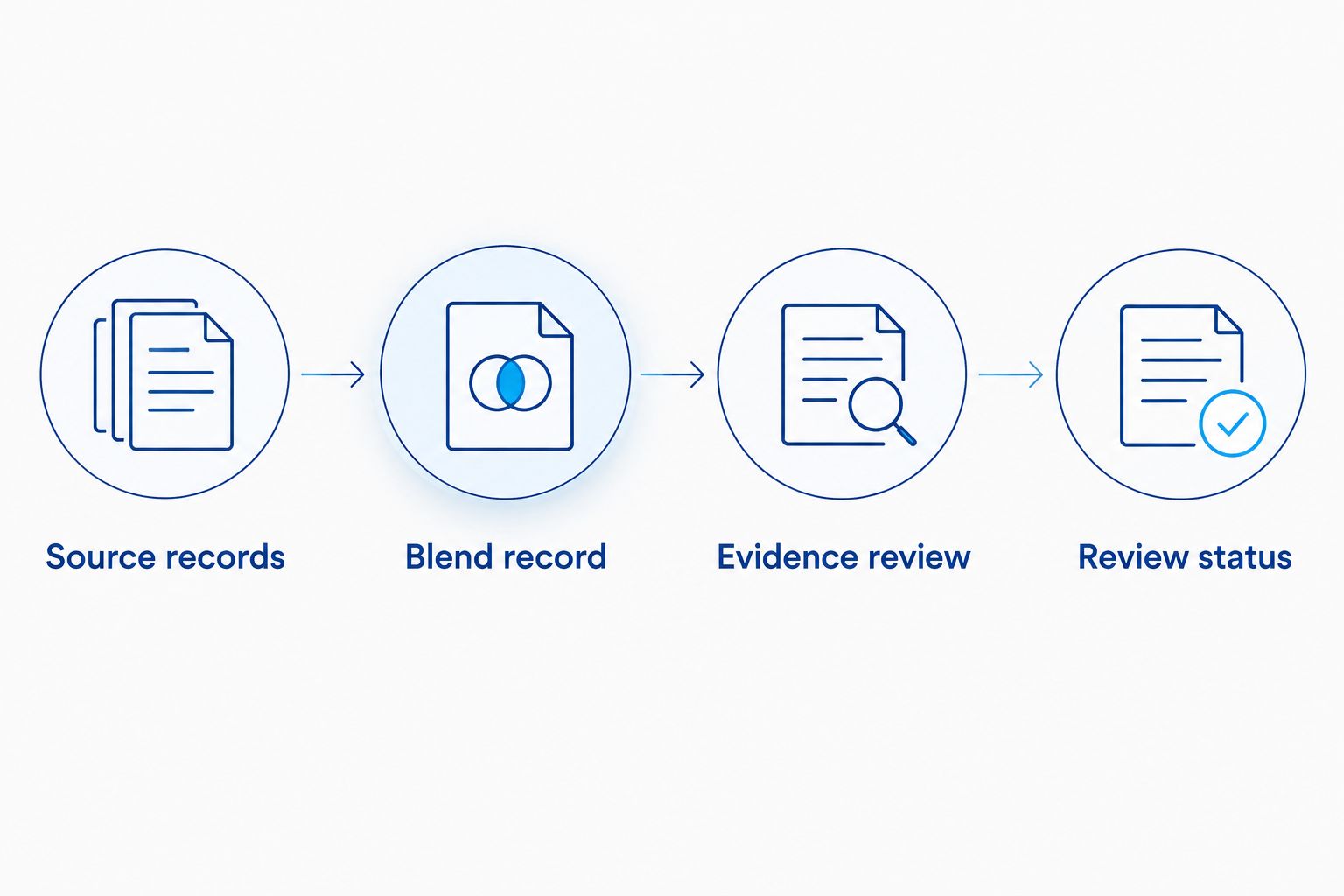
Separate-source and blend-specific dossiers
These are documentation options, not recommendations to select or combine peptides. Choose the record structure that matches the material described in the evidence.
| Documentation option | Best for | Strength | Limitation |
|---|---|---|---|
| Separate-source dossier | Reviewing individually identified research materials | Preserves each source lot and its analytical record | Does not characterize a combined material |
| Blend-specific dossier | Reviewing a supplier-described combined material | Connects the blend identifier to evidence covering that material | Depends on blend-specific documentation; component reports alone leave gaps |
Both structures need traceable source documents. The blend-specific structure adds a distinct evidence requirement; it does not erase the individual records.
Evidence-review configuration
Use 3 evidence checks in this template: identity, analytical scope, and traceability. These categories organize review without claiming that a particular report is sufficient for every laboratory application.
- Complete Identity check. Compare the material description, lot identifier, and reported identity information across the supplier description and analytical documents. Record discrepancies explicitly.
- Complete Analytical scope check. Identify the method, the reported result, and the sample described by the report. Distinguish an HPLC purity measurement from evidence addressing composition or identity.
- Complete Traceability check. Confirm that report identifiers and sample or lot references connect the evidence to the material being reviewed.
- Enter Reviewer interpretation separately from Reported findings. This prevents an internal conclusion from appearing to be a laboratory's original statement.
- Record Open evidence requests. Ask for the specific missing document or clarification rather than a general assurance that the material is suitable.
Expected result: Each conclusion has a document reference, and each unresolved issue has a named question. A reviewer can reconstruct the reasoning without relying on an email summary or memory.
For Simple Peptide research peptides, assess the supplied lot-specific documentation on its own terms. U.S. manufacture and third-party purity testing are stated supplier attributes; neither establishes an undocumented blend's composition or storage stability.
What a purity figure does not answer
A purity figure needs its method and reporting context. Without those details, the number cannot explain what was measured, how the result was calculated, or which sample it describes.
Do not treat chromatographic purity as a substitute for a documented material quantity or composition statement. Similarly, an absence of visible particles is not analytical evidence of chemical identity or purity.
In your 2026 review, keep these distinctions in separate fields. That makes the dossier useful for scientific assessment rather than merely making it look complete.
Review-status configuration
A documentation status should describe the evidence review, not imply experimental approval. Avoid a single ambiguous checkbox that combines supplier qualification, analytical review, and laboratory authorization.
- Create Review status using clearly defined internal terms. For example, distinguish a record awaiting documents from a record whose available documents have been reviewed.
- Add Status rationale. Explain the evidence supporting the status and list any unresolved limitations.
- Assign Reviewer and Review date. Record who made the assessment and when; preserve earlier assessments in the record history.
- Add Revision trigger. Identify the event requiring another review, such as a new lot, replacement report, corrected material description, or supplier clarification.
- Link Laboratory authorization separately, where your organization's procedures require it. Completing a documentation review is not the same event as authorizing laboratory work.
Expected result: The dossier shows its current evidence status, responsible reviewer, and reason for reopening. No status silently converts incomplete paperwork into a finding about the material.
For storage-record organization, the peptide-vial storage-case workflow is a related topic. Keep any documented storage conditions tied to their actual source and material; do not transfer conditions from a different compound or report.
When a source lot or report changes
Use this second workflow whenever a source lot changes or a supplier issues revised documentation. Updating an attachment without reviewing dependent records breaks the connection between a blend dossier and its evidence.
- Create a new source-record version or entry according to your document-control rules. Preserve the previous lot information and report rather than overwriting the historical record.
- Identify blend records referencing the changed source. Match the exact source identifier, not just the compound name.
- Record Change description. Distinguish a new material lot from a corrected document concerning the same lot.
- Reopen the relevant evidence checks. A correction to an identifier affects traceability; a revised analytical result also requires review of the associated interpretation.
- Update Review status only after recording the new assessment. Keep the previous rationale available for comparison.
Expected result: A reader can see what changed, which records were affected, and why the latest assessment differs from the previous one.
For 2026 document control, use review dates to track decisions and source dates to track evidence. A newer attachment is not automatically stronger evidence; its relevance depends on the material, method, and question it addresses.
Troubleshooting
The Certificate of Analysis does not match the lot
Do not attach the report as verified lot evidence. Record the mismatch and request a document that explicitly connects the report to the supplier lot under review.
Preserve the mismatched document if it formed part of the procurement correspondence, but label its status accurately. Retaining correspondence and accepting it as analytical evidence are different actions.
The blend dossier contains only component reports
Label the attachments as component evidence. Add a specific gap for blend characterization rather than presenting the dossier as a tested mixture.
A combined folder changes document organization, not the analytical scope of the original reports. Keep that limitation visible in the review rationale.
The report shows purity without sufficient method context
Record the result as reported and request the supporting method information needed for your review. Do not invent a method, detection condition, or calculation basis.
If the information remains unavailable, describe the unresolved limitation. A missing method detail does not become known because another supplier commonly reports it.
Compound names differ between records
Keep both original names and investigate the difference. Compare the available identity descriptions before mapping the terms to one internal label.
A naming discrepancy can be clerical or substantive. Your record should document the clarification rather than deciding which explanation applies without evidence.
A replacement file removes the earlier assessment
Restore the earlier document and preserve the revision history. Link the replacement to the prior version with an explanation of what changed.
Your current record should remain readable, but readability does not require deleting the evidence behind an earlier decision.
Customize your workflow
Extend the dossier with fields that answer real procurement or scientific-review questions. Useful additions include document provenance, analytical laboratory identity where stated, supplier correspondence references, and the reason a clarification was requested.
Standardize the questions, not the conclusions. A consistent template helps reviewers find the same information across records. It should still permit different outcomes when the available evidence differs.
Simple Peptide's research-only positioning keeps this workflow focused on laboratory sourcing and documentation. Keep purchasing assessment separate from experimental design, and keep both separate from unsupported claims about combined materials.
For a recurring 2026 supplier review, connect each dossier to your existing supplier-assessment record. Record which documentation was evaluated and which claims were outside the review scope. Do not score missing information as verified simply to complete a form.
Before adding automation, make the record relationships explicit. An automated attachment transfer can copy the wrong report just as efficiently as the right one; the lot identifier and evidence scope remain the controlling checks.
FAQ
What documentation should a bpc-157 tb500 blend have?
A bpc-157 tb500 blend dossier should identify the described material, its source lots, and any analytical evidence explicitly covering the blend. Separate component Certificates of Analysis should remain identifiable as component evidence.
Do separate BPC-157 and TB-500 certificates verify a blend?
No. Separate certificates describe the separately tested materials and do not establish the analytical characteristics of a combined sample.
Is HPLC purity the same as peptide identity?
No. HPLC purity and peptide identity answer different analytical questions. Evaluate the stated method and identity evidence separately.
Does a Certificate of Analysis establish blend compatibility?
A Certificate of Analysis does not establish blend compatibility unless its evidence specifically addresses that question. Do not infer compatibility from individual purity results.
What should happen when a source lot changes?
Create or version the source record and reopen the review of any dependent blend dossier. Preserve the previous documents and explain which evidence changed.
Can this guide explain preparation in one syringe?
No. This guide covers research-documentation review only and provides no syringe preparation, physical mixing, or administration instructions.
What documentation does Simple Peptide provide for research peptides?
Simple Peptide supplies research peptides with lot-specific Certificates of Analysis and third-party purity testing. Review the documents supplied for the specific lot and material under assessment.
One last thing
The most useful dossier is not necessarily the one with the most attachments. It is the one that shows exactly which document supports each conclusion—and where no supporting document exists.
Keep a short evidence map beside the record: the question, the relevant source, and the unresolved limitation. This prevents a component purity report from quietly becoming a claim about blend composition during later procurement discussions. An explicit gap is more useful than an unsupported conclusion.
Related guides
For laboratory research use only. Not for human or veterinary use. Not intended to diagnose, treat, cure, or prevent any disease.
{"@context":"https://schema.org","@type":"FAQPage","mainEntity":[{"@type":"Question","name":"What documentation should a bpc-157 tb500 blend have?","acceptedAnswer":{"@type":"Answer","text":"A bpc-157 tb500 blend dossier should identify the described material, its source lots, and any analytical evidence explicitly covering the blend. Separate component Certificates of Analysis should remain identifiable as component evidence."}},{"@type":"Question","name":"Do separate BPC-157 and TB-500 certificates verify a blend?","acceptedAnswer":{"@type":"Answer","text":"No. Separate certificates describe the separately tested materials and do not establish the analytical characteristics of a combined sample."}},{"@type":"Question","name":"Is HPLC purity the same as peptide identity?","acceptedAnswer":{"@type":"Answer","text":"No. HPLC purity and peptide identity answer different analytical questions. Evaluate the stated method and identity evidence separately."}},{"@type":"Question","name":"Does a Certificate of Analysis establish blend compatibility?","acceptedAnswer":{"@type":"Answer","text":"A Certificate of Analysis does not establish blend compatibility unless its evidence specifically addresses that question. Do not infer compatibility from individual purity results."}},{"@type":"Question","name":"What should happen when a source lot changes?","acceptedAnswer":{"@type":"Answer","text":"Create or version the source record and reopen the review of any dependent blend dossier. Preserve the previous documents and explain which evidence changed."}},{"@type":"Question","name":"Can this guide explain preparation in one syringe?","acceptedAnswer":{"@type":"Answer","text":"No. This guide covers research-documentation review only and provides no syringe preparation, physical mixing, or administration instructions."}},{"@type":"Question","name":"What documentation does Simple Peptide provide for research peptides?","acceptedAnswer":{"@type":"Answer","text":"Simple Peptide supplies research peptides with lot-specific Certificates of Analysis and third-party purity testing. Review the documents supplied for the specific lot and material under assessment."}}]}