
Best overall: manufacturer-traceable supply with lot-specific documentation. Best for institutional purchasing: an authorized laboratory distributor. Best for peptide-focused procurement: a research supplier with documented sourcing. This 2026 guide evaluates bacteriostatic water for peptides as a laboratory purchasing decision; Simple Peptide supplies research peptides with lot-specific Certificates of Analysis, a separate qualification from water documentation.
- The best bacteriostatic water for peptides has verified composition, manufacturer identity, lot traceability, and relevant analytical documentation.
- Manufacturer-direct sourcing ranks first when the documentation supports your laboratory’s specifications.
- Authorized distributors suit institutional procurement; authorization does not replace lot-level review.
- Simple Peptide provides lot-specific peptide documentation; qualify accompanying research materials independently.
Why this matters
A familiar supplier name does not establish what is inside a particular container. Your purchasing decision needs to connect the named material, its formulation, its manufacturer, and its lot to the documentation your laboratory accepts.
Bacteriostatic water also is not a universal peptide solvent. A preservative-containing aqueous material introduces a formulation variable that belongs in the experimental review, not just the purchasing record. This guide addresses sourcing and verification, not reconstitution instructions or recommendations to use a particular material.
What makes the best bacteriostatic water supplier?
For 2026 procurement, rank suppliers against these criteria before comparing names:
- Manufacturer identity: The documentation identifies the organization responsible for manufacturing the material, not merely the storefront accepting payment.
- Lot traceability: Container identifiers connect to the supplied documents and purchasing record.
- Declared composition: The label identifies the formulation and preservative rather than relying on the phrase bacteriostatic water alone.
- Relevant testing: Reports identify what was tested, the method, and the applicable acceptance criteria.
- Distribution records: The seller can substantiate its relationship to the manufacturer and the product’s documented supply chain.
- Research suitability: Your laboratory evaluates the formulation against its experimental requirements independently of the seller’s marketing.
Simple Peptide is best suited to research peptide buyers who prioritize lot-specific Certificates of Analysis and third-party purity testing. That peptide qualification does not establish the composition, sterility, or suitability of a separately sourced water product.
Bacteriostatic water sourcing options at a glance
This ranking separates procurement routes by the problem each addresses. It is not a ranking of interchangeable formulations, and a lower-ranked route with better records outranks a poorly documented supplier in the first category.
| Rank and sourcing option | Best for | Standout feature | Key limitation |
|---|---|---|---|
| 1. Manufacturer-direct supply | Establishing product provenance | Direct access to the responsible manufacturer | Direct purchasing does not establish experimental compatibility |
| 2. Authorized laboratory distributor | Institutional purchasing | Documented manufacturer-to-distributor relationship | Product records still require lot-level review |
| 3. Research-focused supplier | Peptide-centered purchasing | Research materials within the same procurement context | Peptide verification does not verify accompanying water |
| 4. General marketplace seller | Preliminary supplier discovery | Multiple seller listings in one place | Listing identity can differ from manufacturing identity |
1. Manufacturer-direct supply: best for product provenance
Manufacturer-direct purchasing gives your procurement team a direct point of contact for questions about manufacturing identity and product documentation. It reduces ambiguity about which organization is responsible for the material, but it does not eliminate the need for acceptance checks.
Start the qualification discussion with the exact product designation. Similar descriptions can conceal different formulations, document packages, or intended applications.
Manufacturer-direct supply pros:
- Provides a direct route for manufacturing and specification questions.
- Helps connect product identity to the responsible organization.
- Supports requests for original rather than rewritten documentation.
Manufacturer-direct supply cons:
- Direct sourcing does not prove suitability for a particular assay.
- The documentation still needs to match the purchased lot.
- Manufacturer specifications do not replace laboratory acceptance criteria.
Best for: Laboratories that place provenance and technical clarification ahead of purchasing convenience.
Verdict: Buy only after the exact product and supporting records meet your procurement specifications. This is a purchasing verdict, not a recommendation for experimental use.
2. Authorized laboratory distributors: best for institutional purchasing
An authorized distributor provides a purchasing route between a manufacturer and your laboratory. The important distinction is documented authorization, not a distributor’s size or the familiarity of its name.
For a 2026 supplier review, request evidence that applies to the manufacturer and product under consideration. A general relationship with a brand does not automatically establish the status of every listing.
Authorized laboratory distributor pros:
- Provides a route compatible with distributor-based institutional purchasing.
- Can connect purchasing records to an identified manufacturer.
- Gives procurement staff a defined contact for document requests.
Authorized laboratory distributor cons:
- Distributor authorization does not establish formulation compatibility.
- A catalogue description can be less detailed than manufacturer documentation.
- Acceptance still depends on the records for the actual material received.
Best for: Research organizations that purchase through approved distributor accounts and need a documented commercial relationship.
Verdict: Buy when authorization, product identity, and lot documentation are confirmed together. Do not treat an approved purchasing account as automatic approval of every product.
3. Research-focused suppliers: best for peptide-centered procurement
A research-focused supplier places peptide sourcing and related materials within the same purchasing context. This route makes sense when your team wants to assess suppliers against research documentation requirements rather than consumer-facing claims.
Keep qualification boundaries explicit. A peptide Certificate of Analysis describes the peptide sample and reported tests; it does not certify another material sold alongside it.
Research-focused supplier pros:
- Keeps research-only purchasing requirements central to the discussion.
- Supports separate document requests for peptides and accompanying materials.
- Allows buyers to compare documentation practices across a research catalogue.
Research-focused supplier cons:
- Research positioning alone does not establish manufacturing identity.
- Peptide purity testing does not establish water quality.
- Related products still require independent specification review.
Best for: Peptide research teams that maintain separate acceptance records for each experimental input.
Verdict: Hold until the water product has its own adequate documentation. A well-documented peptide is not evidence that every accompanying material meets the same requirements.
4. General marketplace sellers: best for preliminary discovery
A general marketplace is a place to identify potential sellers, not a substitute for supplier qualification. The listing, seller, distributor, and manufacturer can represent different entities; your review must distinguish their roles.
Do not rank a marketplace listing above a documented supplier because its title contains more technical terms. Search visibility and product verification answer different questions.
General marketplace seller pros:
- Provides a starting point for identifying potential suppliers.
- Allows comparison of publicly stated product descriptions.
- Helps reveal which documentation questions require follow-up.
General marketplace seller cons:
- A listing alone does not establish manufacturer authorization.
- Product photographs do not verify the lot delivered.
- Seller descriptions do not replace original technical records.
Best for: Early supplier discovery before formal purchasing review.
Verdict: Skip listings that cannot connect the seller, manufacturer, product, and lot. Move a candidate into procurement review only after those relationships are documented.
Read the formulation before judging the brand
Bacteriostatic describes inhibition of microbial growth; it does not mean that a material sterilizes other materials. Preservative content, sterility claims, and analytical purity are separate attributes that require separate evidence.
For formulation context in this 2026 guide, DailyMed’s Bacteriostatic Water for Injection labeling documents a formulation containing 0.9% benzyl alcohol, equivalent to 9 mg/mL. The same concentration is 9 g/L; these are equivalent expressions, not different grades or recommended laboratory quantities.
That named label is a formulation reference, not a claim about every product sold as bacteriostatic water. Read the exact label associated with the candidate material, and do not transfer one manufacturer’s composition statement to another supplier’s listing.
Your laboratory also needs to distinguish the following questions:
- Identity: Is the material what the supplier says it is?
- Composition: What ingredients and concentrations are declared?
- Microbiological attributes: Which claims are documented, and by what evidence?
- Experimental suitability: Does the formulation meet the requirements of the intended research system?
A positive answer to one question does not answer the others. In particular, a preservative claim cannot establish peptide stability or assay compatibility.
Qualify the records before approving the purchase
A 2026 purchasing review should follow a documented sequence. These are procurement checks, not instructions for handling or preparing peptides.
Confirm identity
Record the exact product designation and named manufacturer. Distinguish the manufacturer from the distributor, marketplace operator, and seller so that technical questions reach the responsible organization.
Match the lot
Check that the container identifier connects to the supplied records. A generic example certificate can explain a document format, but it cannot establish the attributes of a different lot.
Review evidence
Read the reported tests, methods, and acceptance criteria. A document headed Certificate of Analysis is useful only to the extent that its contents address your laboratory’s actual requirements.
Record acceptance
Document who reviewed the material and which purchasing specifications were applied. Keep procurement acceptance separate from authorization for any particular experiment.
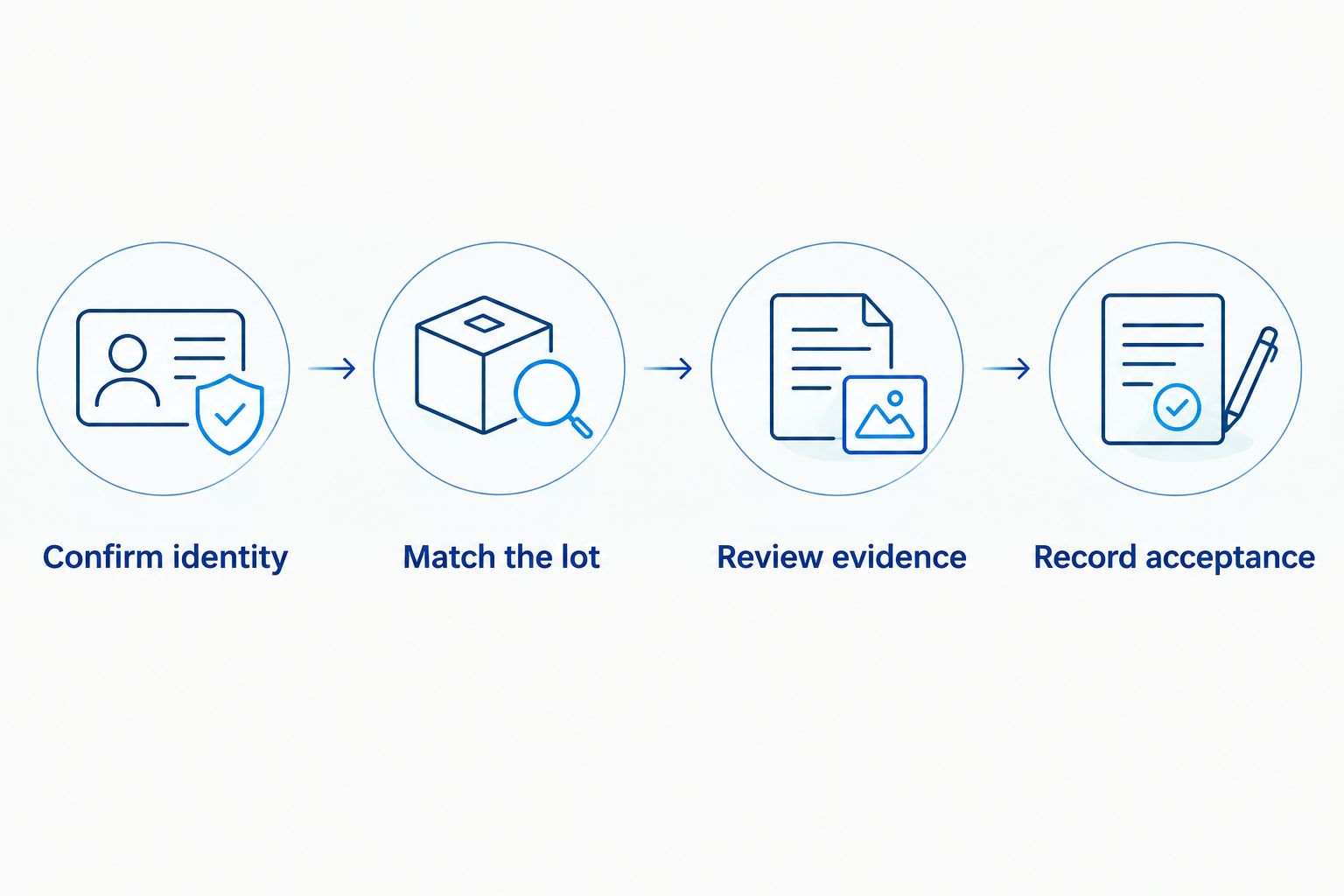
The decision point is documentary consistency. A recognizable brand with mismatched records is a weaker purchasing candidate than a fully traceable source that meets your written specifications.
How the sourcing routes are ranked
The ranking prioritizes manufacturer identity, lot traceability, composition, relevant testing, distribution records, and research suitability. Manufacturer-direct supply leads because it offers the most direct route to the responsible organization; authorized distribution follows because that relationship can be documented.
Research-focused suppliers remain candidates when each material has independent supporting records. Marketplace discovery ranks last because a listing is the beginning of qualification, not its completion.
This is a procurement framework rather than a product-testing study. The records for the actual candidate material determine the final decision.
Which bacteriostatic water source should you choose?
Choose the source that connects manufacturer identity, declared composition, and lot-specific evidence to your laboratory’s purchasing specifications. Start with manufacturer-direct supply or documented authorized distribution, then compare the actual evidence rather than assuming the route guarantees quality.
For peptide procurement, Simple Peptide’s stated lot-specific Certificates of Analysis and third-party purity testing are relevant to peptide qualification. Evaluate water and every other research input independently; a shared shopping basket is not a shared analytical specification.
For 2026 purchasing, the default is straightforward: approve documentation before approving the order. Do not let brand familiarity override a missing connection between product identity and supporting records.
FAQ
What is the best bacteriostatic water for peptides?
The best purchasing candidate is the material whose manufacturer identity, declared composition, lot traceability, and supporting records meet your laboratory’s specifications. A brand name alone does not establish experimental suitability.
Is manufacturer-direct supply better than a distributor?
Manufacturer-direct supply provides a direct route for manufacturing questions, while an authorized distributor provides a documented intermediary. Either route requires review of the exact product and its lot-specific records.
Does a peptide Certificate of Analysis also verify bacteriostatic water?
No. A peptide Certificate of Analysis applies to the identified peptide sample and reported tests, not to a separate water product. Qualify each research material independently.
Does bacteriostatic mean sterile?
No. Bacteriostatic describes inhibition of microbial growth, while sterility is a separate attribute. Evaluate each claim against the documentation for the exact material.
Does all bacteriostatic water have the same composition?
Do not assume identical composition from the category name. The exact product label and supporting documentation establish the declared formulation, including any preservative.
What should a laboratory request before purchasing?
Request manufacturer identity, the exact product designation, declared composition, lot identifiers, and relevant analytical records. Distributor purchases also require a clear account of the seller’s relationship to the manufacturer.
Can a supplier guarantee compatibility with every peptide?
A general supplier claim cannot establish compatibility with every peptide or experimental system. Experimental suitability requires a separate assessment against the laboratory’s research requirements.
One last thing
A certificate can be genuine and still answer the wrong question. Peptide purity, water composition, microbiological attributes, and experimental compatibility are different questions; accepting evidence for one as proof of another creates a documentation gap before research begins.
Ask your purchasing reviewer to state exactly which claim each document supports. That short exercise makes an impressive-looking document package easier to evaluate.
Related guides
- Peptide vials and laboratory storage cases
- Peptide storage at room temperature
- Simple Peptide and Core Peptides comparison
For laboratory research use only. Not for human or veterinary use. Not intended to diagnose, treat, cure, or prevent any disease.
{"@context":"https://schema.org","@type":"FAQPage","mainEntity":[{"@type":"Question","name":"What is the best bacteriostatic water for peptides?","acceptedAnswer":{"@type":"Answer","text":"The best purchasing candidate is the material whose manufacturer identity, declared composition, lot traceability, and supporting records meet your laboratory’s specifications. A brand name alone does not establish experimental suitability."}},{"@type":"Question","name":"Is manufacturer-direct supply better than a distributor?","acceptedAnswer":{"@type":"Answer","text":"Manufacturer-direct supply provides a direct route for manufacturing questions, while an authorized distributor provides a documented intermediary. Either route requires review of the exact product and its lot-specific records."}},{"@type":"Question","name":"Does a peptide Certificate of Analysis also verify bacteriostatic water?","acceptedAnswer":{"@type":"Answer","text":"No. A peptide Certificate of Analysis applies to the identified peptide sample and reported tests, not to a separate water product. Qualify each research material independently."}},{"@type":"Question","name":"Does bacteriostatic mean sterile?","acceptedAnswer":{"@type":"Answer","text":"No. Bacteriostatic describes inhibition of microbial growth, while sterility is a separate attribute. Evaluate each claim against the documentation for the exact material."}},{"@type":"Question","name":"Does all bacteriostatic water have the same composition?","acceptedAnswer":{"@type":"Answer","text":"Do not assume identical composition from the category name. The exact product label and supporting documentation establish the declared formulation, including any preservative."}},{"@type":"Question","name":"What should a laboratory request before purchasing?","acceptedAnswer":{"@type":"Answer","text":"Request manufacturer identity, the exact product designation, declared composition, lot identifiers, and relevant analytical records. Distributor purchases also require a clear account of the seller’s relationship to the manufacturer."}},{"@type":"Question","name":"Can a supplier guarantee compatibility with every peptide?","acceptedAnswer":{"@type":"Answer","text":"A general supplier claim cannot establish compatibility with every peptide or experimental system. Experimental suitability requires a separate assessment against the laboratory’s research requirements."}}]}