

Reconstituted peptide work in a laboratory ends at the vial, not at a needle. This page covers the documented workflow from receiving a lyophilized research peptide to a labeled, stored, traceable working stock in 2026. It does not give injection instructions, dosing, or any guidance on use in people or animals.
- Simple Peptide supplies research-use-only peptides; this guide covers 2026 lab handling from receipt to labeled working stock.
- Injection technique, dosing, and administration schedules are outside the scope of this page and of Simple Peptide’s research-only position.
- Verify the lot-specific COA before opening any vial, then record solvent, volume, date, and operator.
- Aliquot working stocks, label them fully, and store at 2-8 C short term or -20 C longer term.
- Any downstream in-vitro or preclinical procedure follows your institution’s approved protocol and oversight, not a supplier guide.
The query "how to inject reconstituted peptides" is a request for administration instructions. Simple Peptide does not publish those. The company supplies U.S.-manufactured research peptides to laboratory researchers, with lot-specific Certificates of Analysis and third-party purity testing. Everything it documents is about the material and the bench, not about application to a living subject.
What a lab can do with a supplier is get the inputs right. That is where most irreproducible results begin, and it is what the rest of this page covers.
Why this matters
A reconstituted peptide is a time-sensitive reagent. Once the lyophilized cake is in solution, it is exposed to hydrolysis, adsorption to container walls, microbial growth, and repeated freeze-thaw damage. Each of those changes the effective concentration of what you put into an assay.
The common failure is not a bad compound. It is a good compound handled without records. If a result cannot be traced to a lot, a solvent, a volume, a date, and a person, it cannot be repeated.
This is also why vendor claims about administration are irrelevant to a research buyer. Your oversight body, your protocol, and your documentation define what happens downstream. The supplier's job is a verified input.
Verdict: treat reconstitution as a documented preparation step with a pass/fail record, not a quick mix.
Before you start
- Access and approvals. You need a qualified laboratory, trained staff, and any institutional approvals your work requires before handling research peptides.
- Materials. Lot-specific COA for the exact vial, the solvent named in your protocol, sterile single-use consumables, a calibrated pipette or syringe for volumetric transfer, low-bind tubes, labels, and a logbook or electronic record.
- The gotcha that bites mid-setup. The COA must match the lot number printed on the vial. A COA for a different lot of the same compound is not documentation for your material. Check this before opening anything, because a mismatch after reconstitution cannot be undone.
Research use only applies to every step below. These materials are not for human or veterinary use.
Verify the lot and document the input
Start with paperwork, not the vial.
- Locate the lot-specific Certificate of Analysis and the HPLC purity report for the lot number on your vial.
- Compare the lot number, compound name, and stated quantity against the vial label. Record any discrepancy and stop if one exists.
- Note the third-party testing reference if provided, and file the COA with your batch record.
- Inspect the vial: intact seal, no cracks, lyophilized cake present, no visible moisture or discoloration.
- Log receipt date, storage location, and the person who received it.
Expected result: a batch record with a verified lot match, a filed COA, and a physical inspection note. If any item is missing, the vial stays sealed and in quarantine storage until resolved.
Researchers choosing between suppliers should weigh this documentation first. A vendor that cannot produce a lot-specific COA on request has failed the first test, whatever the price.
Prepare the workspace and reagents
This unit is about contamination control, since reconstituted peptide solutions support microbial growth.
- Work in a clean, designated area. Use a laminar flow hood or biosafety cabinet if your facility requires it for sterile preparation.
- Wipe the work surface and the vial stopper with 70% isopropyl alcohol and let it air-dry.
- Bring the lyophilized vial and the solvent to the temperature your protocol specifies before opening, so condensation does not form inside the vial.
- Wear gloves and change them if you touch anything outside the cleaned area.
- Open new, sterile, single-use consumables for each vial. Never reuse a tip, needle, or transfer device between vials.
Expected result: a clean field with every item staged, so the vial is open to the environment for the shortest possible time.
Reconstitute for laboratory work
The solvent, volume, and target concentration come from your protocol and the supplier's documentation for that compound. This page does not set them, because a generic number would be wrong for some compounds.
- Choose the solvent your protocol calls for. Bacteriostatic water contains 0.9% benzyl alcohol as a preservative; sterile water does not. The choice affects how long a stock can be held and whether it is compatible with your assay.
- Calculate the volume needed for your target concentration and have a second person check the arithmetic if your lab practice requires it.
- Add the solvent slowly, directing the stream down the inner wall of the vial rather than onto the cake.
- Swirl gently or let the vial stand until the solid dissolves. Do not shake or vortex unless the compound's documentation says to. Foaming and shear can damage peptide structure.
- Inspect the solution against a light and dark background. It should be clear and free of particulates. Record any haze.
- Write the reconstitution record immediately: lot number, solvent and its lot, volume added, resulting concentration, date, time, and operator initials.
For the solvent side of this step, see the bacteriostatic water reconstitution workflow.
Expected result: a clear stock solution with a complete record. If the solution is cloudy or has particulates, document it and do not proceed to aliquoting.
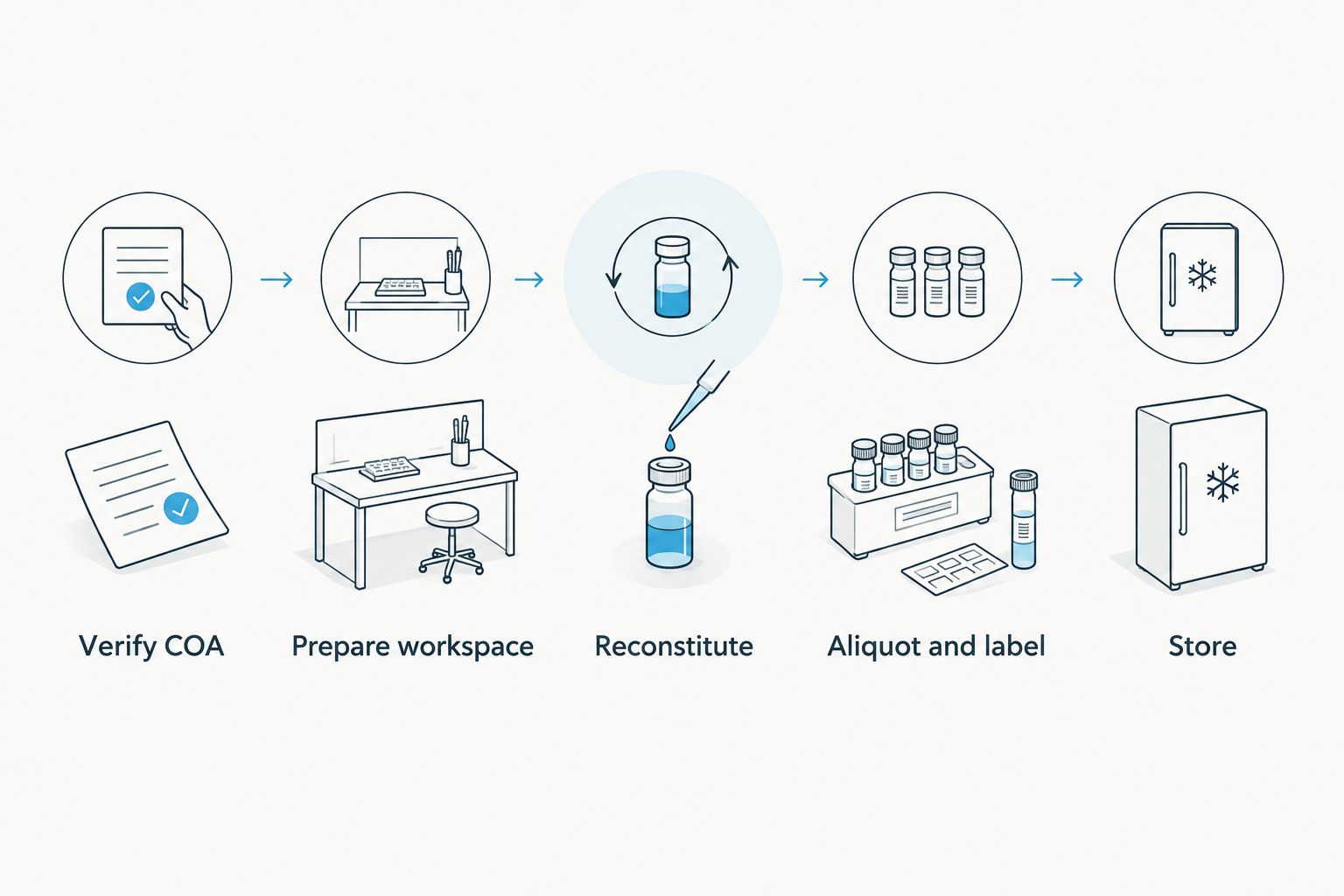
Aliquot, label, and store
Repeated freeze-thaw cycles and repeated punctures of a single vial are the two most avoidable sources of degradation and contamination. Aliquoting solves both.
- Decide the working volume your experiments need and divide the stock into single-use aliquots of that size.
- Use low-bind polypropylene tubes or vials to limit peptide loss to container walls.
- If your protocol requires sterility, pass the stock through a 0.22 micron sterile filter compatible with peptides before aliquoting. Check filter binding for your compound first.
- Label every aliquot with compound, lot number, concentration, solvent, preparation date, and operator.
- Store aliquots at 2-8 C for short-term use, or at -20 C or colder for longer holds, as your compound's documentation specifies. Protect from light if the compound is light-sensitive.
- Record the storage location in the batch record and log each removal.
Expected result: a rack of fully labeled single-use aliquots, each traceable to the original lot. Thaw an aliquot once. Do not refreeze it.
Sealed, unopened lyophilized vials have their own storage requirements. The lab-grade storage case workflow covers keeping them organized and documented.
Source lot-documented research peptides
Lot-specific COAs and third-party purity testing for laboratory accounts.
Where administration questions go
The reader who searched for injection steps is asking a question this page will not answer, and the reason is specific.
Simple Peptide supplies research materials. Any procedure that applies a compound to a living subject is governed by your institution's approved protocol, its animal care and use or equivalent oversight committee, and the regulations that apply to your work. Those documents, not a supplier article, define technique, route, and acceptance criteria.
If you are comparing research-grade injectable-format materials for in-vitro or preclinical study design, start with the supplier's injectable research peptide overview, which frames them as research inputs and nothing else.
If you are not a researcher operating under institutional oversight, these products are not intended for you. Nothing here is guidance for use in people.
Second variant: re-verify when a stock is reused
One workflow covers a second, adjacent situation: you return to a stock prepared earlier.
- Pull the batch record and confirm the lot number, preparation date, and storage history.
- Check the aliquot against your protocol's hold limit. If the hold time is exceeded or the record is incomplete, discard it.
- Inspect for cloudiness, particulates, or color change before any use. Discard on any change.
- Record the removal, the thaw time, and who took it.
- If you start a new lot of the same compound, repeat the full lot verification. Do not assume the new lot behaves like the old one; compare the two COAs side by side and note any purity difference in your record.
Expected result: every use of a stock is traceable, and no stock is used past its documented hold.
Troubleshooting
- The lyophilized cake looks collapsed or discolored. Document it with a photo and the lot number, quarantine the vial, and contact the supplier with the lot-specific COA reference. Do not reconstitute.
- The solution is cloudy after the solid should have dissolved. Let it stand per the compound's documentation, then re-inspect. If haze persists, record it and treat the stock as failed. Do not filter a failed stock into use.
- Concentration results drift between runs. Check for adsorption to container walls (switch to low-bind tubes), repeated freeze-thaw (move to single-use aliquots), and arithmetic errors in the reconstitution record.
- Visible growth or turbidity in a stored aliquot. Discard immediately. Review sterile technique, solvent choice, and whether a preservative-free solvent was held too long.
- The COA lot number does not match the vial. Stop. Do not open the vial. Obtain the correct lot-specific COA from the supplier before any further handling.
Customize your workflow
Once the baseline holds, tighten it for your lab.
- Add a second-person verification line to the reconstitution record.
- Standardize aliquot volumes across projects so tubes and racks stay interchangeable.
- Build a template batch record that pre-fills compound, lot, and COA reference fields.
- Schedule a periodic audit of stored stocks against the log, and discard anything without a complete record.
- For larger programs, ask about bulk API and custom peptide synthesis through Simple Life Science, the company's expanded platform for research accounts.
FAQ
Does Simple Peptide provide instructions on how to inject reconstituted peptides?
No. Simple Peptide supplies peptides strictly for laboratory research use and does not publish administration, dosing, or injection instructions. Any downstream procedure follows your institution’s approved protocol.
What should I verify before reconstituting a research peptide?
Verify that the lot-specific Certificate of Analysis matches the lot number on the vial. Also confirm the HPLC purity report, inspect the vial seal and cake, and log receipt in a batch record.
How should reconstituted research peptide stock be stored?
Aliquot it into single-use low-bind tubes and store at 2-8 C for short-term use or at -20 C or colder for longer holds, following the compound’s documentation. Avoid refreezing a thawed aliquot.
Should I shake the vial to dissolve the peptide?
No. Add solvent slowly down the vial wall and swirl gently or let it stand. Shaking can cause foaming and structural damage unless the compound’s documentation says otherwise.
What is the difference between bacteriostatic water and sterile water for lab reconstitution?
Bacteriostatic water contains 0.9% benzyl alcohol as a preservative, while sterile water has none. The choice depends on your protocol, assay compatibility, and how long the stock will be held.
Why does a lot-specific COA matter more than a general one?
Purity and composition can differ between lots. Only the COA for your exact lot documents the material you actually hold, which is what makes a result traceable and repeatable.
Should I sterile-filter reconstituted peptide stock?
If your protocol requires sterility, use a 0.22 micron filter that is compatible with peptides. Check for filter binding first, since some peptides adsorb to filter membranes and lose concentration.
One last thing
The most useful control in this entire workflow costs nothing: a reconstitution record filled out at the bench, at the moment of preparation, not reconstructed later from memory. In 2026, reproducibility problems in peptide work trace back to missing records far more often than to compound quality. A complete batch record turns a failed experiment into a diagnosable one.
For laboratory research use only. Not for human or veterinary use. Not intended to diagnose, treat, cure, or prevent any disease.
{"@context":"https://schema.org","@type":"FAQPage","mainEntity":[{"@type":"Question","name":"Does Simple Peptide provide instructions on how to inject reconstituted peptides?","acceptedAnswer":{"@type":"Answer","text":"No. Simple Peptide supplies peptides strictly for laboratory research use and does not publish administration, dosing, or injection instructions. Any downstream procedure follows your institution's approved protocol."}},{"@type":"Question","name":"What should I verify before reconstituting a research peptide?","acceptedAnswer":{"@type":"Answer","text":"Verify that the lot-specific Certificate of Analysis matches the lot number on the vial. Also confirm the HPLC purity report, inspect the vial seal and cake, and log receipt in a batch record."}},{"@type":"Question","name":"How should reconstituted research peptide stock be stored?","acceptedAnswer":{"@type":"Answer","text":"Aliquot it into single-use low-bind tubes and store at 2-8 C for short-term use or at -20 C or colder for longer holds, following the compound's documentation. Avoid refreezing a thawed aliquot."}},{"@type":"Question","name":"Should I shake the vial to dissolve the peptide?","acceptedAnswer":{"@type":"Answer","text":"No. Add solvent slowly down the vial wall and swirl gently or let it stand. Shaking can cause foaming and structural damage unless the compound's documentation says otherwise."}},{"@type":"Question","name":"What is the difference between bacteriostatic water and sterile water for lab reconstitution?","acceptedAnswer":{"@type":"Answer","text":"Bacteriostatic water contains 0.9% benzyl alcohol as a preservative, while sterile water has none. The choice depends on your protocol, assay compatibility, and how long the stock will be held."}},{"@type":"Question","name":"Why does a lot-specific COA matter more than a general one?","acceptedAnswer":{"@type":"Answer","text":"Purity and composition can differ between lots. Only the COA for your exact lot documents the material you actually hold, which is what makes a result traceable and repeatable."}},{"@type":"Question","name":"Should I sterile-filter reconstituted peptide stock?","acceptedAnswer":{"@type":"Answer","text":"If your protocol requires sterility, use a 0.22 micron filter that is compatible with peptides. Check for filter binding first, since some peptides adsorb to filter membranes and lose concentration."}}]}