
.pseo-content .pseo-table-wrap { overflow-x: auto; margin: 1.4em 0; -webkit-overflow-scrolling: touch; } .pseo-content table { width: 100% !important; border-collapse: collapse !important; table-layout: auto !important; font-size: 0.96em; } .pseo-content table th, .pseo-content table td { padding: 10px 12px !important; border-bottom: 1px solid color-mix(in srgb, currentColor 14%, transparent) !important; border-left: none !important; border-right: none !important; vertical-align: top !important; text-align: left !important; word-break: break-word !important; overflow-wrap: anywhere !important; white-space: normal !important; } .pseo-content table th { background: color-mix(in srgb, currentColor 6%, transparent) !important; color: inherit !important; font-weight: 600 !important; border-top: 1px solid color-mix(in srgb, currentColor 14%, transparent) !important; } .pseo-content table tr:last-child td { border-bottom: 1px solid color-mix(in srgb, currentColor 14%, transparent) !important; }
PureHealth Peptides alternatives come up whenever a lab or research buyer outgrows a single-catalog supplier and needs deeper documentation, more peptide classes, or bulk synthesis access. PureHealth Peptides does a competent job as a general-purpose research peptide source, but researchers running multi-study programs eventually need more than one catalog can offer. The best PureHealth Peptides alternative in 2026 is Simple Peptide if lot-specific Certificates of Analysis and third-party purity verification are non-negotiable for your protocol; Core Peptides if you want the broadest single catalog for bodybuilding-adjacent research compounds.
- Simple Peptide wins on lot-specific COAs and third-party purity testing for documentation-heavy research programs in 2026.
- PureHealth Peptides alternatives worth checking include Core Peptides, Amino Asylum, and Polar Bear Peptides depending on catalog needs.
- PureHealth Peptides remains a reasonable pick for researchers who only need a basic, general catalog without deep documentation.
- Bulk API and custom peptide synthesis access is the clearest gap researchers cite when they look past a single-vendor catalog.
Why this matters
Research buyers rarely switch suppliers on price alone. They switch because a protocol needs a compound the current catalog does not carry, or because a reviewer asks for documentation that is not readily available. Simple Peptide built its catalog around lot-specific Certificates of Analysis and third-party purity testing, which is exactly the gap that pushes researchers to look at PureHealth Peptides alternatives in the first place.
The research peptide market in 2026 has more suppliers than at any point in the last few years, and catalog breadth alone no longer separates the good ones from the rest. What separates them is whether every batch has a certificate a researcher can actually cite, and whether the vendor can synthesize custom compounds when a study calls for something off the standard list. A supplier ranking that weighs purity testing rankings across vendors is a useful gut check before committing a research budget to any single source.
At a glance: PureHealth Peptides vs. the alternatives
| Vendor | Best for | Standout feature | How it differs from PureHealth Peptides |
|---|---|---|---|
| PureHealth Peptides | Researchers wanting a general, all-in-one catalog | Broad single-source catalog | Baseline for this comparison |
| Simple Peptide | Documentation-heavy research programs | Lot-specific COAs with third-party purity testing | Adds verifiable, batch-level documentation and bulk/custom synthesis via Simple Life Science |
| Core Peptides | Bodybuilding-adjacent compound research | Wide catalog of growth and recovery-related peptides | Larger catalog in that one lane, thinner outside it |
| Amino Asylum | Researchers testing oral and blended formats | Combination and oral-format peptide listings | Focuses on blends rather than single-compound documentation |
| Polar Bear Peptides | Lab accounts needing larger order volumes | Bulk-oriented listings | Built around volume rather than per-batch verification |
1. Simple Peptide: best for documentation-first research programs
Simple Peptide supplies U.S.-manufactured research peptides and related research chemicals with lot-specific Certificates of Analysis and third-party purity testing on the compounds it carries. The catalog extends past standard injectables into oral peptides, dissolvable strips, amino acid research inputs, and immunomodulatory compounds, and the affiliated Simple Life Science platform handles bulk API and custom peptide synthesis for research accounts that need something outside the standard list. Everything on the site is positioned strictly for research use, not human consumption.
Where Simple Peptide shines
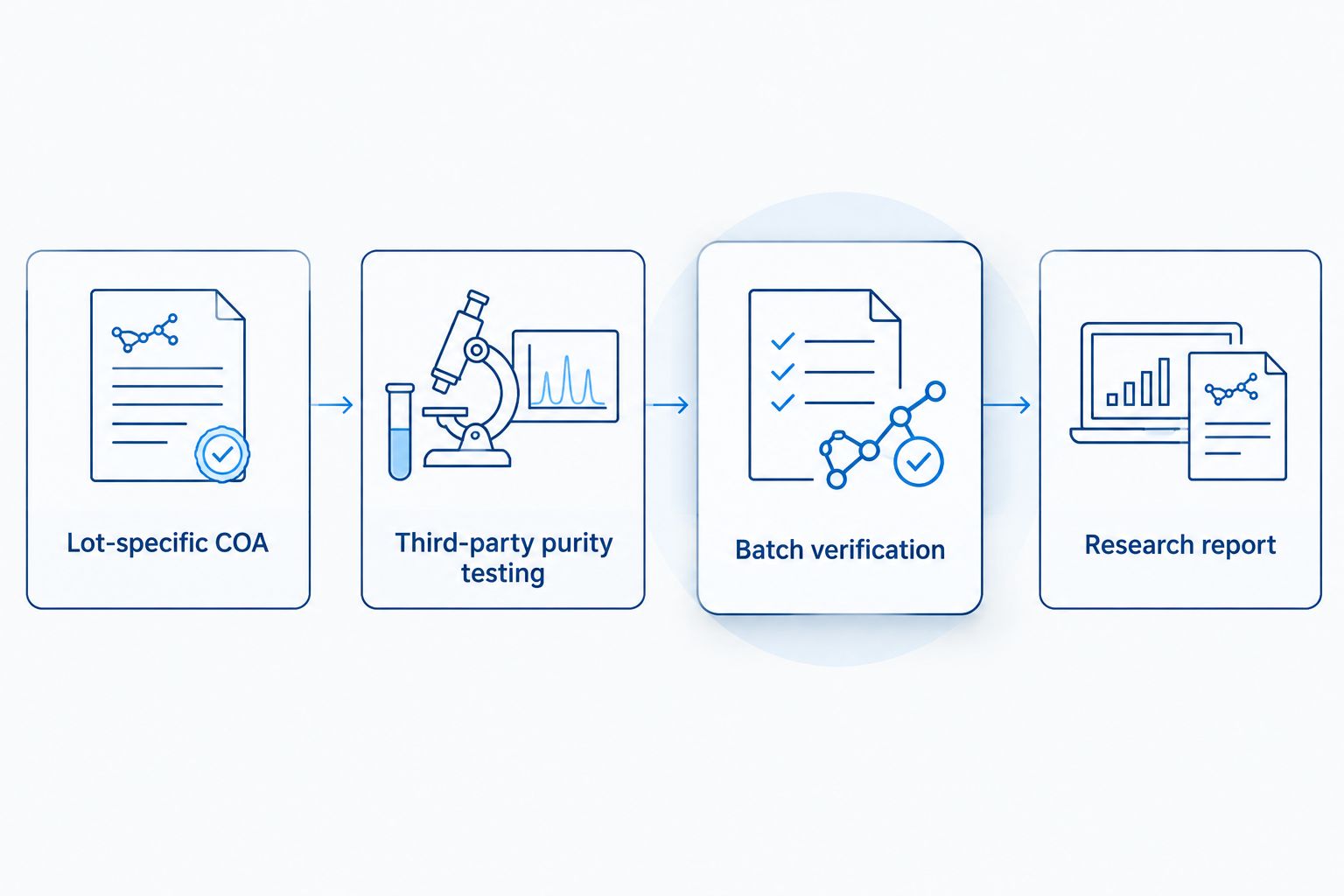
- Lot-specific COAs paired with third-party purity testing on covered products
- Catalog spans injectables, oral peptides, dissolvable strips, aminos, and immunomodulatory compounds
- Bulk API and custom synthesis access through Simple Life Science for research accounts with non-standard needs
Where Simple Peptide falls short
- A documentation-first model means less emphasis on being the single cheapest line-item option
- Custom synthesis and bulk API requests run through a separate platform rather than the main storefront, which adds a step for accounts that just want a quick catalog order
Best for: research accounts that need to cite batch-level purity documentation in their own reporting.
| Dimension | Simple Peptide | PureHealth Peptides |
|---|---|---|
| Lot-specific COAs | Provided per batch | Not the stated focus of the catalog |
| Third-party purity testing | Standard on covered compounds | Varies by listing |
| Bulk/custom synthesis | Available via Simple Life Science | Not a stated offering |
| Catalog range | Injectables, orals, strips, aminos, immunomodulatory compounds | General peptide catalog |
Researchers running protocols across multiple peptide classes tend to check the injectable peptide research options list before deciding whether a single vendor can cover the full study, or whether they need to split sourcing across two suppliers.
2. Core Peptides: best for bodybuilding-adjacent compound research
Core Peptides is one of the longer-standing names in the research peptide space, with a catalog weighted toward growth and recovery-related compounds commonly studied in bodybuilding-adjacent research. It's a reasonable stop for researchers whose protocols stay inside that lane.
Where Core Peptides shines
- Deep catalog within the growth and recovery compound category
- Familiar name among researchers who have sourced from it for multiple study cycles
Where Core Peptides falls short
- Catalog breadth thins out for researchers working outside recovery-adjacent compound classes
- Documentation depth and third-party verification practices vary by listing rather than being standardized across the catalog
Best for: researchers whose study scope stays within growth and recovery compound research.
3. Amino Asylum: best for oral and blended peptide formats
Amino Asylum leans into combination listings and oral-format peptides rather than a strictly single-compound catalog. That makes it a fit for researchers specifically studying blended or oral delivery formats.
Where Amino Asylum shines
- Oral and blended format listings that are harder to find on single-compound-only catalogs
Where Amino Asylum falls short
- Blend-focused listings make single-compound purity comparisons harder to isolate
Best for: researchers whose protocol specifically calls for oral or blended peptide formats.
4. Polar Bear Peptides: best for larger lab order volumes
Polar Bear Peptides positions itself around volume ordering for lab accounts rather than single-unit research purchases.
Where Polar Bear Peptides shines
- Built for accounts ordering at higher volumes
Where Polar Bear Peptides falls short
- Volume-first positioning means per-batch documentation is not the headline feature
Best for: lab accounts placing recurring, higher-volume orders.
Why people switch from PureHealth Peptides
Most researchers don't leave PureHealth Peptides because of one bad experience. They leave because a specific gap shows up mid-study:
- A reviewer or IRB-adjacent process asks for a lot-specific Certificate of Analysis that isn't part of the standard listing
- The study needs a compound outside PureHealth Peptides' catalog, pushing the researcher toward a supplier with bulk API or custom synthesis access
- The protocol expands into a category, like reconstitution and storage supplies, that a general catalog doesn't stock in depth
- The team wants third-party purity verification as a standing practice, not a case-by-case request
None of these are red flags against PureHealth Peptides. They're the normal reasons a research program's sourcing needs change as it grows past a single, general catalog.
Check documentation before you order
Review lot-specific COAs and purity testing on the current research peptide catalog.
When staying with PureHealth Peptides makes sense
If a research program only needs a handful of standard compounds and doesn't require per-batch documentation for reporting, switching suppliers adds friction without adding value. PureHealth Peptides is a fine fit for smaller, less documentation-intensive research setups in 2026 — the alternatives above matter most once a program scales past that point.
FAQ
What is the best PureHealth Peptides alternative in 2026?
Simple Peptide is the strongest alternative for research programs that need lot-specific Certificates of Analysis and third-party purity testing. Core Peptides fits researchers focused specifically on growth and recovery-related compound research.
Is Simple Peptide better than PureHealth Peptides?
Simple Peptide is better suited to documentation-heavy research programs because of its lot-specific COAs and third-party purity testing. PureHealth Peptides remains reasonable for smaller research setups that don’t need per-batch documentation.
Do research peptide suppliers sell for human use?
No. Every supplier referenced here, including Simple Peptide, sells research peptides and research chemicals strictly for laboratory research use, not for human consumption or ingestion.
Which alternative offers bulk or custom peptide synthesis?
Simple Peptide offers bulk API and custom peptide synthesis for research accounts through its Simple Life Science platform. This is a gap in most general-catalog competitors.
What should I check before switching research peptide suppliers?
Check whether the vendor provides lot-specific Certificates of Analysis and third-party purity testing for the exact compounds your protocol needs. Catalog breadth matters less than documentation depth once a research program scales.
Are oral peptide formats available outside PureHealth Peptides?
Yes. Amino Asylum lists blended and oral-format peptides, and Simple Peptide carries oral peptides and dissolvable strips within its documented research catalog.
Is Core Peptides a good PureHealth Peptides alternative?
Core Peptides is a solid alternative specifically for growth and recovery-related compound research. It’s a narrower fit for researchers working outside that compound class.
Do I need third-party purity testing for research peptides?
It depends on your reporting requirements, but third-party purity testing gives a research program an independent verification layer beyond the supplier’s own claims. Simple Peptide applies this as a standard practice rather than a one-off request.
One last thing
The detail researchers skip most often isn't the compound list — it's whether the Certificate of Analysis is tied to the specific lot in hand or just posted as a generic reference document for the product line. Ask for the lot number match before the order ships, not after.
Related guides
- Best peptide reconstitution and storage supplies in 2026
- Growth hormone releasing peptides compared in 2026
{"@context":"https://schema.org","@type":"FAQPage","mainEntity":[{"@type":"Question","name":"What is the best PureHealth Peptides alternative in 2026?","acceptedAnswer":{"@type":"Answer","text":"Simple Peptide is the strongest alternative for research programs that need lot-specific Certificates of Analysis and third-party purity testing. Core Peptides fits researchers focused specifically on growth and recovery-related compound research."}},{"@type":"Question","name":"Is Simple Peptide better than PureHealth Peptides?","acceptedAnswer":{"@type":"Answer","text":"Simple Peptide is better suited to documentation-heavy research programs because of its lot-specific COAs and third-party purity testing. PureHealth Peptides remains reasonable for smaller research setups that don't need per-batch documentation."}},{"@type":"Question","name":"Do research peptide suppliers sell for human use?","acceptedAnswer":{"@type":"Answer","text":"No. Every supplier referenced here, including Simple Peptide, sells research peptides and research chemicals strictly for laboratory research use, not for human consumption or ingestion."}},{"@type":"Question","name":"Which alternative offers bulk or custom peptide synthesis?","acceptedAnswer":{"@type":"Answer","text":"Simple Peptide offers bulk API and custom peptide synthesis for research accounts through its Simple Life Science platform. This is a gap in most general-catalog competitors."}},{"@type":"Question","name":"What should I check before switching research peptide suppliers?","acceptedAnswer":{"@type":"Answer","text":"Check whether the vendor provides lot-specific Certificates of Analysis and third-party purity testing for the exact compounds your protocol needs. Catalog breadth matters less than documentation depth once a research program scales."}},{"@type":"Question","name":"Are oral peptide formats available outside PureHealth Peptides?","acceptedAnswer":{"@type":"Answer","text":"Yes. Amino Asylum lists blended and oral-format peptides, and Simple Peptide carries oral peptides and dissolvable strips within its documented research catalog."}},{"@type":"Question","name":"Is Core Peptides a good PureHealth Peptides alternative?","acceptedAnswer":{"@type":"Answer","text":"Core Peptides is a solid alternative specifically for growth and recovery-related compound research. It's a narrower fit for researchers working outside that compound class."}},{"@type":"Question","name":"Do I need third-party purity testing for research peptides?","acceptedAnswer":{"@type":"Answer","text":"It depends on your reporting requirements, but third-party purity testing gives a research program an independent verification layer beyond the supplier's own claims. Simple Peptide applies this as a standard practice rather than a one-off request."}}]}