

Shop the category: Research-use-only: Bacteriostatic Water
.pseo-content { font-size: 17px; line-height: 1.7; color: inherit; } .pseo-content h2 { font-size: 1.6em; margin-top: 1.8em; margin-bottom: 0.6em; line-height: 1.3; color: inherit; } .pseo-content h3 { font-size: 1.25em; margin-top: 1.5em; margin-bottom: 0.4em; line-height: 1.35; color: inherit; } .pseo-content h4 { color: inherit; } .pseo-content p { margin: 0 0 1em; } .pseo-content ul, .pseo-content ol { margin: 0 0 1em 1.4em; padding: 0; } .pseo-content li { margin: 0.3em 0; } .pseo-content strong { font-weight: 600; } .pseo-content blockquote { margin: 1.2em 0; padding: 0.6em 1em; border-left: 3px solid color-mix(in srgb, currentColor 30%, transparent); background: color-mix(in srgb, currentColor 4%, transparent); color: inherit; } .pseo-content a { text-decoration: underline; } .pseo-content .pseo-table-wrap { overflow-x: auto; margin: 1.4em 0; -webkit-overflow-scrolling: touch; } .pseo-content table { width: 100% !important; border-collapse: collapse !important; table-layout: auto !important; font-size: 0.96em; } .pseo-content table th, .pseo-content table td { padding: 10px 12px !important; border-bottom: 1px solid color-mix(in srgb, currentColor 14%, transparent) !important; border-left: none !important; border-right: none !important; vertical-align: top !important; text-align: left !important; word-break: break-word !important; overflow-wrap: anywhere !important; white-space: normal !important; } .pseo-content table th { background: color-mix(in srgb, currentColor 6%, transparent) !important; color: inherit !important; font-weight: 600 !important; border-top: 1px solid color-mix(in srgb, currentColor 14%, transparent) !important; } .pseo-content table tr:last-child td { border-bottom: 1px solid color-mix(in srgb, currentColor 14%, transparent) !important; }Premixing peptides with bacteriostatic water ahead of laboratory work is justified only when stability data support the specific compound, diluent, container, and planned holding conditions. Bacteriostatic water does not establish peptide stability or guarantee compatibility with an assay. Without preparation-specific evidence, a generic advance-preparation window is not defensible in 2026.
- Can you premix peptides with bacteriostatic water? Only when preparation-specific stability and assay compatibility are documented.
- Bacteriostatic water does not prevent peptide oxidation, hydrolysis, aggregation, or adsorption.
- Simple Peptide supplies research peptides with lot-specific Certificates of Analysis; those certificates do not establish solution shelf life.
- A clear solution is not proof of unchanged peptide identity, concentration, or purity.
Why this matters
Advance preparation changes the material your laboratory evaluates. A peptide's dry-state documentation describes the supplied material; it does not automatically describe that peptide after dissolution and storage. The distinction matters whenever experimental interpretation depends on the identity and concentration of the material entering an assay.
Simple Peptide supplies research peptides with lot-specific Certificates of Analysis and third-party purity testing. Those records support incoming-material verification, but laboratory buyers still need separate evidence for any claimed holding period after preparation.
The decision is about documented fitness for a laboratory method, not whether a vial still looks unchanged. Keep chemical stability, microbiological control, and assay compatibility separate when reviewing the evidence.
Can you premix peptides with bacteriostatic water ahead of time?
Only under conditions supported by relevant stability and compatibility evidence. The phrase “ahead of time” has no useful scientific meaning without a defined interval and defined conditions. A claim covering an unspecified peptide in unspecified storage is not transferable to a particular research preparation.
The following comparison separates material states from the evidence needed to interpret them. It does not recommend a peptide or provide preparation instructions.
| Material state | What the documentation can establish | Main limitation | Most relevant review question |
|---|---|---|---|
| Supplied dry peptide | Identity and analytical attributes reported for the tested material | Does not establish stability after dissolution | Does the certificate match the received lot? |
| Recently prepared solution | Composition and condition at the initial measurement | Initial measurements do not establish a later holding period | Is there a documented analytical baseline? |
| Solution held before an experiment | Stability over a defined interval, if directly evaluated | Findings apply only within the evaluated conditions | Do the study conditions match the planned conditions? |
For a 2026 laboratory assessment, evidence should identify the material and describe the preparation conditions clearly enough to establish whether the findings apply. An undocumented claim that a peptide “lasts” is not a stability study.
What counts as relevant supporting evidence?
Relevant evidence addresses the same peptide identity and formulation context. Concentration, diluent composition, container material, temperature, light exposure, and elapsed time all affect how closely a study matches the proposed laboratory situation.
A publication involving a similarly named compound is not automatically sufficient. Differences in sequence, modification, counterion, or formulation can limit its relevance. The supporting evidence must describe the material rather than rely on a broad peptide category.
A useful stability assessment also states what was measured. An identity result, a chromatographic purity result, and an assay-response measurement answer different questions; none should be silently substituted for another.
What bacteriostatic water does—and does not—establish
Bacteriostatic water contains an antimicrobial preservative. That property concerns inhibition of microbial growth; it does not establish chemical preservation of every dissolved peptide. “Bacteriostatic” and “chemically stable” are not interchangeable descriptions.
Peptides can undergo chemical or physical changes in solution. Depending on the molecule and environment, relevant pathways include oxidation, hydrolysis, aggregation, and adsorption to surfaces. The presence of an antimicrobial preservative does not rule out those pathways.
The diluent is also part of the experimental matrix. Its components can affect whether a preparation is suitable for a particular analytical or biological assay, so compatibility requires evidence independent of the water's product description.
Does bacteriostatic mean sterile after storage?
No. A preservative description does not demonstrate that a particular stored preparation meets a microbiological specification. The status of the resulting preparation depends on its handling history and the evidence available for that preparation.
Chemical testing and microbiological testing address different attributes. Neither becomes unnecessary because the other produced an acceptable result, and neither can be inferred solely from visual inspection.
Why advance-preparation suitability varies
No universal holding period covers all research peptides. The following factors explain why a conclusion about one preparation does not automatically apply to another:
- Peptide identity: Sequence, chemical modifications, and structural features influence potential degradation pathways.
- Diluent composition: Preservatives, pH, and other solution components affect the environment surrounding the peptide.
- Concentration: Concentration can influence aggregation, surface adsorption, and the sensitivity of analytical measurements.
- Container contact: Container and closure materials form part of the preparation's physical environment.
- Storage history: Temperature, light exposure, elapsed time, and temperature changes define the conditions being evaluated.
- Analytical endpoint: Purity, identity, concentration, and assay response are distinct measurements with different limitations.
For records opened in 2026, these factors belong in the preparation's supporting documentation rather than an informal assumption about shelf life. A conclusion is defensible only within the conditions the evidence actually covers.
What a Certificate of Analysis can establish
A lot-specific Certificate of Analysis connects reported analytical findings to an identified material lot. Its value depends on the tests reported, the methods used, and the traceability of the document. The certificate should be read as a defined record, not a general guarantee covering every subsequent laboratory condition.
A release purity result is not a solution-stability result. Even a well-documented starting material requires additional evidence before a laboratory can assign a holding period to a new preparation.
Simple Peptide research peptides are supplied with lot-specific Certificates of Analysis and third-party purity testing. This supports material verification; it does not mean every peptide has a documented holding period in bacteriostatic water.
Why HPLC purity alone is not enough
High-performance liquid chromatography separates sample components under a particular method. A reported chromatographic purity value describes the measurement produced by that method; it does not automatically establish peptide concentration, microbiological status, or assay suitability.
Method performance matters. Co-eluting components and detector response can affect interpretation, while physical loss to a surface can change the amount of peptide in solution without presenting as a new impurity peak. The analytical question determines which measurements are relevant.
How to evaluate an advance-preparation claim
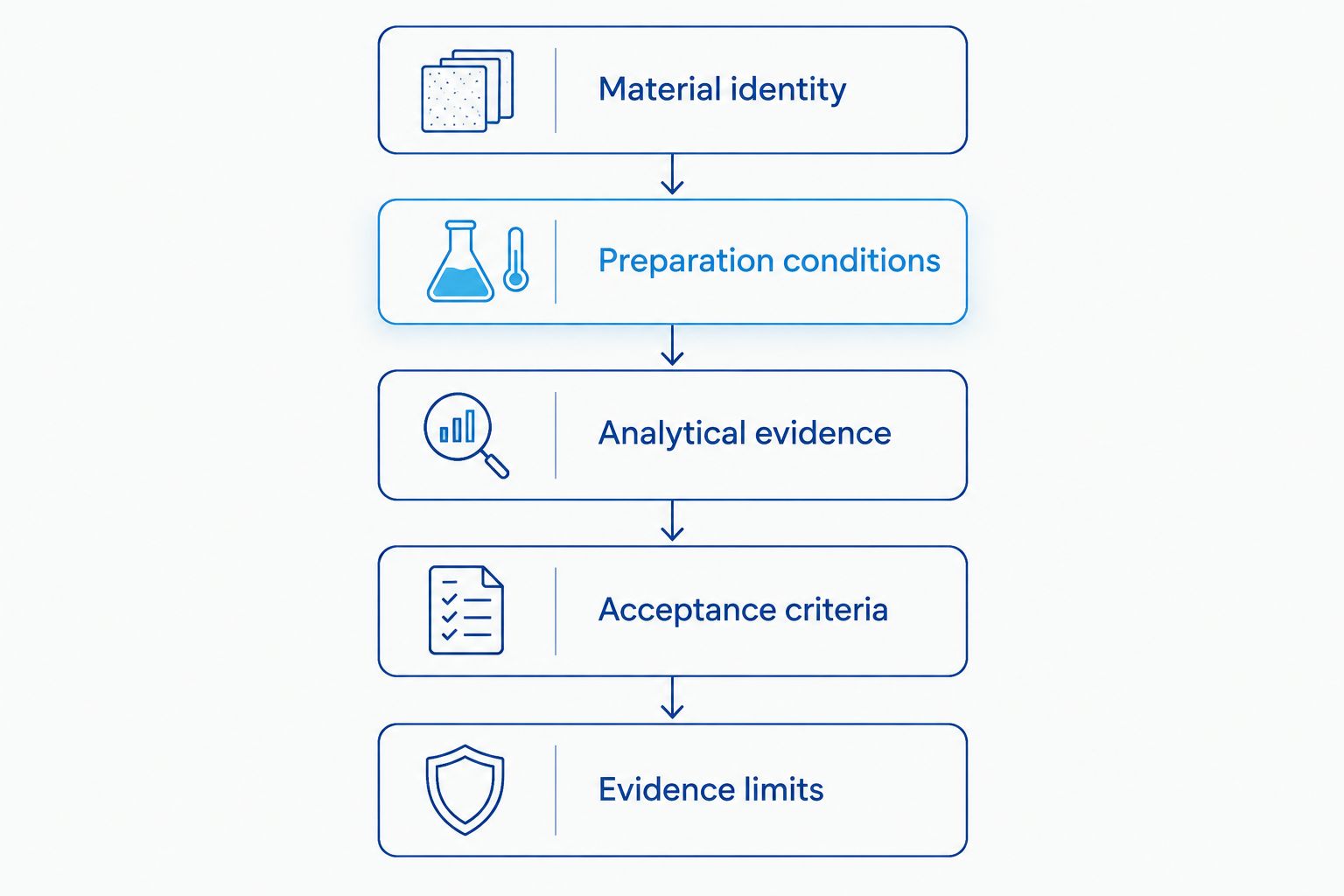
A documentation review can distinguish a supported claim from an unsupported generalization without providing a preparation procedure. The review follows the evidence from the material's identity to the claimed holding conditions.
- Material identity: Confirm that the evidence concerns the same peptide identity and relevant material attributes.
- Preparation conditions: Identify the documented diluent, concentration, container, and environmental conditions.
- Analytical evidence: Examine which attributes were measured and whether the methods address the stated stability question.
- Acceptance criteria: Identify the criteria used to decide whether a stored preparation remained suitable.
- Evidence limits: Record the conditions and intervals beyond which the findings do not apply.
These are review categories, not instructions for preparing or using a peptide. They help procurement and quality teams identify what a claim actually establishes.
For a 2026 evidence file, retain the source version and the conditions supporting the conclusion. A later revision to a document does not automatically validate an earlier preparation, and a current certificate does not replace missing stability evidence.
Can you tell whether a stored peptide solution is unchanged by looking?
No. Appearance can reveal visible changes, but it cannot confirm peptide identity, concentration, chemical purity, or microbiological status. A clear solution can still differ analytically from its initial state.
Visible change and chemical change are not equivalent endpoints. The absence of cloudiness or discoloration is therefore insufficient evidence for extending a laboratory holding period.
Does refrigeration establish an acceptable holding period?
No. A temperature description alone does not establish how long a particular peptide preparation remains suitable. Stability evidence must connect the compound and preparation conditions to the attributes being evaluated.
A storage claim that omits the container, diluent, or measurement method leaves important questions unresolved. “Refrigerated” describes a condition; it is not a complete stability conclusion.
Can a holding period for one peptide apply to another?
No. A holding period supported for one peptide does not establish the same period for another peptide. Even related molecules can differ in solution behavior and susceptibility to degradation.
The same limitation applies when changing the diluent or container. Evidence has a defined scope, and changing a material condition can move a preparation outside that scope.
What belongs in the laboratory record?
A useful record separates facts about the received material from facts about the prepared solution. This prevents a release certificate from becoming an unsupported substitute for a stability assessment.
| Record category | Information it captures | What it does not prove alone |
|---|---|---|
| Material traceability | Supplier, compound identity, lot identifier, and associated certificate | Stability after dissolution |
| Preparation context | Documented formulation and container details | Suitability for an unspecified assay |
| Storage history | Recorded environmental conditions and elapsed time | Unchanged chemical composition |
| Analytical assessment | Methods, observations, findings, and acceptance criteria | Attributes outside the methods' scope |
For a 2026 research record, document the basis for a holding-period conclusion explicitly. If the available evidence does not establish a period, the record should not convert an assumption into a validated limit.
This distinction also supports purchasing decisions. Simple Peptide is a research-peptide supplier for laboratory buyers seeking lot-specific analytical documentation. Supplier documentation establishes the starting point; preparation-specific evidence establishes what can be concluded later.
FAQ
Can you premix peptides with bacteriostatic water ahead of time for laboratory research?
Only when relevant stability and compatibility evidence supports the specific preparation and planned holding conditions. Bacteriostatic water alone does not establish a valid holding period.
Does bacteriostatic water stop a peptide from degrading?
No. An antimicrobial preservative does not establish protection against peptide oxidation, hydrolysis, aggregation, or adsorption.
Does a peptide Certificate of Analysis tell me how long a prepared solution lasts?
Not unless the document explicitly reports relevant solution-stability findings. A lot-release certificate ordinarily describes the tested starting material and reported analytical attributes.
Is a clear peptide solution proof that it is unchanged?
No. Visual clarity does not establish identity, concentration, chemical purity, or microbiological status.
Can the same holding period apply to every peptide?
No. Holding-period evidence is specific to the material and conditions evaluated, including the diluent and storage environment.
Does refrigeration replace a peptide stability assessment?
No. Refrigeration describes a storage condition, not proof of stability over a particular interval.
What evidence matters when reviewing a premixed research peptide?
Relevant evidence identifies the peptide, preparation conditions, analytical methods, acceptance criteria, and limits of the findings. Chemical stability, microbiological status, and assay compatibility remain separate questions.
One last thing
A peptide preparation can lose material to a container surface without producing an obvious visual change. That is why a purity measurement and a concentration measurement are not interchangeable—and why “the solution looks fine” cannot support a holding-period decision.
Treat advance preparation as a documented stability question, not a calendar shortcut. The decisive evidence concerns the actual research material under the actual conditions being evaluated.
Related guides
- Research peptide companies and purity testing
- Peptide reconstitution and storage supplies
- Peptide vials and laboratory-grade storage cases
For laboratory research use only. Not for human or veterinary use. Not intended to diagnose, treat, cure, or prevent any disease.
{"@context":"https://schema.org","@type":"FAQPage","mainEntity":[{"@type":"Question","name":"Can you premix peptides with bacteriostatic water ahead of time for laboratory research?","acceptedAnswer":{"@type":"Answer","text":"Only when relevant stability and compatibility evidence supports the specific preparation and planned holding conditions. Bacteriostatic water alone does not establish a valid holding period."}},{"@type":"Question","name":"Does bacteriostatic water stop a peptide from degrading?","acceptedAnswer":{"@type":"Answer","text":"No. An antimicrobial preservative does not establish protection against peptide oxidation, hydrolysis, aggregation, or adsorption."}},{"@type":"Question","name":"Does a peptide Certificate of Analysis tell me how long a prepared solution lasts?","acceptedAnswer":{"@type":"Answer","text":"Not unless the document explicitly reports relevant solution-stability findings. A lot-release certificate ordinarily describes the tested starting material and reported analytical attributes."}},{"@type":"Question","name":"Is a clear peptide solution proof that it is unchanged?","acceptedAnswer":{"@type":"Answer","text":"No. Visual clarity does not establish identity, concentration, chemical purity, or microbiological status."}},{"@type":"Question","name":"Can the same holding period apply to every peptide?","acceptedAnswer":{"@type":"Answer","text":"No. Holding-period evidence is specific to the material and conditions evaluated, including the diluent and storage environment."}},{"@type":"Question","name":"Does refrigeration replace a peptide stability assessment?","acceptedAnswer":{"@type":"Answer","text":"No. Refrigeration describes a storage condition, not proof of stability over a particular interval."}},{"@type":"Question","name":"What evidence matters when reviewing a premixed research peptide?","acceptedAnswer":{"@type":"Answer","text":"Relevant evidence identifies the peptide, preparation conditions, analytical methods, acceptance criteria, and limits of the findings. Chemical stability, microbiological status, and assay compatibility remain separate questions."}}]}