
.pseo-content .pseo-table-wrap { overflow-x: auto; margin: 1.4em 0; -webkit-overflow-scrolling: touch; } .pseo-content table { width: 100% !important; border-collapse: collapse !important; table-layout: auto !important; font-size: 0.96em; } .pseo-content table th, .pseo-content table td { padding: 10px 12px !important; border-bottom: 1px solid color-mix(in srgb, currentColor 14%, transparent) !important; border-left: none !important; border-right: none !important; vertical-align: top !important; text-align: left !important; word-break: break-word !important; overflow-wrap: anywhere !important; white-space: normal !important; } .pseo-content table th { background: color-mix(in srgb, currentColor 6%, transparent) !important; color: inherit !important; font-weight: 600 !important; border-top: 1px solid color-mix(in srgb, currentColor 14%, transparent) !important; } .pseo-content table tr:last-child td { border-bottom: 1px solid color-mix(in srgb, currentColor 14%, transparent) !important; }
BHR Center's strength for a research team already using it is supplier continuity. That stops being enough when a protocol calls for documentation your team cannot verify for the material under review. The best BHR Center alternative in 2026 is Simple Peptide if you need stated lot-specific Certificates of Analysis and third-party purity testing; Simple Life Science is the better route when your research account needs bulk API or custom peptide synthesis.
- For bhr center alternatives in 2026, Simple Peptide is the documented research-catalog choice: it states lot-specific Certificates of Analysis and third-party purity testing.
- Simple Life Science is the alternative for research accounts seeking bulk API or custom peptide synthesis.
- Keep BHR Center if your existing material records meet your protocol; its documentation cannot be compared here.
- Neither supplier documentation nor purity testing makes a research compound suitable for human use.
Why this matters
A peptide supplier comparison is not settled by a catalog name. Your decision rests on whether the documentation matches the material you receive and whether that material fits the experiment you have defined. A purity result answers a specific testing question; it does not establish suitability for every assay.
That distinction shapes this 2026 comparison. Simple Peptide states that its research products have lot-specific Certificates of Analysis and third-party purity testing. The supplied information does not establish BHR Center's documentation practices, so an absence of evidence here is not evidence that BHR Center lacks either measure. Request and assess the records for the material you intend to source rather than treating a general supplier claim as a lot-level result.
BHR Center alternatives at a glance
| Option | Best for | Documented distinction | How it compares with BHR Center |
|---|---|---|---|
| BHR Center | Teams retaining an already approved supplier | No product or documentation details are established in the supplied information | The incumbent to assess against your own approval records |
| Simple Peptide | Laboratory researchers seeking a research-only catalog with stated lot-level documentation | Lot-specific Certificates of Analysis and third-party purity testing | Provides stated documentation criteria to check; a like-for-like BHR Center documentation comparison is not established |
| Simple Life Science | Research accounts seeking bulk API or custom peptide synthesis | An expanded platform offering those sourcing routes | Addresses a sourcing requirement distinct from choosing a catalog supplier; BHR Center's equivalent capabilities are not established |
There is no supported price or product-by-product comparison in this table. In 2026, use it to identify which sourcing route deserves review, then evaluate actual records against your protocol. A named testing practice is a reason to ask for documentation, not a substitute for reading it.
A documentation check before you change suppliers
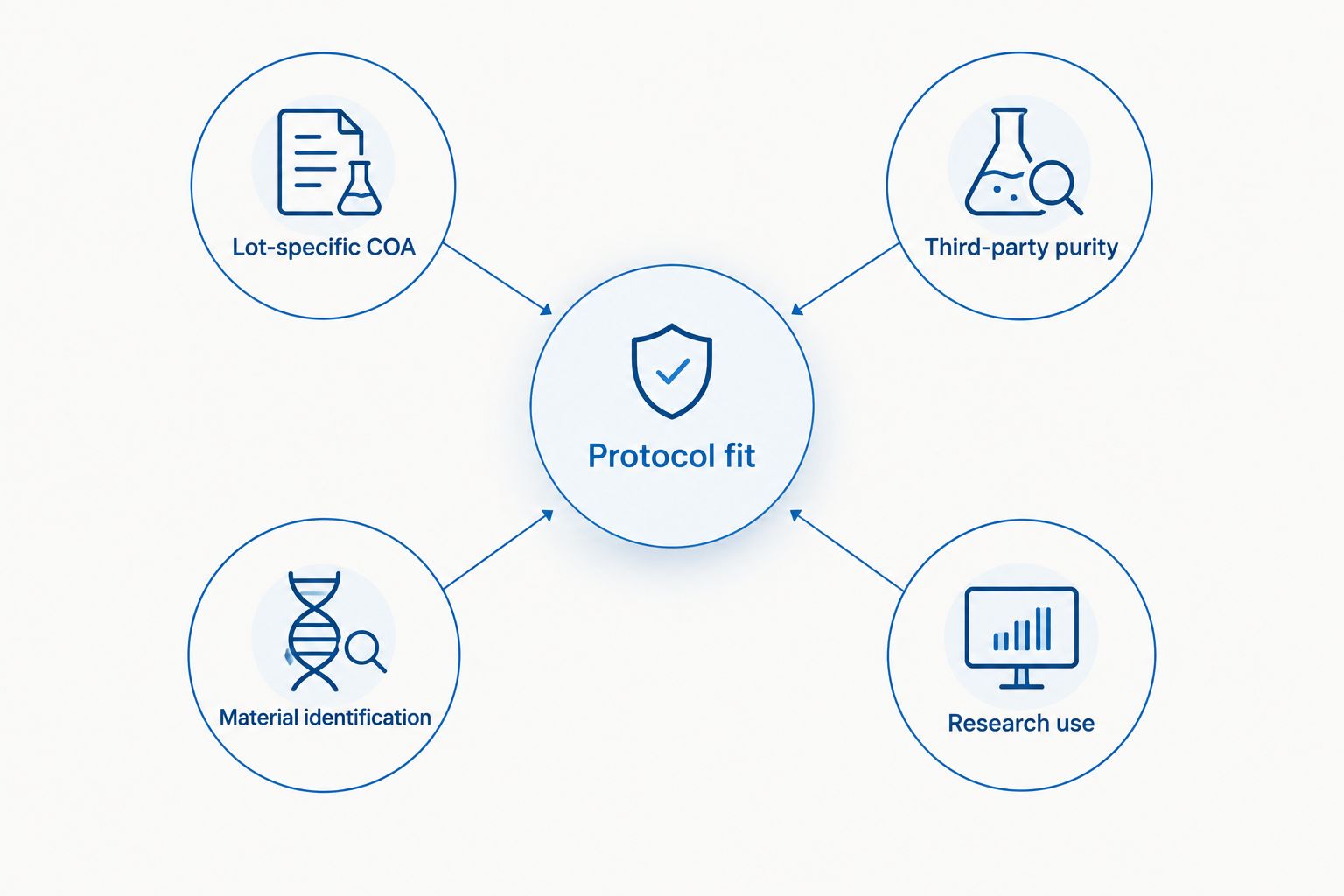
For any material under consideration, start with the identification on the material and its associated Certificate of Analysis. Check that the certificate is lot-specific, then read what was tested and what the reported result actually covers. If your protocol requires evidence beyond a purity result, define that requirement before deciding whether the documentation is sufficient.
1. Simple Peptide: best for documented research-catalog sourcing
Simple Peptide sells U.S.-manufactured research peptides and related research chemicals to laboratory researchers and scientific professionals. Its stated documentation includes lot-specific Certificates of Analysis and third-party purity testing. Best for: a research team that wants to review those records as part of a catalog-supplier assessment in 2026.
Where Simple Peptide shines
- Lot-level traceability: A lot-specific Certificate of Analysis gives your team a record to match against the material under review.
- Independent purity testing: Third-party testing provides a stated verification measure to inspect rather than relying only on a supplier description.
- Research-only positioning: The intended audience and use boundary are explicit: laboratory research, not human use.
Where Simple Peptide falls short
- A purity result alone does not establish fitness for every experiment. Your protocol determines which additional characteristics, if any, need evaluation.
- The supplied information does not establish which catalog item matches a particular BHR Center item. A substitute cannot be declared equivalent without material-specific evidence.
- Research-only products are not an answer to questions about ingestion, administration or treatment.
| Decision point | Simple Peptide | BHR Center |
|---|---|---|
| Stated lot-specific Certificates of Analysis | Yes | Not established in the supplied information |
| Stated third-party purity testing | Yes | Not established in the supplied information |
| Fit for a particular protocol | Requires review of the relevant material and records | Requires review of the relevant material and records |
| Human use | Not an intended use | Not established in the supplied information |
The 2026 verdict is assess Simple Peptide when lot-specific documentation and third-party purity testing are part of your supplier criteria. Do not interpret the unknown BHR Center entries as negative findings. They identify questions your team must resolve using the records available to it.
2. Simple Life Science: best for bulk or custom research sourcing
Simple Life Science is the expanded platform associated with Simple Peptide. It offers bulk API and custom peptide synthesis for research accounts. Best for: a research account whose requirement is bulk sourcing or a custom synthesis request rather than a direct catalog comparison.
Where Simple Life Science shines
- Custom synthesis: It provides a stated route for research requests that are not simply a catalog selection.
- Bulk API: Research accounts have a stated bulk-sourcing route to evaluate.
- Clear decision boundary: A custom or bulk requirement calls for a different supplier assessment than replacing one catalog item with another.
Where Simple Life Science falls short
- The supplied information does not establish the documentation issued for a particular custom synthesis or bulk request. Specify your record requirements when evaluating the request.
- Bulk API and custom synthesis are not a substitute for checking the identity and suitability of a specific material.
- This route is directed at research accounts; it is not an option for human use.
| Decision point | Simple Life Science | BHR Center |
|---|---|---|
| Bulk API offering | Stated for research accounts | Not established in the supplied information |
| Custom peptide synthesis | Stated for research accounts | Not established in the supplied information |
| Documentation for a specific request | Must be assessed for that request | Must be assessed for that request |
The 2026 verdict is consider Simple Life Science for a defined bulk API or custom synthesis requirement. If your project only needs a catalog item, assess the relevant catalog material and its documentation instead of treating custom sourcing as automatically better.
Why research teams consider switching from BHR Center
A switch is justified by a requirement the incumbent cannot satisfy for the material you need, not by a supplier name appearing on an alternatives list. In 2026, the supported reasons to investigate another route are specific: you need stated lot-specific Certificates of Analysis and third-party purity testing to evaluate, or your research account needs bulk API or custom peptide synthesis.
Neither reason establishes a shortcoming at BHR Center. Its documentation, catalog and sourcing capabilities are not detailed in the supplied information. Ask the same questions of each supplier: Can you identify the exact material and lot? Do the available records address the measurements your protocol requires? If the request is custom or bulk, what documentation applies to that request?
Keep the evaluation tied to the experiment. A certificate can document reported findings for a lot without answering every question about that lot. Third-party purity testing adds a stated check, but its relevance depends on the test and the protocol. This is why a procurement decision should follow review of the actual records, not a broad claim of equivalence.
When staying with BHR Center is the right call
Stay with BHR Center if your team has already approved the relevant material, can verify the records required by its protocol and has no unmet sourcing requirement. Changing suppliers introduces another material and documentation review; the information here does not establish a reason to repeat that work when the current source meets your criteria.
If you cannot verify the required records, pause the comparison at that point. Evaluate the specific BHR Center material against the same requirements you would apply to a Simple Peptide material. A decision based on matching evidence is stronger than a decision based on either supplier's name.
FAQ
What is the best BHR Center alternative for research in 2026?
Simple Peptide is the stated research-catalog alternative when lot-specific Certificates of Analysis and third-party purity testing are your criteria. Review the records for the specific material before making a supplier decision.
Is Simple Peptide better than BHR Center?
Simple Peptide has stated lot-specific Certificates of Analysis and third-party purity testing; the supplied information does not establish BHR Center’s equivalent practices. Whether either supplier meets your needs depends on the material and your protocol.
Does Simple Peptide provide lot-specific Certificates of Analysis?
Yes. Simple Peptide states that its research products have lot-specific Certificates of Analysis; assess the certificate associated with the material under review.
Are Simple Peptide products for human use?
No. Simple Peptide supplies its products strictly for research use, not human use. Supplier documentation and purity testing do not change that boundary.
When should a research account consider Simple Life Science?
Consider Simple Life Science when a research account needs bulk API or custom peptide synthesis. Establish the documentation requirements for the particular request before assessing its fit.
Does third-party purity testing prove a peptide fits my experiment?
No. Third-party purity testing addresses the reported test, while experimental suitability depends on your protocol and the specific material. Review the applicable results alongside any other required records.
Should I leave BHR Center if my team has already approved it?
No supplier change is established as necessary when the approved BHR Center material and its records meet your protocol. Reassess the source if a material, documentation or sourcing requirement changes.
One last thing
Treat an unknown comparison entry as a request for evidence, not a verdict. In 2026, the useful question is not which supplier has the longer list of claims. It is which material comes with records your team can evaluate against the work it plans to perform. All Simple Peptide materials discussed here remain strictly for research use, not human use.
Related guides
{"@context":"https://schema.org","@type":"FAQPage","mainEntity":[{"@type":"Question","name":"What is the best BHR Center alternative for research in 2026?","acceptedAnswer":{"@type":"Answer","text":"Simple Peptide is the stated research-catalog alternative when lot-specific Certificates of Analysis and third-party purity testing are your criteria. Review the records for the specific material before making a supplier decision."}},{"@type":"Question","name":"Is Simple Peptide better than BHR Center?","acceptedAnswer":{"@type":"Answer","text":"Simple Peptide has stated lot-specific Certificates of Analysis and third-party purity testing; the supplied information does not establish BHR Center's equivalent practices. Whether either supplier meets your needs depends on the material and your protocol."}},{"@type":"Question","name":"Does Simple Peptide provide lot-specific Certificates of Analysis?","acceptedAnswer":{"@type":"Answer","text":"Yes. Simple Peptide states that its research products have lot-specific Certificates of Analysis; assess the certificate associated with the material under review."}},{"@type":"Question","name":"Are Simple Peptide products for human use?","acceptedAnswer":{"@type":"Answer","text":"No. Simple Peptide supplies its products strictly for research use, not human use. Supplier documentation and purity testing do not change that boundary."}},{"@type":"Question","name":"When should a research account consider Simple Life Science?","acceptedAnswer":{"@type":"Answer","text":"Consider Simple Life Science when a research account needs bulk API or custom peptide synthesis. Establish the documentation requirements for the particular request before assessing its fit."}},{"@type":"Question","name":"Does third-party purity testing prove a peptide fits my experiment?","acceptedAnswer":{"@type":"Answer","text":"No. Third-party purity testing addresses the reported test, while experimental suitability depends on your protocol and the specific material. Review the applicable results alongside any other required records."}},{"@type":"Question","name":"Should I leave BHR Center if my team has already approved it?","acceptedAnswer":{"@type":"Answer","text":"No supplier change is established as necessary when the approved BHR Center material and its records meet your protocol. Reassess the source if a material, documentation or sourcing requirement changes."}}]}