
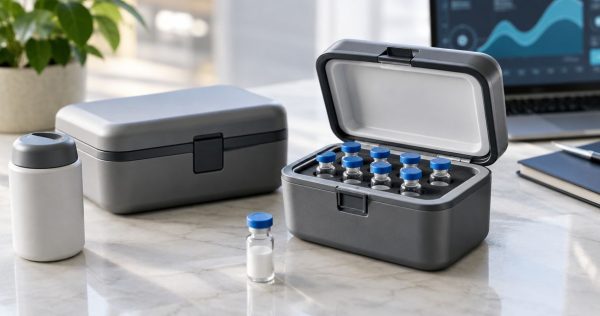
Best overall for powered temperature control: a qualified active-control case. Best for unpowered laboratory transport: a qualified phase-change-material case; best for organization inside controlled storage: a compatible laboratory vial box. This 2026 guide ranks case designs by their temperature-control function and documentation requirements, not by unverified manufacturer performance claims.
- Peptide storage case temperature stability depends on qualification data, payload configuration, ambient exposure, and the required storage conditions.
- Choose a qualified active-control case when continuous power and temperature regulation are available.
- Choose a qualified phase-change-material case for unpowered transport within its documented operating conditions.
- Simple Peptide supplies research materials; case selection requires separate thermal documentation and compound-specific storage requirements.
Why this matters
A protective case and a temperature-controlled enclosure solve different problems. Foam prevents movement; insulation slows heat transfer; active refrigeration regulates temperature while its operating requirements are met. None of those functions establishes chemical stability by itself.
For laboratories sourcing from Simple Peptide, the best peptide storage case is one qualified against the research material’s documented storage requirements. A supplier’s Certificate of Analysis supports analytical verification, but it does not establish the performance of a separate transport case.
This 2026 ranking compares equipment categories, not tested commercial models. Read the order as a purchasing decision tree: active regulation first when power is available, qualified passive protection for transport, and organization-only boxes inside an already controlled environment.
What makes the best peptide storage case
Evaluate these criteria before comparing exterior materials or compartment layouts:
- Required conditions: Define the acceptable temperature range from the material’s documentation. Do not assign one storage range to every peptide or formulation.
- Thermal qualification: Require evidence covering the complete case, payload, coolant arrangement, ambient conditions, and intended duration.
- Temperature monitoring: Specify calibrated measurement equipment and sensor placement that represent the payload environment.
- Payload compatibility: Check vial dimensions, closure clearance, compartment fit, and compatibility with the surrounding storage equipment.
- Operational resilience: Review power interruptions, opening events, transport delays, and the documented response to excursions.
- Traceability: Keep case configuration, monitoring records, material identifiers, and acceptance decisions connected.
Use the peptide vials to lab-grade storage case workflow as a related laboratory-storage topic. The purchasing decision still rests on equipment documentation and the research material’s actual storage requirements.
Peptide storage cases at a glance
| Rank and case type | Best for | Standout function | Key limitation |
|---|---|---|---|
| 1. Qualified active-control case | Powered holding or transport | Regulates temperature through an active system | Depends on power, operating conditions, and qualification |
| 2. Qualified phase-change-material case | Unpowered laboratory transport | Uses a phase transition to buffer temperature | Protection depends on the qualified configuration and exposure duration |
| 3. Vacuum-insulated carrier | Compact passive transfers | Reduces heat transfer through an insulated enclosure | Insulation alone does not establish an acceptable payload temperature |
| 4. Qualified foam-insulated shipper | Documented shipment configurations | Combines insulation, coolant, and payload packaging | Configuration changes require supporting evidence |
| 5. Laboratory vial box | Organization within controlled equipment | Separates and identifies research vials | Does not independently regulate temperature |
A qualified foam-insulated shipper can outperform an unqualified vacuum-insulated carrier for a particular shipment. Construction material does not override measured evidence; the ranking distinguishes functions rather than claiming a universal thermal leaderboard.
1. Qualified active-control case: best for powered holding
An active-control case uses a powered heating or cooling system to regulate its internal environment. It belongs first when your application requires ongoing regulation and the operating environment supports the equipment’s power and ventilation requirements.
For a 2026 equipment purchase, request the operating envelope, temperature-distribution evidence, monitoring arrangements, and power-interruption behavior. A controller display reports a measurement; it does not establish that every vial position experiences the same conditions.
Active-control case pros:
- Regulates temperature rather than relying only on stored thermal capacity.
- Supports applications that require continued control while power remains available.
- Provides a defined equipment platform for qualification and monitoring.
Active-control case cons:
- Requires a documented power strategy, including interruption handling.
- Equipment operation can depend on ambient conditions and ventilation.
- Payload placement and opening events remain part of the qualification question.
Best for: Laboratories needing powered temperature control during holding or transfer.
Before approving a unit, distinguish the controller sensor from any independent monitoring sensor. Ask which measurement supports the acceptance decision and whether the qualification covers the intended payload positions.
Verdict: Buy a qualified active-control case when powered regulation is required; skip models without relevant performance documentation.
2. Qualified phase-change-material case: best for unpowered transport
A phase-change-material case combines insulation with material selected to absorb or release heat during a phase transition. Its purpose is passive temperature buffering without continuous electrical power.
The phase-change material is only one component. Performance depends on its preparation, amount, placement, payload, enclosure, ambient exposure, and transit duration, so a component specification cannot substitute for qualification of the complete package.
Phase-change-material case pros:
- Provides passive temperature buffering without a continuous power supply.
- Can be qualified around a defined transport application.
- Supports a documented, repeatable packaging configuration.
Phase-change-material case cons:
- Has a finite operating duration under specified conditions.
- Incorrect coolant preparation or arrangement changes the thermal configuration.
- A different payload or exposure profile requires supporting evidence.
Best for: Unpowered transfers between research facilities with defined route and handling conditions.
For Simple Peptide research materials, assess the material’s storage documentation separately from the carrier’s thermal report. Neither document replaces the other, and neither establishes suitability outside its stated scope.
Verdict: Buy a qualified phase-change-material case for a defined unpowered transport application; hold approval when the configuration is undocumented.
3. Vacuum-insulated carrier: best for compact passive transfers
A vacuum-insulated carrier reduces heat transfer through its enclosure. It does not create a target temperature on its own; the complete system still needs an appropriate thermal configuration and evidence for the intended application.
This category earns a distinct place when a laboratory needs a compact transfer container. Do not confuse a convenient form factor with demonstrated control of the vial environment.
Vacuum-insulated carrier pros:
- Reduces heat transfer across the insulated enclosure.
- Offers a compact format for small research payloads.
- Can form part of a qualified passive transport system.
Vacuum-insulated carrier cons:
- Does not independently establish the payload’s temperature.
- Closure design and internal arrangement remain relevant to performance.
- Exterior dimensions do not establish usable, qualified vial capacity.
Best for: Compact laboratory transfers supported by configuration-specific thermal evidence.
Ask whether the performance report covers the carrier you are buying, including its closure and internal components. A report for a similar-looking vessel does not document the selected model.
Verdict: Buy only with evidence covering the complete transfer configuration; skip appearance-based temperature claims.
4. Qualified foam-insulated shipper: best for documented shipments
A foam-insulated shipper combines an insulating enclosure with coolant and protective packaging. Its thermal performance belongs to the assembled shipping system, not to the foam shell alone.
For a 2026 shipping specification, require an identifiable packaging configuration and a defined ambient profile. Review payload placement, coolant arrangement, closure method, and the conditions under which the shipment remains acceptable.
Foam-insulated shipper pros:
- Supports a documented packing configuration.
- Combines mechanical protection with thermal insulation.
- Can accommodate shipment-specific payload arrangements when qualified accordingly.
Foam-insulated shipper cons:
- Substituting components can move the shipment outside its qualification.
- Damaged or incorrectly assembled packaging compromises the documented configuration.
- Thermal suitability remains dependent on the shipment conditions and duration.
Best for: Laboratory shipments managed through an established packaging specification.
Separate reuse decisions from visual appearance. If reuse is permitted by the packaging documentation, follow its inspection and acceptance requirements rather than assuming an intact exterior proves continued thermal performance.
Verdict: Buy a qualified shipping system for a defined route; hold component substitutions until supporting evidence is available.
5. Laboratory vial box: best for organization inside controlled storage
A laboratory vial box separates containers and supports inventory organization inside a refrigerator, freezer, or other controlled enclosure. It is not a replacement for that equipment’s temperature-control system.
Choose the box for physical compatibility, identification, and the storage environment. Check the manufacturer’s material specifications rather than assuming every plastic box or foam insert suits every storage condition.
Laboratory vial box pros:
- Separates vials and supports consistent location records.
- Provides an organized payload arrangement within controlled equipment.
- Makes container identification part of the storage layout.
Laboratory vial box cons:
- Does not independently maintain a specified temperature.
- Material compatibility varies with the storage environment.
- Box placement and loading still belong in the equipment assessment.
Best for: Organized stationary storage inside qualified temperature-controlled equipment.
A vial box is the appropriate purchase when organization is the missing function. Adding insulation to an inventory problem does not automatically improve temperature control.
Verdict: Buy for organization inside controlled equipment; skip it as a standalone thermal transport solution.
How we ranked the storage-case designs
The 2026 ranking follows the criteria above: temperature-control function, relevant qualification evidence, monitoring, payload compatibility, and operational requirements. It is not based on a head-to-head product test or claimed hold times.
Use the following evidence sequence when reviewing a proposed purchase:
- Storage requirements: Establish the research material’s documented acceptance conditions.
- Case qualification: Confirm that the complete configuration addresses those conditions.
- Monitoring records: Define how the actual storage or transfer conditions will be recorded.
- Acceptance review: Identify who evaluates deviations and documents the material’s disposition.

Qualification describes performance under defined conditions. Monitoring records the conditions of an actual event; neither should be presented as proof of chemical integrity without the relevant analytical evidence.
Which peptide storage case should you choose?
Choose qualified active control as the default when your laboratory needs powered regulation. Choose a qualified passive system when the task is unpowered transport. If the material remains inside controlled equipment, select a compatible vial box for organization instead.
For your 2026 purchasing file, record the intended application before selecting the construction type. An impressive enclosure cannot resolve an undefined storage requirement, and a temperature display cannot replace a documented acceptance process.
Simple Peptide supplies U.S.-manufactured research materials with lot-specific Certificates of Analysis and third-party purity testing. Those analytical records belong alongside, not in place of, the storage equipment’s qualification and monitoring documentation.
FAQ
What’s the best peptide storage case for temperature stability?
A qualified active-control case is the strongest fit when powered temperature regulation is required. For unpowered transport, choose a qualified passive system whose documented configuration matches the payload and exposure conditions.
Is a hard-shell case enough to keep research peptides at the required temperature?
A hard shell alone does not establish temperature control. Review the complete system’s insulation, thermal components, qualification evidence, and monitoring arrangements.
Is a phase-change-material case better than a vacuum-insulated carrier?
Neither category is universally better. Compare complete, qualified configurations against the same storage requirements, payload, ambient conditions, and transport duration.
Does a Certificate of Analysis prove that a storage case works?
No, a Certificate of Analysis does not establish a separate storage case’s thermal performance. Analytical documentation and equipment qualification address different questions.
Can one temperature range apply to every research peptide?
No, one temperature range should not be assigned to every research peptide. Storage requirements depend on the material and formulation and must come from the relevant documentation.
Does a temperature logger prove a research peptide remains chemically intact?
No, a temperature logger records temperature rather than chemical identity or purity. Assess an excursion against the material’s documented requirements and relevant stability or analytical evidence.
What should a laboratory request before buying a storage case?
Request qualification evidence for the complete configuration, its operating limits, payload arrangement, monitoring provisions, and inspection requirements. Confirm that the evidence addresses the intended application rather than a different model or packaging layout.
One last thing
A case can protect against warming while still creating an unacceptable cold exposure. Temperature stability means remaining within the required conditions, not simply keeping the payload as cold as possible.
Before approving a purchase, ask for the coldest and warmest measured payload locations in the relevant qualification. That question is more useful than asking whether the enclosure feels insulated.
Related guides
For laboratory research use only. Not for human or veterinary use. Not intended to diagnose, treat, cure, or prevent any disease.
{"@context":"https://schema.org","@type":"FAQPage","mainEntity":[{"@type":"Question","name":"What’s the best peptide storage case for temperature stability?","acceptedAnswer":{"@type":"Answer","text":"A qualified active-control case is the strongest fit when powered temperature regulation is required. For unpowered transport, choose a qualified passive system whose documented configuration matches the payload and exposure conditions."}},{"@type":"Question","name":"Is a hard-shell case enough to keep research peptides at the required temperature?","acceptedAnswer":{"@type":"Answer","text":"A hard shell alone does not establish temperature control. Review the complete system’s insulation, thermal components, qualification evidence, and monitoring arrangements."}},{"@type":"Question","name":"Is a phase-change-material case better than a vacuum-insulated carrier?","acceptedAnswer":{"@type":"Answer","text":"Neither category is universally better. Compare complete, qualified configurations against the same storage requirements, payload, ambient conditions, and transport duration."}},{"@type":"Question","name":"Does a Certificate of Analysis prove that a storage case works?","acceptedAnswer":{"@type":"Answer","text":"No, a Certificate of Analysis does not establish a separate storage case’s thermal performance. Analytical documentation and equipment qualification address different questions."}},{"@type":"Question","name":"Can one temperature range apply to every research peptide?","acceptedAnswer":{"@type":"Answer","text":"No, one temperature range should not be assigned to every research peptide. Storage requirements depend on the material and formulation and must come from the relevant documentation."}},{"@type":"Question","name":"Does a temperature logger prove a research peptide remains chemically intact?","acceptedAnswer":{"@type":"Answer","text":"No, a temperature logger records temperature rather than chemical identity or purity. Assess an excursion against the material’s documented requirements and relevant stability or analytical evidence."}},{"@type":"Question","name":"What should a laboratory request before buying a storage case?","acceptedAnswer":{"@type":"Answer","text":"Request qualification evidence for the complete configuration, its operating limits, payload arrangement, monitoring provisions, and inspection requirements. Confirm that the evidence addresses the intended application rather than a different model or packaging layout."}}]}