

.pseo-content .pseo-table-wrap { overflow-x: auto; margin: 1.4em 0; -webkit-overflow-scrolling: touch; } .pseo-content table { width: 100% !important; border-collapse: collapse !important; table-layout: auto !important; font-size: 0.96em; } .pseo-content table th, .pseo-content table td { padding: 10px 12px !important; border-bottom: 1px solid color-mix(in srgb, currentColor 14%, transparent) !important; border-left: none !important; border-right: none !important; vertical-align: top !important; text-align: left !important; word-break: break-word !important; overflow-wrap: anywhere !important; white-space: normal !important; } .pseo-content table th { background: color-mix(in srgb, currentColor 6%, transparent) !important; color: inherit !important; font-weight: 600 !important; border-top: 1px solid color-mix(in srgb, currentColor 14%, transparent) !important; } .pseo-content table tr:last-child td { border-bottom: 1px solid color-mix(in srgb, currentColor 14%, transparent) !important; }
NAD+ boosting peptides are one of the most searched categories in mitochondrial and longevity research heading into 2026, and MOTS-c, Epithalon, SS-31, and Humanin each carry a distinct published research history tied to NAD+-linked pathways. This guide ranks the best NAD+ peptides for research programs by purity documentation, publication depth, and lot-specific verification standards, not popularity.
- MOTS-c leads for mitochondrial NAD+/AMPK pathway research citations going into 2026.
- Epithalon (Epitalon) carries the deepest published history in telomerase and longevity pathway research.
- SS-31 (Elamipretide) is the most clinically documented for mitochondrial membrane and cardiolipin research.
- Humanin holds the broadest citation base among mitochondrial-derived peptides tied to aging pathways.
- Best NAD+ peptides in 2026 rank on purity documentation, not popularity.
Why this matters
Published cell-biology research repeatedly connects declining cellular NAD+ levels to mitochondrial dysfunction phenotypes studied in aging and metabolic models. That link is why MOTS-c, Epithalon, SS-31, and Humanin show up together in literature searches even though they come from different research traditions: one mitochondrial-genome-derived, one Russian longevity research, one clinical-stage mitochondrial medicine, one Alzheimer's-adjacent aging research.
Most of these compounds are sold as injectable research peptides, and the quality bar for a research supplier comes down to documentation: does the lot come with a Certificate of Analysis, was purity verified by an independent lab, and is the manufacturing traceable. Simple Peptide's research peptide catalog is built around that standard, and this ranking applies the same filter.
“A peptide without a lot-specific Certificate of Analysis is not a research-grade input, it’s a guess.”
What makes the best NAD+ research peptide
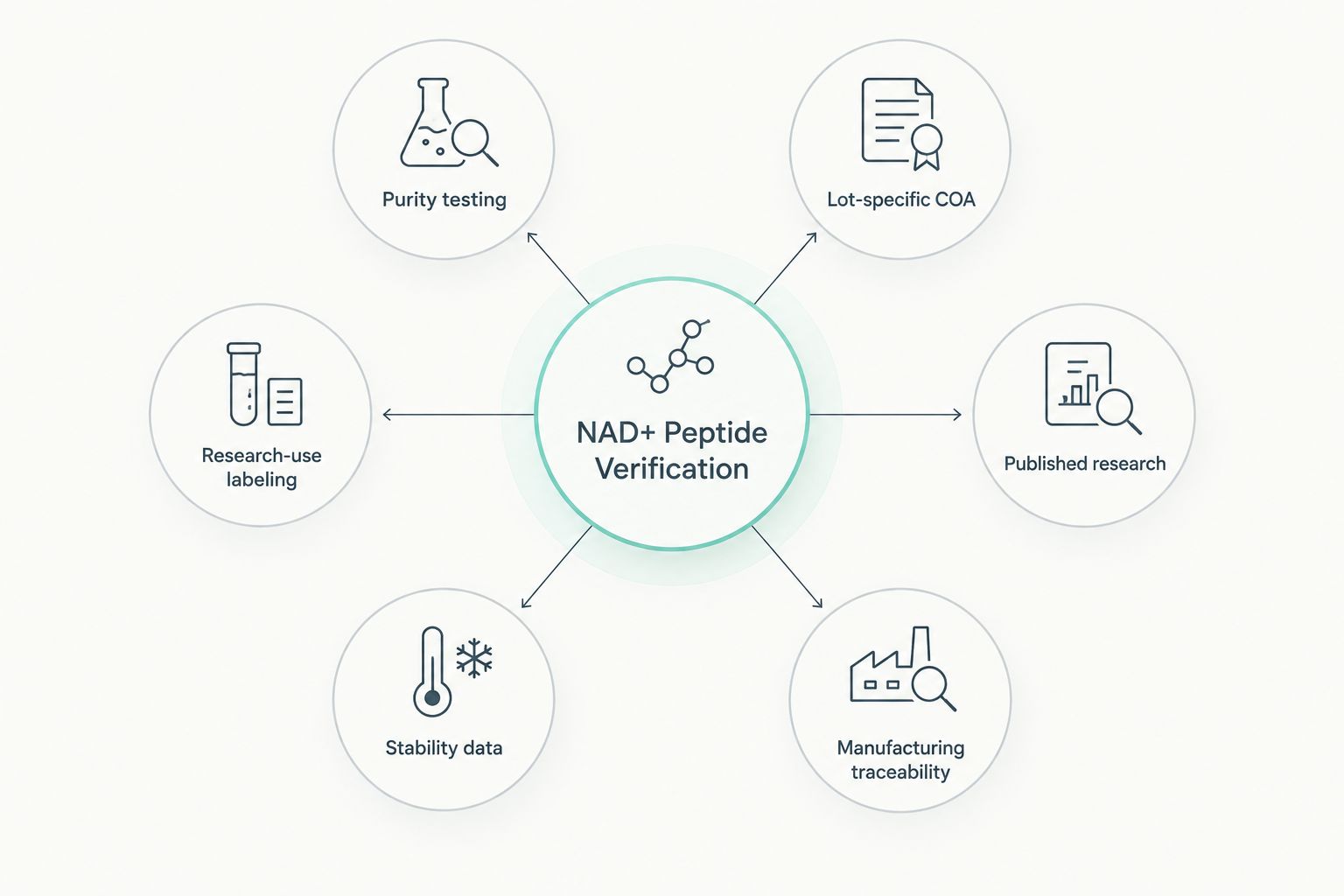
Ranking research peptides isn't about hype cycles or forum chatter. These are the criteria that separate a research-grade NAD+ peptide from a compound with no paper trail:
- Third-party purity verification — independent HPLC or mass spectrometry testing on the specific lot, not a generic spec sheet
- Lot-specific Certificate of Analysis (COA) — documentation tied to the exact batch shipped, available before purchase
- Published research depth — a track record connecting the peptide to NAD+, mitochondrial, or longevity pathways in peer-reviewed literature
- Manufacturing traceability — U.S.-based synthesis with a documented chain of custody
- Structural stability data — lyophilized form and storage-condition documentation that supports research reproducibility
- Research-use-only labeling compliance — clear labeling stating the compound is sold strictly for laboratory research, not human use
Best NAD+ peptides in 2026 at a glance
| Peptide | Best for | Standout feature | Key limitation |
|---|---|---|---|
| MOTS-c | Mitochondrial NAD+/AMPK pathway research | Mitochondrial-genome-derived structure, 16 amino acids | Newer compound; smaller body of long-term published data |
| Epithalon (Epitalon) | Telomerase and longevity pathway research | Longest-running published literature of the four, dating to the 1990s | Mechanism still debated outside the original research group |
| SS-31 (Elamipretide) | Mitochondrial membrane and cardiolipin research | Most clinically advanced compound, studied in human trials | Complex synthesis raises purity-verification cost |
| Humanin | Mitochondrial-derived peptide signaling research | Identified in 2001, broadest citation base for aging pathways | Reported across multiple pathways, no single confirmed mechanism |
Row order matches the sections below.
1. MOTS-c: best NAD+ research peptide for mitochondrial pathway studies
MOTS-c is a 16-amino acid peptide encoded in the mitochondrial genome, first described in metabolic research published in 2015. It's studied for its role in activating AMPK and supporting mitochondrial-nuclear communication under metabolic stress, which places it directly inside NAD+-linked pathway research.
MOTS-c pros:
- Direct mitochondrial-genome origin gives it a distinct mechanism from synthetic longevity peptides
- Growing volume of 2026 publications tying it to metabolic and exercise-adaptation research
- Available with lot-specific COA and third-party purity verification from research suppliers like Simple Peptide
MOTS-c cons:
- Fewer long-term studies than Epithalon or Humanin
- Some proposed mechanisms are still being replicated across independent labs
Best for: mitochondrial biogenesis and NAD+/AMPK pathway research programs.
Verdict: Buy for programs mapping mitochondrial metabolic pathways.
2. Epithalon (Epitalon): best NAD+ research peptide for telomerase and longevity pathway studies
Epithalon is a synthetic 4-amino acid peptide (Ala-Glu-Asp-Gly) that traces back to Russian aging-research literature from the 1990s, where it was studied for telomerase-activating effects in cell models. It's the most cited compound on this list for longevity-adjacent pathway research, and it shows up frequently in longevity peptide research alongside NAD+ pathway studies.
Epithalon pros:
- Deepest published research history of the four compounds
- Small peptide size simplifies synthesis and purity verification
- Frequently paired with NAD+ and sirtuin pathway research in literature reviews
Epithalon cons:
- Much of the foundational literature comes from a single research group
- Independent replication outside that group remains limited
Best for: telomerase and longevity signaling pathway research.
Verdict: Buy for literature-based longevity pathway studies.
3. SS-31 (Elamipretide): best NAD+ research peptide for mitochondrial membrane research
SS-31, also studied under the name Elamipretide, is a synthetic 4-amino acid peptide developed to bind cardiolipin on the inner mitochondrial membrane. It's the most clinically advanced compound on this list, studied in human clinical trials for mitochondrial disease, which gives it a research paper trail the other three don't fully match.

SS-31 pros:
- Clinical-stage research history adds mechanistic detail rare in this category
- Directly targets mitochondrial membrane integrity, a core piece of NAD+-linked bioenergetics research
- Well-documented synthesis route supports consistent lot-specific purity testing
SS-31 cons:
- More complex synthesis than the tetrapeptides on this list, which raises verification overhead
- Higher cost of production relative to shorter-chain peptides
Best for: mitochondrial membrane and oxidative-stress pathway research.
Verdict: Hold — confirm the research question specifically needs membrane-level data before ordering.
4. Humanin: best NAD+ research peptide for mitochondrial-derived peptide signaling research
Humanin is a 24-amino acid peptide encoded in the mitochondrial 16S rRNA region, identified in 2001 during Alzheimer's-disease-adjacent research. Since then it's picked up the broadest citation base of the four compounds, appearing across cytoprotection, metabolic, and aging-pathway studies that intersect with NAD+ research.
Humanin pros:
- Longest continuous publication history among mitochondrial-derived peptides
- Studied across more research contexts than any other peptide on this list
- Structural analogs (like HNG) give researchers more than one entry point into the literature
Humanin cons:
- Broad citation base means no single confirmed mechanism ties all findings together
- Cross-pathway effects can complicate isolating NAD+-specific outcomes
Best for: mitochondrial-derived peptide signaling research across aging-pathway literature.
Verdict: Buy for broad aging-pathway literature reviews.
How we ranked these NAD+ peptides
Every compound above was scored against the same six criteria Simple Peptide applies across its research peptide catalog: purity verification, lot-specific COA availability, published research depth, manufacturing traceability, stability documentation, and research-use-only labeling compliance. MOTS-c, Epithalon, SS-31, and Humanin all clear the documentation bar; where they split is publication depth and mechanistic clarity, which is what separates the best-for labels above.
Which NAD+ peptide should you choose?
MOTS-c is the default pick for most NAD+/AMPK pathway research programs in 2026, given its direct mitochondrial origin and the growing volume of recent publications. Choose Epithalon when the research question centers on telomerase or longevity signaling specifically. Reach for SS-31 only when the study design needs mitochondrial membrane-level data — it's the most documented option but also the most expensive to verify. Default to Humanin for aging-pathway literature reviews that need the widest citation base to draw from.
Browse verified NAD+ research peptides
Lot-specific Certificates of Analysis and third-party purity testing on every Simple Peptide research peptide batch.
FAQ
What is the best NAD+ peptide for research in 2026?
MOTS-c is the most requested NAD+-pathway peptide in 2026 research literature, based on publication volume and purity documentation available from research suppliers. Epithalon and Humanin remain close alternatives depending on whether the study focuses on longevity or broader aging-pathway signaling.
Is MOTS-c the same as NAD+?
No. MOTS-c is a 16-amino acid mitochondrial-derived peptide studied for its role in NAD+-linked metabolic pathways, while NAD+ itself is a coenzyme sold separately as a distinct research chemical.
What’s the difference between Epithalon and SS-31 in NAD+ pathway research?
Epithalon is studied for telomerase and longevity signaling, while SS-31 (Elamipretide) targets mitochondrial membrane integrity and cardiolipin binding. Both intersect with NAD+-linked bioenergetics research but through different mechanisms.
Do NAD+ research peptides need a Certificate of Analysis?
Yes. A lot-specific Certificate of Analysis confirms the purity of the exact batch shipped, and research-grade suppliers such as Simple Peptide provide one before purchase rather than a generic spec sheet.
How is Humanin connected to NAD+ pathway research?
Humanin is a 24-amino acid mitochondrial-derived peptide identified in 2001 and studied across cytoprotection and aging-pathway research that overlaps with NAD+ metabolism studies. Its citation base is broader than the other three peptides on this list.
Why do researchers request lot-specific purity testing for these peptides?
Lot-specific testing confirms that the exact batch received matches the purity claimed, which matters for reproducibility across independent research programs. A generic purity claim without lot-level verification can’t be trusted for comparative studies.
Can NAD+ research peptides be used outside a laboratory setting?
No. These compounds are sold strictly for research use and are not approved for human consumption; they are evaluated under controlled laboratory conditions only.
What documentation should a NAD+ peptide supplier provide?
A research-grade supplier should provide a lot-specific Certificate of Analysis, third-party purity verification, and clear research-use-only labeling on every batch shipped in 2026.
One last thing
Humanin rarely appears alone in current literature searches. Its synthetic analog HNG shows up almost as often, and suppliers sometimes list the two under slightly different names. If a literature review is scoped narrowly to Humanin by name, it's worth widening the search to catch analog-labeled studies too, or the citation count looks thinner than it actually is.
Related guides
- Best growth hormone releasing peptides compared in 2026
- Best peptides for muscle recovery and injury repair in 2026
- Best peptides for cognitive function and focus in 2026
{"@context":"https://schema.org","@type":"FAQPage","mainEntity":[{"@type":"Question","name":"What is the best NAD+ peptide for research in 2026?","acceptedAnswer":{"@type":"Answer","text":"MOTS-c is the most requested NAD+-pathway peptide in 2026 research literature, based on publication volume and purity documentation available from research suppliers. Epithalon and Humanin remain close alternatives depending on whether the study focuses on longevity or broader aging-pathway signaling."}},{"@type":"Question","name":"Is MOTS-c the same as NAD+?","acceptedAnswer":{"@type":"Answer","text":"No. MOTS-c is a 16-amino acid mitochondrial-derived peptide studied for its role in NAD+-linked metabolic pathways, while NAD+ itself is a coenzyme sold separately as a distinct research chemical."}},{"@type":"Question","name":"What's the difference between Epithalon and SS-31 in NAD+ pathway research?","acceptedAnswer":{"@type":"Answer","text":"Epithalon is studied for telomerase and longevity signaling, while SS-31 (Elamipretide) targets mitochondrial membrane integrity and cardiolipin binding. Both intersect with NAD+-linked bioenergetics research but through different mechanisms."}},{"@type":"Question","name":"Do NAD+ research peptides need a Certificate of Analysis?","acceptedAnswer":{"@type":"Answer","text":"Yes. A lot-specific Certificate of Analysis confirms the purity of the exact batch shipped, and research-grade suppliers such as Simple Peptide provide one before purchase rather than a generic spec sheet."}},{"@type":"Question","name":"How is Humanin connected to NAD+ pathway research?","acceptedAnswer":{"@type":"Answer","text":"Humanin is a 24-amino acid mitochondrial-derived peptide identified in 2001 and studied across cytoprotection and aging-pathway research that overlaps with NAD+ metabolism studies. Its citation base is broader than the other three peptides on this list."}},{"@type":"Question","name":"Why do researchers request lot-specific purity testing for these peptides?","acceptedAnswer":{"@type":"Answer","text":"Lot-specific testing confirms that the exact batch received matches the purity claimed, which matters for reproducibility across independent research programs. A generic purity claim without lot-level verification can't be trusted for comparative studies."}},{"@type":"Question","name":"Can NAD+ research peptides be used outside a laboratory setting?","acceptedAnswer":{"@type":"Answer","text":"No. These compounds are sold strictly for research use and are not approved for human consumption; they are evaluated under controlled laboratory conditions only."}},{"@type":"Question","name":"What documentation should a NAD+ peptide supplier provide?","acceptedAnswer":{"@type":"Answer","text":"A research-grade supplier should provide a lot-specific Certificate of Analysis, third-party purity verification, and clear research-use-only labeling on every batch shipped in 2026."}}]}