Best overall starting point: Eurofins BioPharma Product Testing. Best for analytical-development enquiries: Intertek. Best for specification-led quality-control enquiries: SGS. This 2026 guide compares peptide purity testing labs by the analytical questions your laboratory needs answered—not by an unsupported claim that one provider produces better measurements.
- Shortlist Eurofins BioPharma Product Testing, Intertek, and SGS for peptide purity testing labs; confirm project-specific capabilities before selection.
- HPLC peak-area purity does not establish peptide identity, absolute content, or sterility.
- Choose a testing laboratory by method suitability, lot traceability, and access to supporting analytical records.
- Simple Peptide is a research supplier, not an independent testing laboratory; evaluate supplier documentation separately.
Why this matters
A peptide purity percentage answers a narrower question than many procurement teams assume. It describes the analytical result under a particular method; it does not independently establish everything present in a research material.
For researchers sourcing from Simple Peptide, supplier documentation and independent testing serve different roles. A lot-specific Certificate of Analysis connects reported measurements to a supplied lot. An independent laboratory engagement lets you define additional questions, methods, and reporting requirements.
Buy an analytical answer, not merely a purity percentage. Your laboratory selection should begin with the decision the report must support: incoming-material acceptance, investigation of an unexpected peak, or development of a repeatable quality-control method.
What makes the best peptide purity testing labs
Use these criteria to evaluate each provider in 2026. Ask for written confirmation from the specific laboratory location receiving your material; a corporate service listing is not a project scope.
- Peptide-specific scope: The proposal identifies the peptide, sample matrix, intended measurement, and relevant analytical techniques.
- Method suitability: The laboratory explains whether an existing method fits the material or requires development and qualification.
- Identity verification: The scope distinguishes chromatographic purity from molecular identity and proposes appropriate complementary analysis.
- Traceable documentation: Sample identifiers, lot references, method identifiers, and report identifiers remain connected throughout the assignment.
- Reviewable records: The deliverables specify chromatograms, integration information, acceptance criteria, and any underlying data available for review.
- Defined exclusions: The proposal states which questions remain unanswered, including content, water, counterions, residual solvents, and microbiological attributes where relevant.
Peptide testing laboratories at a glance
The order below is a procurement shortlist, not a measured performance ranking. These providers publish pharmaceutical analytical services; the table assigns a distinct enquiry route rather than asserting verified differences in accuracy, turnaround, or service quality.
| Laboratory | Best for | Relevant service category | Key limitation |
|---|---|---|---|
| Eurofins BioPharma Product Testing | Broad initial analytical scoping | Biopharmaceutical analytical testing and characterization | Network-level capabilities do not establish the receiving site's scope |
| Intertek | Analytical-development enquiries | Pharmaceutical analysis and method development | A development enquiry still needs a defined question and deliverables |
| SGS | Specification-led quality-control enquiries | Pharmaceutical analytical testing and quality control | A specification can omit important attributes unless you define them |
No provider is designated a budget winner. Compare proposals only after the laboratories have priced the same analytical question and reporting package; a basic purity determination and an impurity investigation are different assignments.
1. Eurofins BioPharma Product Testing: best for broad scoping
Eurofins BioPharma Product Testing provides analytical services for pharmaceutical and biopharmaceutical materials. It is a starting point when your enquiry spans chromatographic purity, identity, and additional characterization rather than a single isolated measurement.
Ask the receiving laboratory to turn that broad enquiry into a bounded assignment. The proposal should identify the responsible site, analytical techniques, sample requirements, reporting package, and any work assigned elsewhere within the organization.
Eurofins BioPharma Product Testing pros
- A relevant starting point for enquiries involving several analytical questions.
- Pharmaceutical and biopharmaceutical testing provides an appropriate service context for peptide enquiries.
- A scoped proposal can separate routine measurements from additional characterization.
Eurofins BioPharma Product Testing cons
- The network name alone does not confirm a particular site's peptide capabilities.
- Broad service coverage does not establish that every measurement belongs in your project.
- A general enquiry needs refinement before competing proposals become comparable.
Best for: Research procurement teams defining an initial analytical package across several material attributes.
Send a written list of decisions the results must support. Ask which measurements address each decision and which conclusions the proposed report cannot support. This prevents a broad quotation from becoming an expensive collection of unrelated tests.
Verdict: Hold until the receiving site confirms peptide-specific scope and deliverables.
2. Intertek: best for analytical-development enquiries
Intertek provides pharmaceutical analytical services, including method development. It belongs on the shortlist when your main question concerns whether an analytical method adequately separates or characterizes your research material.
A development enquiry is different from asking a laboratory to run a sample against an established method. Define the analytical problem first: unresolved peaks, inconsistent integration, matrix interference, or uncertainty about whether the method measures the intended attribute.
Intertek pros
- Method-development services match enquiries about analytical suitability.
- A development scope can address the method rather than only the reported result.
- Pharmaceutical analysis provides a relevant context for discussing qualification and validation requirements.
Intertek cons
- Development work requires a clearer problem statement than a routine testing request.
- A developed method is not automatically validated for every intended application.
- The proposal must specify whether subsequent routine testing is included.
Best for: Laboratory teams investigating a method limitation or establishing an analytical approach for a defined research material.
For a 2026 development brief, specify the sample matrix, known analytical concern, required output, and intended decision. Ask the laboratory to distinguish feasibility work, development, qualification, and validation rather than treating those terms as interchangeable.
Verdict: Hold until the development objective and completion criteria are documented.
3. SGS: best for specification-led quality-control enquiries
SGS provides pharmaceutical analytical testing and quality-control services. It is a relevant enquiry route when your research organization already has a material specification and needs a laboratory to evaluate defined attributes against it.
Send the complete specification rather than a request for a generic purity certificate. The laboratory should identify which methods it can perform, which require transfer or additional work, and which acceptance criteria need clarification.
SGS pros
- Quality-control services fit enquiries organized around defined specifications.
- A written specification gives the laboratory a concrete reporting framework.
- Attribute-by-attribute scoping helps procurement teams compare equivalent assignments.
SGS cons
- Testing against an incomplete specification leaves unanswered questions.
- An existing method still needs an assessment of suitability for the submitted material.
- A passing result establishes conformity only for the attributes actually examined.
Best for: B2B research buyers with established acceptance criteria and a clearly defined testing package.
Ask the receiving site how it records deviations, handles unexpected findings, and reports results outside specification. Request the applicable procedure or contractual description rather than assuming every laboratory handles these events identically.
Verdict: Hold until the laboratory accepts the specification and defines exception reporting.
What an HPLC purity result establishes
HPLC separates sample components under defined chromatographic conditions. A detector records signals, and the laboratory integrates selected peaks according to its method and reporting rules.
For a peak-area purity result, the reported proportion depends on which peaks the method detects, resolves, and includes in the calculation. Co-eluting compounds, differences in detector response, and excluded signals affect interpretation. HPLC area purity is not the same measurement as peptide mass fraction.
UV peptide methods commonly use wavelengths near 214 nm or 220 nm, where peptide-bond absorbance is relevant. Detection at 280 nm emphasizes contributions from aromatic residues such as tryptophan and tyrosine. These wavelengths are analytical choices, not a universal acceptance standard.
Ask the laboratory to explain the detector settings and why they fit your peptide. A chromatogram without sufficient method context is difficult to evaluate, even when the reported percentage looks precise.
| Analytical question | Relevant approach | What the result does not establish alone |
|---|---|---|
| What proportion of integrated chromatographic signal belongs to the main peak? | Suitable HPLC method and documented integration | Absolute peptide content |
| Does the measured molecular mass match the expected material? | Appropriate mass spectrometry | Complete sequence confirmation or exclusion of every isomer |
| How much target material is present? | Suitable quantitative assay with appropriate calibration | All impurity identities |
| Are water or counterions relevant to the material balance? | Separate, appropriate measurements | Chromatographic purity |
What to request in the analytical package
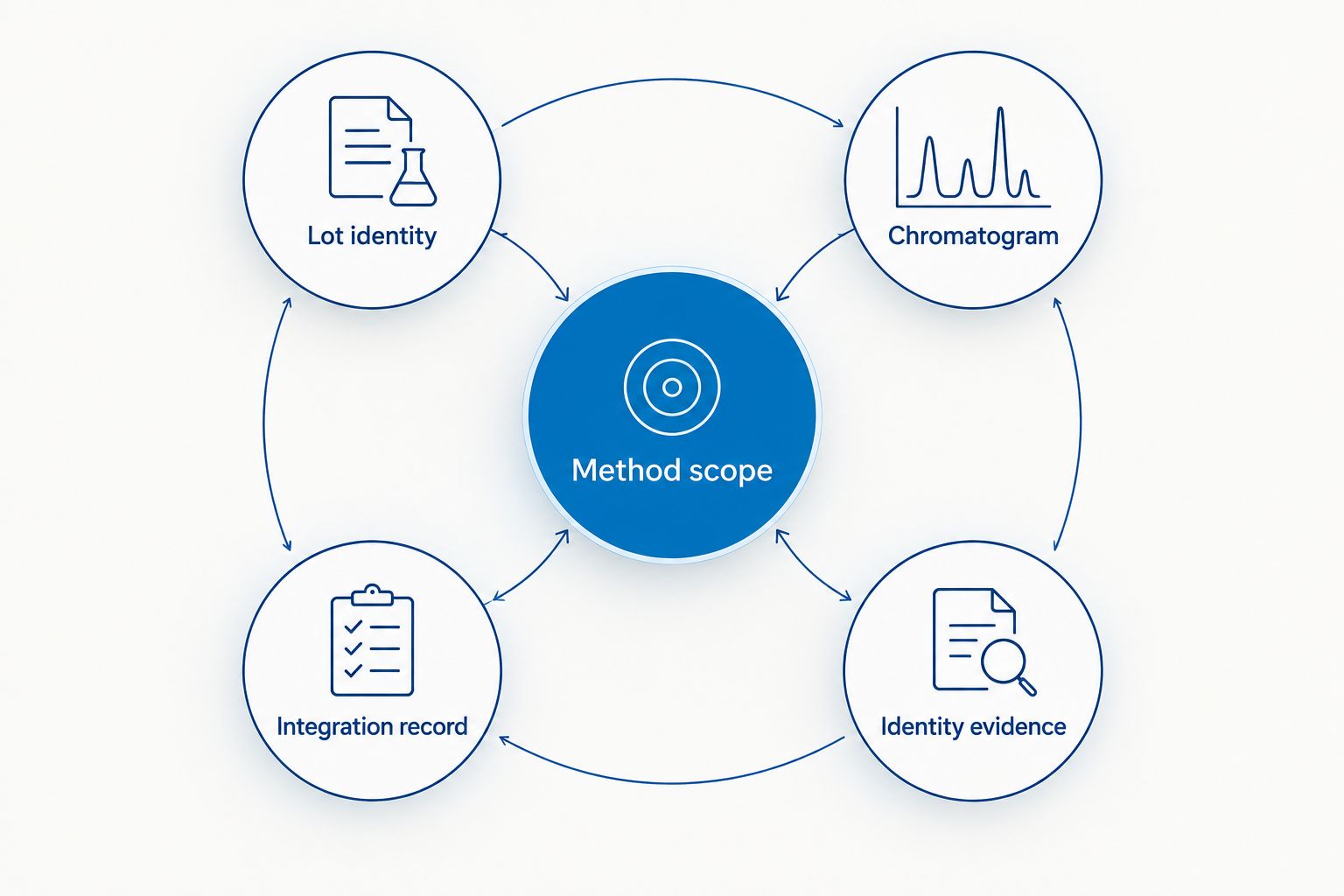
Your 2026 testing brief should connect the material, method, and reported conclusion. Keep the following elements explicit rather than relying on a generic promise of a COA.
- Lot identity: Record the supplier lot and your submitted sample identifier. If material is subdivided internally, retain the relationship between those records.
- Method scope: Identify the procedure, analytical objective, detector, and relevant method conditions. State whether the work is routine testing or development.
- Chromatogram: Request a legible chromatogram with the reporting context needed to understand the result. A single percentage is not a substitute for the separation record.
- Integration record: Ask how peaks are selected, excluded, and integrated. Clarify how manual changes are documented when they occur.
- Identity evidence: Specify the complementary evidence required to support the expected molecular identity. Do not treat a retention-time match as complete structural confirmation.
Request enough information to understand what was measured and how the conclusion was reached. Do not demand an undefined collection of raw files: specify the records your laboratory can review and the format it can retain.
For Simple Peptide research materials, keep supplier-issued documentation and independently commissioned reports distinguishable in your records. Neither document should silently replace the other, particularly when the measurements address different attributes.
How to compare laboratory proposals fairly
Begin with the same written enquiry for every provider. Differences between proposals then reveal differences in scope rather than differences in how each laboratory interpreted an informal request.
Your enquiry should state the research material, available documentation, analytical question, expected report contents, and decision criteria. Ask each laboratory to list assumptions and exclusions separately from the proposed work.
For your 2026 comparison, resolve these points before approval:
- Does the proposal measure purity, identity, content, or a combination?
- Is the method established for the material, or is development required?
- Which site performs the work, and is any work subcontracted?
- Which chromatograms and supporting records accompany the report?
- What happens if the sample produces an unexpected analytical finding?
- Who reviews and authorizes the final report?
Do not substitute an accreditation logo for this review. Where accreditation matters to your purchasing requirements, inspect the applicable scope and receiving site rather than assuming every advertised technique is covered.
How the shortlist is ranked
This shortlist groups established analytical providers by enquiry type: broad scoping, method development, and specification-led quality control. It does not claim comparative testing, measured accuracy differences, confirmed project acceptance, or a site-by-site audit.
The selection criteria remain the same for every provider: suitable methods, distinct identity evidence, traceable documentation, reviewable records, and explicit exclusions. A laboratory earns your assignment through its written response to those requirements—not through its position in this article.
Which peptide purity testing laboratory should you choose?
Start with Eurofins BioPharma Product Testing when you need help defining the overall analytical package. Direct an analytical-development enquiry to Intertek, or a specification-led quality-control enquiry to SGS, while confirming the receiving site's actual capabilities.
For undecided buyers, the next move is not ordering the broadest test package. Write the analytical question first. Select the laboratory whose proposal answers it with suitable methods and documentation you can evaluate.
For Simple Peptide peptide purity verification, apply the same standard to supplier records and independent reports: identify the lot, understand the measurement, and limit conclusions to the evidence supplied.
FAQ
What’s the best way to choose peptide purity testing labs?
Choose peptide purity testing labs by method suitability, lot traceability, and reviewable reporting. Shortlist providers against the same written analytical question, then confirm the receiving site’s capabilities and exclusions.
Does HPLC establish peptide identity?
HPLC purity testing alone does not establish complete peptide identity. Appropriate complementary analysis, including mass spectrometry where suitable, addresses identity questions that a chromatographic percentage cannot answer.
Is Eurofins better than Intertek or SGS for peptide testing?
A universal performance ranking is not established here. Compare Eurofins BioPharma Product Testing, Intertek, and SGS through project-specific proposals that define the methods, receiving site, and reporting package.
Does a high HPLC purity result show how much peptide is in a sample?
A high HPLC peak-area purity result does not independently establish absolute peptide content. Content requires an appropriate quantitative measurement, and other material components need separate consideration.
What should a peptide purity report include?
A peptide purity report should connect the sample identifier, method, result, and supporting chromatographic information. Request clear integration rules and distinguish purity measurements from identity and content measurements.
Do research peptides need the same testing package for every project?
No single testing package answers every research question. Define the material attributes and decisions relevant to your laboratory, then commission suitable measurements rather than treating a generic COA as complete characterization.
Can a supplier COA replace independent laboratory testing?
A supplier COA and independently commissioned testing serve different purposes. Whether additional testing is needed depends on your research organization’s acceptance requirements, the supplied evidence, and the unresolved analytical questions.
One last thing
A more precise-looking purity percentage is not necessarily a more informative result. Additional decimal places do not resolve co-elution, establish identity, or explain what the method excluded.
Before accepting a report, read its conclusion alongside the chromatogram and method scope. If those records answer different questions, request clarification before the result enters your material-acceptance record.
Related guides
For laboratory research use only. Not for human or veterinary use. Not intended to diagnose, treat, cure, or prevent any disease.
{"@context":"https://schema.org","@type":"FAQPage","mainEntity":[{"@type":"Question","name":"What's the best way to choose peptide purity testing labs?","acceptedAnswer":{"@type":"Answer","text":"Choose peptide purity testing labs by method suitability, lot traceability, and reviewable reporting. Shortlist providers against the same written analytical question, then confirm the receiving site's capabilities and exclusions."}},{"@type":"Question","name":"Does HPLC establish peptide identity?","acceptedAnswer":{"@type":"Answer","text":"HPLC purity testing alone does not establish complete peptide identity. Appropriate complementary analysis, including mass spectrometry where suitable, addresses identity questions that a chromatographic percentage cannot answer."}},{"@type":"Question","name":"Is Eurofins better than Intertek or SGS for peptide testing?","acceptedAnswer":{"@type":"Answer","text":"A universal performance ranking is not established here. Compare Eurofins BioPharma Product Testing, Intertek, and SGS through project-specific proposals that define the methods, receiving site, and reporting package."}},{"@type":"Question","name":"Does a high HPLC purity result show how much peptide is in a sample?","acceptedAnswer":{"@type":"Answer","text":"A high HPLC peak-area purity result does not independently establish absolute peptide content. Content requires an appropriate quantitative measurement, and other material components need separate consideration."}},{"@type":"Question","name":"What should a peptide purity report include?","acceptedAnswer":{"@type":"Answer","text":"A peptide purity report should connect the sample identifier, method, result, and supporting chromatographic information. Request clear integration rules and distinguish purity measurements from identity and content measurements."}},{"@type":"Question","name":"Do research peptides need the same testing package for every project?","acceptedAnswer":{"@type":"Answer","text":"No single testing package answers every research question. Define the material attributes and decisions relevant to your laboratory, then commission suitable measurements rather than treating a generic COA as complete characterization."}},{"@type":"Question","name":"Can a supplier COA replace independent laboratory testing?","acceptedAnswer":{"@type":"Answer","text":"A supplier COA and independently commissioned testing serve different purposes. Whether additional testing is needed depends on your research organization's acceptance requirements, the supplied evidence, and the unresolved analytical questions."}}]}